Beware of fake job offers and payment requests. We only use official email IDs and never conduct interviews on messaging apps.Beware of fake job offers and payment requests. We only use official email IDs and never conduct interviews on messaging apps.
Ask an AI assistant about your brand today, and the answer may not be entirely aligned with how you want your business to be represented. It could present outdated information, overlook your key differentiators, or even position a competitor more favorably. As AI-powered platforms become a trusted source of research and recommendations, these responses are increasingly shaping how customers, prospects, and decision-makers perceive brands. The challenge is that much of this narrative is being built from information available across the web, not necessarily from sources you directly control.
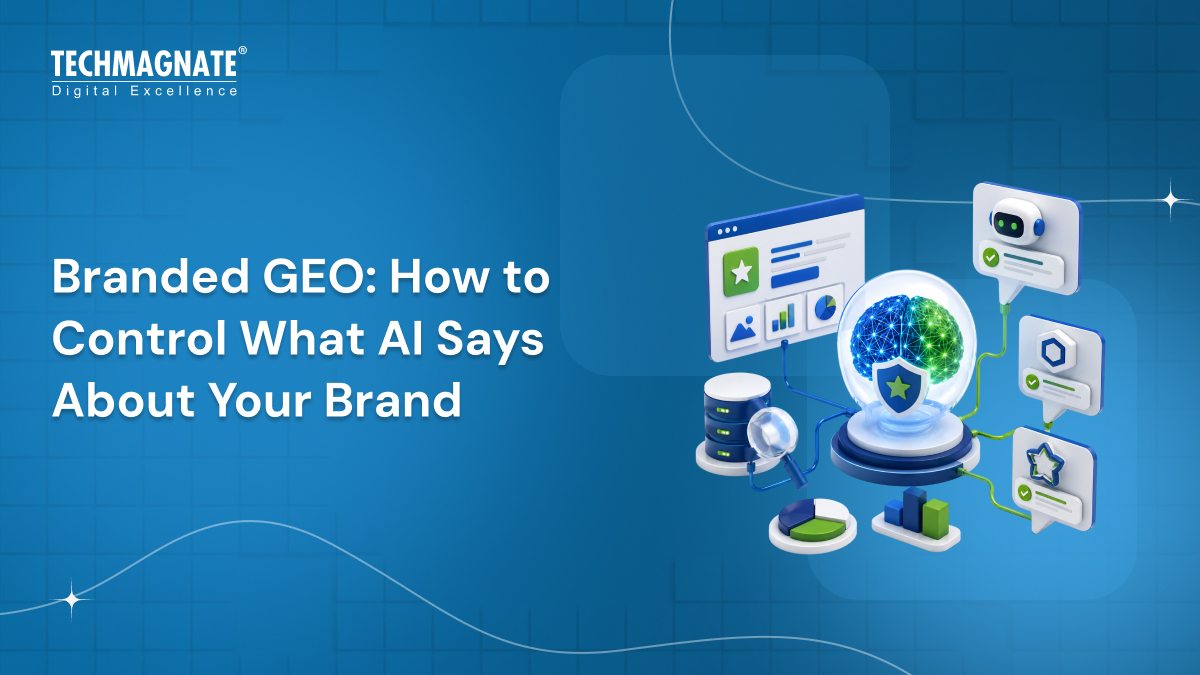
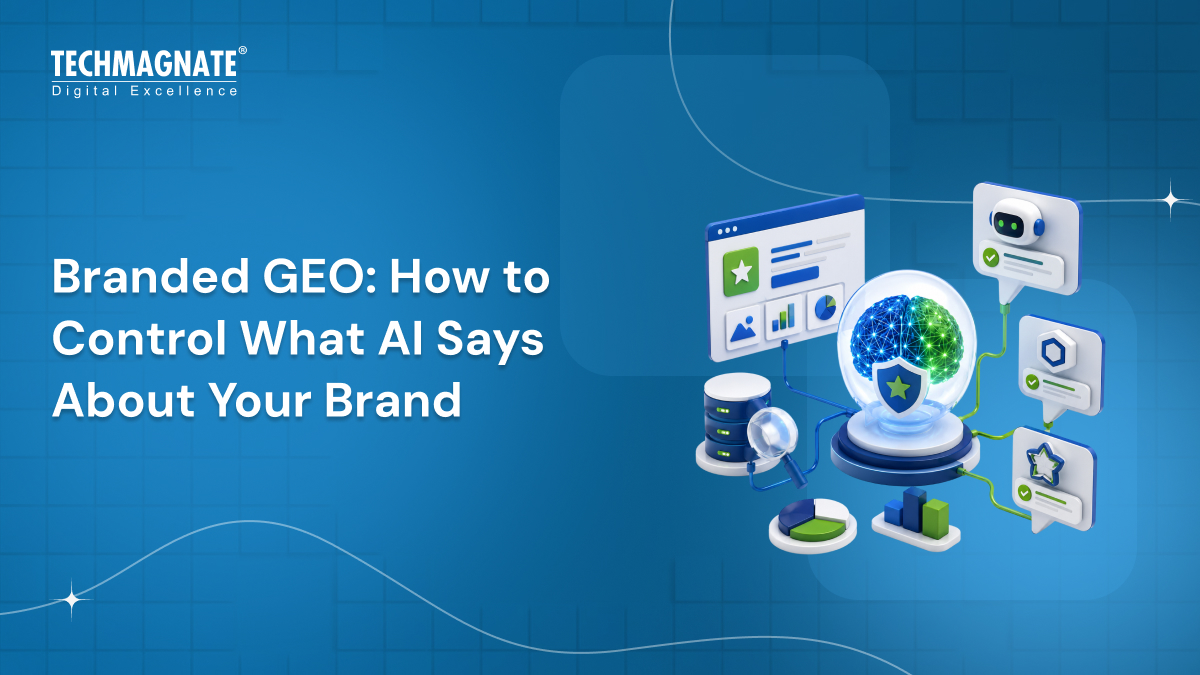
That is why branded GEO is becoming a critical part of modern digital strategy. Branded GEO, or Generative Engine Optimization, is the practice of influencing how AI platforms understand, interpret, and present your business. If you want to control what AI says about your brand, strong search rankings alone are no longer enough. Brands must also ensure that AI systems consistently find accurate, authoritative, and up-to-date information, so the story being told reflects their expertise, credibility, and market position.
Table of Contents
What is Branded GEO?
Branded GEO is the practice of influencing how AI platforms describe your business when someone searches for your brand by name. It focuses on shaping the information AI systems use when answering questions about your company, products, services, and reputation.
Unlike general GEO, which aims to improve visibility for broader industry and topic-based searches, branded AI search optimization focuses specifically on brand-related queries. The goal is to ensure that AI systems present accurate, trustworthy, and consistent information when users search for your business. For example, potential customers may ask:
What does this company do?
Is this brand trustworthy?
How does this company compare to competitors?
What are customers saying about this business?
The responses generated by AI platforms help shape your AI brand narrative, which is the overall impression users form about your business. For many prospects, these AI-generated answers may be their first interaction with your brand, making their accuracy and consistency increasingly important.
To generate these responses, AI systems draw information from a variety of sources, including your website, customer reviews, news articles, business directories, social profiles, and other third-party content. They analyze these signals to build an understanding of your business and present answers to user questions.
While businesses cannot directly control AI-generated responses, they can influence the information AI systems rely on. Publishing accurate content, maintaining consistent brand information, and earning trusted mentions across the web can help shape how AI platforms understand and describe a company. This ability to influence the narrative is at the core of branded search and effective branded GEO.
Why This Matters Now
Consumers increasingly use AI tools during the research phase of the buying journey. Before requesting a demo, contacting a sales team, or making a purchase, many users now ask AI assistants for information about brands.
When AI responses are inaccurate, the consequences can be significant:
Outdated descriptions of products or services
Incorrect company information
Missing achievements or strengths
Competitor-focused comparisons
Misleading brand positioning
These issues can affect trust before a prospect ever reaches your website.
A term often discussed in AI is hallucination, when an AI system confidently presents incorrect information as fact. Research has shown that hallucination rates vary widely by model, task type, and measurement methodology. Some evaluations have reported rates as high as 20–35% in specific scenarios, though leading models have reduced this significantly in recent updates. The key point for brands is not the exact rate, but the fact that AI errors do occur and when they involve your brand, the reputational consequences are real.
This creates real challenges for brand reputation in AI search. AI responses can shape how people see a brand, especially when the information is outdated, incomplete, or inconsistent. As more people use AI for research, accurate brand representation becomes increasingly important.
Step 1: Audit What AI Says About You Today
To understand how to control what ChatGPT and other AI tools say about your brand, start by reviewing what they currently generate. You cannot directly control AI responses, but you can influence them by shaping the underlying information these systems rely on. Establishing a clear baseline helps you identify gaps, inaccuracies, or outdated details that need correction.
Start by conducting a branded query AI audit across major platforms such as ChatGPT, Gemini, and Perplexity. Use the same set of questions on each platform to compare how your brand is described across AI systems. Ask questions such as:
What is [Brand Name]?
What does [Brand Name] do?
Is [Brand Name] reliable?
What are customers saying about [Brand Name]?
Who are [Brand Name]’s competitors?
[Brand Name] vs [Competitor Name]
Why should I choose [Brand Name]?
Record your findings using a simple audit template:
Question
AI Platform
Response Summary
Sources Referenced
Errors Found
What is Brand X?
ChatGPT
What is Brand X?
Gemini
What is Brand X?
Perplexity
Brand X vs Competitor
ChatGPT
Brand X vs Competitor
Gemini
As you review the responses, pay attention to the following:
Incorrect or outdated information
Missing details about your company
Competitor bias in comparisons
Negative or misleading sentiment
Inconsistent descriptions across platforms
Hallucinated facts – details that are entirely fabricated
Sentiment refers to the overall tone of an answer, whether it is positive, neutral, or negative. It can influence a user’s perception of your business. Identifying these patterns early helps you prioritize the issues that may have the greatest impact on how potential customers perceive your brand, as reflected in AI-generated answers.
Also note the sources AI relies on, such as your website, review platforms, news articles, business directories, or competitor content. These sources often explain why certain responses appear and where corrections may be needed.
Many brands uncover issues through this process that traditional search analysis may miss. For a deeper assessment, Techmagnate’s AI SEO Services can provide a comprehensive audit of brand visibility across multiple platforms.
This review establishes a benchmark for measuring future improvements and identifying opportunities to shape AI brand description more effectively over time.
Step 2: Shape the Narrative, The Levers You Control
Once you understand how AI platforms currently describe your business, the next step is to improve the information signals they rely on. While you cannot directly control AI-generated responses, you can influence the information ecosystem that shapes them. To manage a brand in AI answers, focus on three core areas: owned content, earned visibility, and consistency.
Owned Content: Give AI Better Information
Your website is often one of the most important sources AI systems and search engines can reference when understanding your company. The clearer and more accurate your content is, the easier it becomes for AI tools to interpret your brand correctly.
Focus on strengthening the following assets:
About pages
Company profiles
FAQ pages
Product and service pages
Leadership pages
Customer success stories
These assets should clearly communicate:
Company history
Core services
Target audience
Key differentiators
Areas of expertise
An entity is the way AI systems identify and understand a brand, person, product, or organization. Strong entity signals help AI connect the right information to your company and reduce the chances of confusion with similar businesses.
Structured data, accurate business information, and well-organized content can help search engines and AI systems interpret your brand more accurately. Businesses looking to strengthen these signals often invest in Answer Engine Optimization Services to improve how their content is discovered and understood. Over time, these efforts can increase the likelihood that AI describes your brand more accurately.
Earned Media: Build Corroboration
Owned content is important, but AI systems also look beyond your website. This is where earned visibility becomes valuable.
One of the most important concepts in branded GEO is corroboration. In simple terms, corroboration means that multiple trusted sources independently confirm the same information. For example:
Your website states that your company launched in 2015.
An industry publication reports the same launch year.
Business directories display the same information.
When credible sources consistently agree on key facts, AI systems are more likely to recognize those facts as reliable information.
To strengthen corroboration:
Earn coverage from reputable publications
Encourage authentic customer reviews
Participate in industry reports and research
Secure mentions on authoritative websites
Maintain accurate business listings
This is where earned visibility plays a significant role in building your AI brand narrative. Strategic outreach and Digital PR Services can help increase the number of trusted sources consistently discussing your brand.
Corroboration also influences sentiment, which refers to the overall positive, neutral, or negative tone associated with your brand online. When accurate information appears consistently across credible sources, AI systems have a stronger foundation for generating balanced and reliable descriptions.
At Techmagnate, we have observed that brands with consistent information across trusted sources are often better positioned to be accurately represented in AI-generated responses.
Consistency: Remove Conflicting Signals
Even strong content and media coverage can lose their impact if brand information differs across platforms. Conflicting information can make it harder for AI systems to determine which details are current and accurate.
Review and align the following sources:
Website content
LinkedIn profile
Google Business Profile
Social media channels
Press releases
Business directories
Review platforms
Pay attention to details such as your company description, founding year, service offerings, locations, and positioning. These facts should remain consistent wherever your brand appears online.
When owned content, earned visibility, and consistent brand information work together, AI systems are more likely to develop an accurate understanding of your business. Collectively, these three pillars provide the strongest foundation for influencing how your brand is represented in AI-generated answers.
Step 3: Defend Against Competitors Framing You
One of the biggest challenges in brand AI visibility control is competitor-led framing. When users ask AI tools questions such as “Brand A vs Brand B” or “Which solution should I choose?”, AI systems generate answers using information from multiple sources, including brand websites, review platforms, comparison articles, and industry publications. If competitor-focused content is more prominent across trusted sources, AI may be more likely to reflect that perspective in its response.
It is possible to influence the information AI systems rely on. By creating clear, accurate, and authoritative content, you give AI platforms a stronger understanding of your brand. To strengthen your position in AI-generated comparisons, focus on the following actions:
Create comparison pages for key competitors.
Clearly explain your differentiators and strengths.
Highlight the customer segments and use cases you serve best.
Address common questions and objections with factual information.
Monitor “Brand vs Competitor” AI queries regularly.
These actions help ensure AI systems have access to your perspective rather than relying primarily on competitor or third-party content.
Competitor Defense Checklist
Use the following checklist to maintain a balanced brand narrative across AI platforms:
Review AI-generated comparison answers regularly.
Keep competitor comparison content updated.
Refresh your positioning and differentiators as your business evolves.
Track competitor mentions in AI-generated responses.
Correct outdated or inconsistent information across digital channels.
Regular monitoring is important because AI-generated answers can change as new information becomes available. A strong branded GEO strategy for reputation helps ensure AI platforms can access accurate information about your brand. When your positioning, strengths, and ideal use cases are clearly documented, AI systems are more likely to generate fair and balanced comparisons.
Step 4: Fix Harmful or Wrong AI Claims
Many businesses eventually ask, “How do I fix what AI says about my company?” The most effective approach is not to react emotionally, but to follow a structured process. While you cannot directly edit AI-generated responses, you can improve the information AI systems use and reduce the chance of inaccurate claims appearing in future answers.
1. Identify the Source
Start by finding where the incorrect information may have originated. Review:
Review websites
Business directories
Outdated articles
Forum discussions
Third-party databases
Understanding the source helps you determine what needs to be corrected.
2. Correct the Information
Update inaccurate details wherever possible. Prioritize your most authoritative channels:
Company website
Google Business Profile
Social media profiles
Public business listings
Correcting information at the source improves the quality of the information available to AI systems and users.
3. Reinforce Accurate Facts
Publish consistent and factual information across trusted platforms. Focus on keeping important details such as company descriptions, services, leadership information, and business milestones aligned across all channels.
The stronger the corroboration across credible sources, the more likely AI systems are to reflect accurate information in future responses.
4. Submit Platform Feedback
Many AI platforms allow users to report inaccurate or misleading answers. While feedback does not guarantee a change, it provides a way for providers to review potentially problematic outputs.
5. Escalate Serious Issues
If misinformation creates reputational risk, consider additional action, including:
Following this process can help improve the accuracy of information associated with your brand and support a stronger brand reputation and AI search visibility over time.
Conclusion
You cannot directly edit AI-generated answers, but you can influence the information AI systems use to describe your brand. That is the foundation of branded GEO. The most effective approach is to audit AI responses, maintain accurate brand information, earn credible third-party validation, and monitor how your company appears across AI platforms.
While no business can guarantee AI outputs, consistent information and credible third-party validation can improve the likelihood of accurate brand representation over time. As AI becomes a common research tool, AI visibility is increasingly tied to brand reputation.
To understand how AI platforms currently describe your business and identify areas for improvement, connect with Techmagnate for AI SEO Services and get a detailed visibility audit and expert recommendations customized for your brand.
Frequently Asked Questions
Can I control what ChatGPT says about my brand?
Not directly. However, you can influence what AI systems surface by ensuring your brand information is accurate, consistent, and authoritative across trusted sources.
How do I fix what AI says about my company?
Start by identifying and correcting the original source of the inaccurate information. Then reinforce the correct facts across credible platforms and use available feedback tools where appropriate.
Can I influence my AI brand description?
Consistent brand information, authoritative content, and trusted third-party mentions can influence how AI systems understand and describe your company.
What is the difference between branded GEO and general GEO?
General GEO focuses on improving visibility for broader industry topics and non-branded queries. Branded GEO focuses specifically on how AI describes your company by name – covering brand accuracy, reputation management, and competitive positioning in AI-generated responses.
How long does it take to improve what AI says about my brand?
There is no fixed timeline. AI systems update their responses as new information becomes available, but improvements depend on how quickly accurate, consistent information spreads across trusted sources. Most brands see gradual improvement over weeks to months following a structured branded GEO effort.
Sarvesh Bagla is an enterprise SEO expert and industry leader who has driven transformational digital growth for India’s top brands across the BFSI, Healthcare, Automotive, and ECommerce industries. As the Founder and CEO of Techmagnate, he leads large-scale organic search strategies and performance marketing campaigns for businesses looking to succeed in today’s AI-driven search landscape.
A strong advocate for thought leadership, Sarvesh is deeply involved in SEO evangelism and regularly contributes to industry discussions through LinkedIn, webinars, and CMO roundtables. His focus today is on helping brands prepare for an AI-first SEO future (AEO, GEO) and strategies for Large Language Models (LLMs) at the core.
Get the most valuable search related insights about leading brands, trending keywords, search volumes, fastest growing categories, city-level insights and much more!
It has come to our notice that fraudulent job offers are being circulated on the internet through messaging apps like WhatsApp and Telegram, which falsely claim to be from Techmagnate. We take this matter seriously and would like to caution all candidates to be wary of such postings.
Please Note That –
We do not charge any fees/security deposit/payment from candidates, irrespective of the professional experience they hold, for job applications or interviews
Official communication channels include our website and verified social media accounts, primarily LinkedIn.
Kindly double-check the domain name – @techmagnate.com – in the email address
We follow a transparent and ethical approach for hiring/onboarding supported by proper documentation.
Ensure that you only apply through verified channels to avoid being scammed. We also recommend that you exercise caution when sharing personal information or financial details with any job posting or recruitment agencies claiming to represent us.
We want to ensure that potential candidates interested in joining Techmagnate have a safe and positive experience.
If you find that someone that fits the description above has reached out to you, please notify us immediately at jobs@techmagnate.com.
 Important Alert: