Beware of fake job offers and payment requests. We only use official email IDs and never conduct interviews on messaging apps.Beware of fake job offers and payment requests. We only use official email IDs and never conduct interviews on messaging apps.
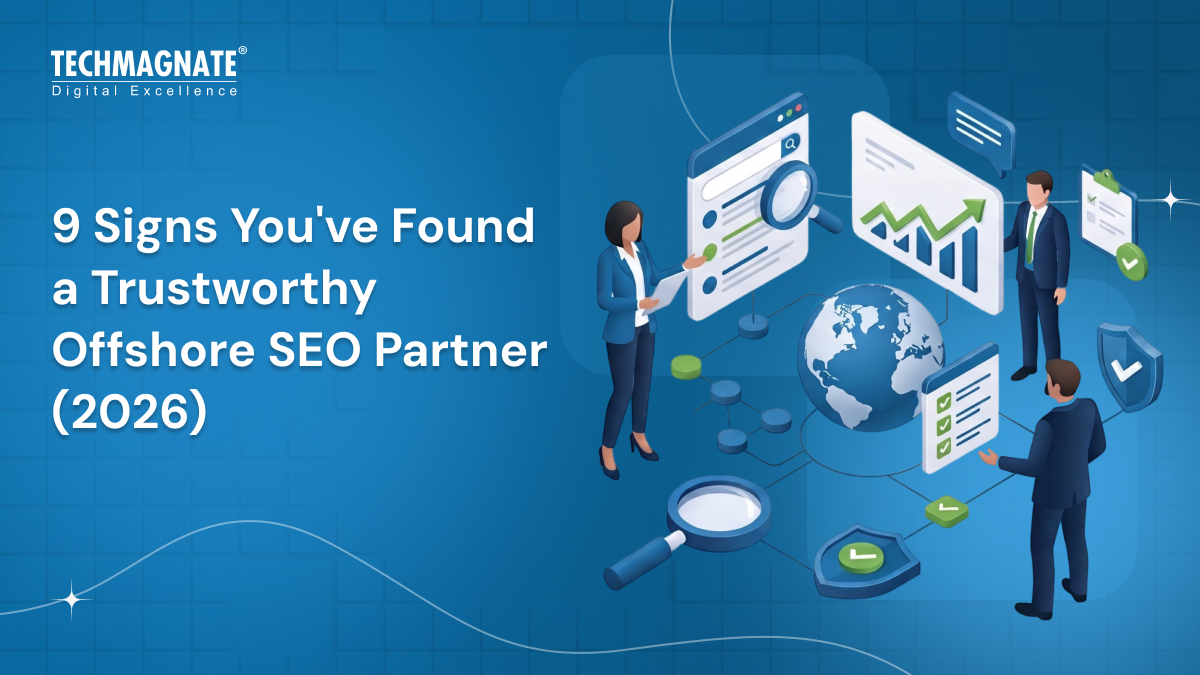
A trustworthy offshore SEO partner diagnoses before pitching, explains exactly what they will do, promises realistically, proves results through independent reviews, reports on leads rather than rankings, prices transparently, communicates on a fixed cadence, protects your data, and is willing to tell you no. The scammy ones do the opposite. Below are the nine signs, the red flags to walk away from, and what to do if you are already in an engagement that feels wrong. If you are nervous, start with a small paid project rather than a retainer.
If you are a founder or small-business owner outsourcing SEO for the first time, the real worry usually is not which agency ranks best. It is whether you are about to waste money on a scam. That is a fair concern. SEO is easy to fake for a few months and hard to verify if you are not an expert. The good news is that trustworthiness leaves visible fingerprints. Use the nine signs below as a vetting checklist before you sign anything.
Discover What Your Customers Search ForDiscover What Your Customers Search For
Get insights on evolving customer behaviour, high volume keywords, search trends, and more.
How to Choose an Offshore SEO Company: The Nine Signs
They Diagnose Before They Pitch
A trustworthy partner asks about your business, goals, and website before recommending anything.
If someone quotes you a fixed “package” before ever looking at your site, your market, or your margins, they’re not solving your problem – they’re selling a product. Real SEO starts with an audit, not an invoice. And it starts with a conversation: what does success actually look like for you? More leads? More sales? More qualified sign-ups? Because traffic alone pays no bills.
How to check: On the first call, notice the ratio of questions to sales talk. A good partner spends more time understanding you than describing themselves.
They Explain Their Methods in Simple Terms
You should understand what they’ll actually do, and none of it should sound secret.
White-hat SEO comes down to three things: technical fixes, useful content, and authoritative links. Nothing more, nothing hidden. Be wary of proprietary “black box” methods, promises of thousands of backlinks, or anyone who won’t explain their approach in simple terms. If they can’t explain it, it’s usually because secrecy is a hiding tactic that may get sites penalised.
How to check: Ask what they’ll do in the first 90 days. A trustworthy partner gives you a clear, specific plan. If the answer is vague or sounds too good to be true, that’s a red flag.
They Make Realistic Promises
No credible partner guarantees #1 rankings or a fixed date, because no one controls Google.
Trust is built on honesty about uncertainty. A good partner tells you what to expect, and when: early movement in 3-6 months, meaningful lead growth in 6-12. That timeline isn’t a hedge – it’s how SEO actually works.
So treat “guaranteed rankings,” “instant results,” or “page one in 30 days” as what they are: classic scam signals. Nobody controls Google’s algorithm, and anyone claiming they do is either lying to you or about to get your site penalised trying to prove it.
How to check: If they guarantee specific rankings, end the conversation. That single promise tells you they either don’t understand SEO or are willing to mislead you.
They Can Prove Results Independently
Look for verifiable proof: Clutch or G2 reviews, real case studies, and references, not just testimonials on their own site.
Anyone can write glowing quotes about themselves – testimonials on a homepage prove nothing except that someone knows how to write a testimonial. Third-party review platforms and named case studies with real, checkable metrics are far harder to fake. And reference calls with current clients tell you what no marketing page ever will: the unfiltered truth.
How to check: Search their name on Clutch and G2, and ask to speak to a client in a similar situation to yours.
They Report on Business Outcomes, Not Vanity Metrics
The right partner shows you leads, enquiries, and revenue signals alongside rankings and impressions.
Rankings and organic traffic are a means to an end, not the end goal itself. If your monthly report highlights “impressions up 40%” but says nothing about conversions, form fills, or conversions, your agency is optimizing for numbers that look good on paper, not for what actually grows your business.
A results-driven SEO partner connects the dots between SERP rankings and real business outcomes. They’ll show you how organic traffic is translating into qualified leads, and how those leads are contributing to revenue, not just how many keywords moved up a few positions.
How to check: Ask to see a sample monthly report before signing. Check whether it connects SEO activity to business results.
Their Pricing and Contract are Transparent
Clear pricing, no hidden fees, reasonable notice, and no punishing lock-in are all signs of a partner confident in their own work.
SEO compounds over quarters, so a serious programme usually comes with an initial term. That is legitimate. What matters is whether the exit is defined and whether you keep what you paid for.
The warning signs are auto-renewal you have to fight, penalty clauses for leaving, deliverables nobody will put in writing, and analytics or content that sits in the agency’s name.
How to check: Read the exit clause before the pricing. Ask what the notice period is, what happens at renewal. Confirm in writing that you own your content, links, analytics, and Search Console access from day one.
Communication is Clear, Prompt, and has a Named Owner
You should know exactly who your point of contact is and when you’ll hear from them, especially across time zones.
The most common offshore failure isn’t skill – it’s communication drift, work quietly diverging from what you actually needed while everyone’s too polite or too far away to notice. A trustworthy partner closes that gap structurally: a named account manager you can actually reach, a fixed check-in cadence, and guaranteed overlap hours with your working day.
How to check: During the sales process, track how fast and clearly they respond. It rarely gets better after you sign.
They Take Security and Confidentiality Seriously
Even for a small business, a real partner signs an NDA and handles your data and logins responsibly.
You will be sharing website access, analytics, and sometimes customer data. A trustworthy agency has a clear answer on confidentiality, access controls, and who touches your systems. It also does not quietly hand your work to anonymous freelancers.
How to check: Ask for an NDA and how they manage access. Hesitation here is a meaningful red flag.
They’re Willing to Tell You “No”
A partner who pushes back on unrealistic goals or a tactic that won’t work is an expert. One who agrees with everything is a salesperson.
Genuine expertise sometimes sounds like “no.” That keyword isn’t worth chasing. That timeline isn’t realistic. Those aren’t the answers a salesperson gives – they’re the answers someone who actually wants you to succeed gives, even when it costs them the deal.
An advisor who only ever tells you what you want to hear isn’t optimising for your results. They’re optimising for your signature.
How to check: Float a slightly unrealistic goal and see whether they manage your expectations honestly or just nod along.
Red Flags at a Glance
Guaranteed #1 rankings, or results in days.
A full-scope monthly retainer priced far below market, usually means automated link building.
Only self-published testimonials, with no Clutch or G2 presence and no references.
Vagueness about methods, or an unwillingness to describe the first 90 days.
Auto-renewing contracts, penalty exit clauses, or terms you cannot find.
Slow, unclear communication during the sales process.
Reluctance to sign an NDA or to explain data handling.
Analytics, Search Console, or content held in the agency’s name.
Already in An Engagement That Feels Wrong?
Plenty of people reading this are not vetting a new agency. They are four to eight months into one and quietly worried. The signs above will not help you there, so here is what will.
Your Backlink Profile. In Ahrefs, Semrush or Search Console, look at where links actually come from. If most trace to a handful of low-quality blogs running the same template, you are looking at a link network, not the disclosed, quality-controlled work a trustworthy white label SEO agency delivers.
Whether the Work Shipped. Ask for the list of pages changed, then check them live. Recommendations that never shipped are the most common form of quiet failure, and they rarely appear in the monthly report.
Whether the Numbers Reconcile. Compare the agency’s reporting against your own Search Console. You own that data, and if the two do not match, ask why before you ask anything else.
If any of these three points doesn’t hold up, it’s worth getting an SEO audit with a trustworthy agency before you escalate the issue, an agency can review your existing SEO programme and give you a clear, honest read on whether the work is genuine, so you go into the conversation with evidence, not guesswork.
Frequently Asked Questions
Is Outsourcing SEO to India Trustworthy?
Outsourcing SEO to India can be trustworthy – India has both excellent SEO agencies and bad actors, as any large services market does, and the trust depends on the individual partner, not the country. Vet the agency directly: check independent reviews on Clutch or G2, ask for named case studies and reference calls, expect a simple-English explanation of their methods, and read the exit terms before the pricing. Start with a small paid project before you commit to a monthly retainer.
Is it safe to outsource SEO overseas?
Yes, if you vet properly. Check independent reviews, sign an NDA, agree on a contract with defined deliverables and a clear notice period, confirm you own your assets, and pilot the relationship first. Safety comes from selection and paperwork.
How much does it cost to outsource SEO to India?
Three different things get priced differently, and confusing them is where most of the anxiety about cheap SEO comes from.
An ongoing full-scope retainer, covering technical work, content, and link acquisition, runs roughly $500 to $3,000 a month for most startups and small businesses.
A one-time audit typically costs $150 to $900.
A short paid pilot, a scoped test of one deliverable, sits below both. It should. It is a scoped test, so a low price there is appropriate.
How long before I see results?
SEO results usually appear as early ranking movement in three to six months, with dependable lead generation around six to twelve months. Newer sites and competitive niches take longer. SEO compounds over time, so consistency matters more than speed.
Should I hire an agency or a freelancer?
For outsourced SEO, a freelancer can be cheaper on narrow tasks such as a one-off audit or a technical fix. An agency gives you a team, continuity, and accountability across technical work, content, and links. If SEO matters to your growth, an agency reduces the risk of the whole program stalling when one person is unavailable.
How do I know if the SEO work I am already paying for is real?
To tell whether the SEO work you are already paying for is real, check three things yourself: your backlink profile, whether the recommended changes are live on your site, and whether the agency’s reporting reconciles with your own Search Console data. If any of the three does not hold up, buy an independent audit for a few hundred dollars before you escalate.
Sarvesh Bagla is an enterprise SEO expert and industry leader who has driven transformational digital growth for India’s top brands across the BFSI, Healthcare, Automotive, and ECommerce industries. As the Founder and CEO of Techmagnate, he leads large-scale organic search strategies and performance marketing campaigns for businesses looking to succeed in today’s AI-driven search landscape.
A strong advocate for thought leadership, Sarvesh is deeply involved in SEO evangelism and regularly contributes to industry discussions through LinkedIn, webinars, and CMO roundtables. His focus today is on helping brands prepare for an AI-first SEO future (AEO, GEO) and strategies for Large Language Models (LLMs) at the core.
Get the most valuable search related insights about leading brands, trending keywords, search volumes, fastest growing categories, city-level insights and much more!
It has come to our notice that fraudulent job offers are being circulated on the internet through messaging apps like WhatsApp and Telegram, which falsely claim to be from Techmagnate. We take this matter seriously and would like to caution all candidates to be wary of such postings.
Please Note That –
We do not charge any fees/security deposit/payment from candidates, irrespective of the professional experience they hold, for job applications or interviews
Official communication channels include our website and verified social media accounts, primarily LinkedIn.
Kindly double-check the domain name – @techmagnate.com – in the email address
We follow a transparent and ethical approach for hiring/onboarding supported by proper documentation.
Ensure that you only apply through verified channels to avoid being scammed. We also recommend that you exercise caution when sharing personal information or financial details with any job posting or recruitment agencies claiming to represent us.
We want to ensure that potential candidates interested in joining Techmagnate have a safe and positive experience.
If you find that someone that fits the description above has reached out to you, please notify us immediately at jobs@techmagnate.com.
Team @Techmangate
Build a Better Digital Marketing Strategy with Techmagnate’s Search Trends Reports
 Important Alert: