Beware of fake job offers and payment requests. We only use official email IDs and never conduct interviews on messaging apps.Beware of fake job offers and payment requests. We only use official email IDs and never conduct interviews on messaging apps.
Summary: SEO is a vital part of digital marketing, offering the potential for increased online visibility, traffic, and revenue. By following the best practices and staying updated on SEO trends, businesses can achieve success in any industry. Read the blog to understand everything about SEO.
Key Takeaways:-
SEO improves your website’s visibility in organic search results, driving more traffic and potential revenue.
Search engines rank pages using algorithms that consider on-page, off-page, and technical factors.
On-page elements (e.g., title tags, content), off-page elements (e.g., backlinks), and technical factors (e.g., site speed, mobile-friendliness) all impact rankings.
Search engines use bots to crawl and index pages for later retrieval.
SEO is dynamic, requiring regular updates to stay ahead of evolving algorithms.
Search engine optimization (SEO) is a crucial aspect of digital marketing that can help businesses increase their online visibility and drive more organic traffic to their websites. In this comprehensive blog post, we will cover everything you need to know about SEO, from its definition and historical perspective to how it works, why it’s important, and best practices to follow. We will also discuss different types of SEO, best SEO tools and analytics, and future developments in the field.
Table of Contents
What is SEO?
SEO (Search Engine Optimization) is the practice of improving a website so it ranks higher on search engines like Google, Bing, and Yahoo. When people search for information, products, or services online, SEO helps your website appear at the top of search results, increasing visibility and attracting more visitors.
It works by optimizing different aspects of your website, such as:
Using the right keywords that people search for.
Creating high-quality content that answers users’ questions.
Improving website speed and user experience to keep visitors engaged.
Building trust with search engines through backlinks from other websites.
In simple terms, SEO helps search engines understand your website better so they can show it to the right audience at the right time.
History of SEO
SEO started in the mid-1990s when search engines like Yahoo! and AltaVista were popular. Back then, websites could rank by simply adding lots of keywords, even if they weren’t relevant.
In 1998, Google introduced PageRank, which changed SEO by ranking websites based on quality and relevance rather than just keywords. Over the years, Google launched multiple updates (like Panda, Penguin, and RankBrain) to improve search results and reduce spammy tactics.
Today, SEO focuses on user experience, content quality, and technical performance rather than just keywords. As search engines evolve, SEO continues to change, requiring businesses to stay updated with the latest trends and best practices.
Discover What Your Customers Search ForDiscover What Your Customers Search For
Get insights on evolving customer behaviour, high volume keywords, search trends, and more.
Search engines like Google, Bing, and Yahoo help users find relevant information by following a three-step process: Crawling, Indexing, and Ranking.
1. Crawling
Search engines use automated bots, known as crawlers or spiders, to scan the internet for new and updated content. These bots follow links from one page to another, discovering and collecting information about web pages.
2. Indexing
Once a page is crawled, the search engine analyzes its content to determine its relevance and stores it in a massive database called the search index. This index acts as a giant library of web pages, ready to be retrieved when a user searches for something. However, not all pages get indexed—Google may exclude low-quality or duplicate content.
3. Ranking
When a user enters a search query, the search engine evaluates indexed pages using complex ranking algorithms. These algorithms assess multiple factors, including:
✔ Content relevance – How well the content matches the search intent.
✔ Keyword optimization – The strategic use of keywords within the content.
✔ Backlinks – The number and quality of links from other reputable websites.
✔ User experience – Factors like mobile-friendliness, page speed, and navigation.
✔ Schema markup – Structured data that helps search engines understand content better.
How Search Results Are Displayed
Search engines present results in different formats, including:
🔹 Traditional blue links – Standard organic search results.
🔹 Featured Snippets – Highlighted answers at the top of the page.
🔹 People Also Ask (PAA) – Related questions with dropdown answers.
🔹 Image and Video Results – Visual content relevant to the query.
🔹 Local Listings – Google Business Profiles appearing for location-based searches.
By understanding how search engines work, businesses can optimize their websites to rank higher and gain better visibility in search results.
Types of SEO
On-Page SEO Factors
On-page SEO includes everything you can control on your website to improve rankings and attract more visitors. Let’s break it down in simple terms:
1. Title Tags (Page Titles)
Title tags are the headlines that appear in search results. A well-written title tells users what your page is about and encourages them to click.
✅ Example: Instead of “Page 1 – My Website”, use “10 Easy SEO Tips to Rank Higher | [Your Brand]”
2. Meta Descriptions
A meta description is the short text below your title in search results. It should be interesting and relevant so people want to click. Optimizing meta tags for SEO helps improve visibility and click-through rates.
✅ Example:“Want to rank higher on Google? Learn simple SEO tips to boost your website’s traffic!”
3. Headings (H1, H2, H3, etc.)
Headings make your content easy to read and help search engines understand it better. Using header tags in SEO properly ensures better structure and improves rankings.
✅ Best Practice:
H1: The main title of your page (only one per page)
H2 & H3: Subheadings to organize your content into sections
4. URLs (Website Links)
A clean and simple URL is easier to read and understand. Search engines prefer short, clear URLs.
✅ Good URL: website.com/seo-tips
🚫 Bad URL: website.com/page?id=1234
5. Content Optimization
Your content should be helpful, well-structured, and naturally include important keywords (without overloading them). A strong SEO content strategy ensures that your content remains relevant, engaging, and optimized for search engines.
✅ Tip: Write for people first, then optimize for search engines.
6. Internal Linking (Bonus Tip!)
Adding links to other pages on your website helps users navigate easily and improves SEO.
✅ Example: If you mention “SEO tools” in your blog, link to another page that talks about SEO tools in detail.
Off-Page SEO Factors
Off-page SEO includes everything that happens outside your website but still affects your rankings. The most important factor? Backlinks—when other websites link to yours.
Think of backlinks as votes of confidence from other websites. The more high-quality sites linking to you, the more search engines trust your content and rank it higher.
✅ Example: Imagine you wrote an amazing SEO guide. If a famous digital marketing blog links to it, Google sees your site as a valuable source of information.
But backlinks aren’t the only off-page SEO strategy! Here are other important ways to boost your site’s authority:
✔ Guest Blogging: Writing articles for other websites and getting a backlink in return.
✔ Social Media Engagement: Shares, likes, and comments help spread your content to a wider audience.
✔ Brand Mentions: When people mention your website or business online (even without a link), it builds credibility.
✔ Influencer Marketing: Collaborating with influencers to get your content noticed and shared.
Why Is Off-Page SEO Important?
Google and other search engines don’t just look at your website—they check what others say about you. Strong off-page SEO signals tell them:
✔ Your website is trustworthy and valuable
✔ You are an authority in your industry
✔ People find your content useful and worth sharing
Off-page SEO is a key component of SEO marketing, as it involves strategies such as building backlinks, engaging on social media, and leveraging brand mentions—factors that help to boost your website’s credibility and search engine rankings.
Technical SEO Factors
Technical SEO ensures that search engines can properly crawl, index, and understand your website. It also improves user experience, making your site more accessible and efficient.
Here are the key technical SEO factors to focus on:
✅1. Site Structure & Navigation
A well-organized website helps users and search engines find information easily.
✔ Best Practice: Use clear categories and internal linking to connect related content.
✔ Example: A blog about SEO should have structured sections like On-Page SEO, Off-Page SEO, and Technical SEO for easy navigation.
✅2. Mobile-Friendliness & Responsiveness
Since most users browse on mobile devices, Google prioritizes mobile-friendly websites.
✔ Best Practice: Use a responsive design that adjusts to different screen sizes.
✔ Example: A website should be easy to read and navigate on both desktop and mobile.
✅3. Page Speed Optimization
Fast-loading pages provide a better user experience and improve rankings.
✔ Best Practice: Compress images, enable browser caching, and optimize code.
✔ Example: Using a CDN (Content Delivery Network) can help load pages faster for users worldwide.
✅4. Schema Markup (Structured Data)
Schema markup helps search engines understand content and display rich snippets in search results.
✔ Best Practice: Use schema for products, reviews, events, and more.
✔ Example: A recipe website can use schema to display star ratings, cooking time, and ingredients in search results.
✅5. HTTPS & Website Security
Google prefers secure websites with HTTPS, as it protects user data.
✔ Best Practice: Install an SSL certificate and keep your site updated.
✔ Example: A site using HTTPS instead of HTTP appears more trustworthy in search results.
✅6. XML Sitemaps & Robots.txt
These files help search engines crawl your site efficiently.
✔ Best Practice: Submit an XML sitemap in Google Search Console and use a robots.txt file to control crawling.
✔ Example: Exclude unimportant pages (like admin or login pages) using robots.txt.
✅7. Fixing Broken Links & Redirects
Broken links hurt SEO and create a bad user experience.
✔ Best Practice:Regularly check for broken links and use 301 redirects for removed pages.
✔ Example: If you delete an old blog post, redirect it to a relevant new page to avoid broken links.
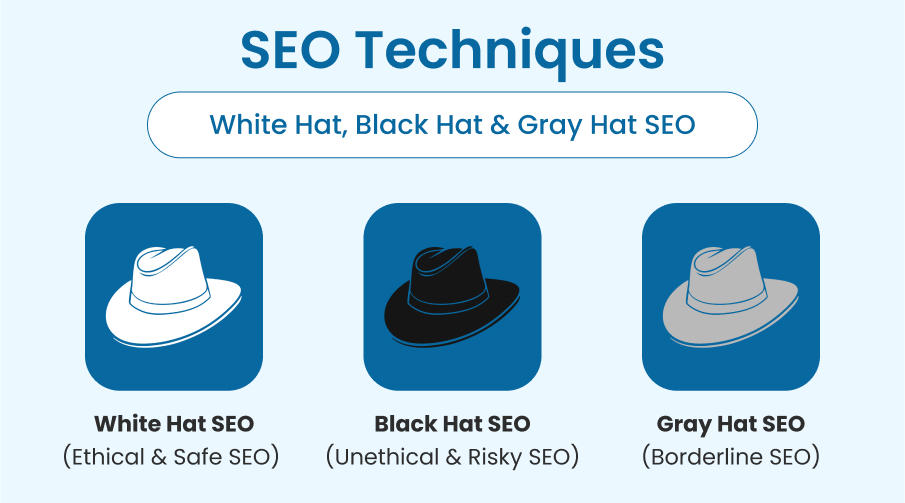
SEO Techniques: White Hat, Black Hat & Gray Hat SEO
SEO techniques define the strategies used to improve website rankings. They are divided into three main categories, often referred to as SEO hats, based on how they align with search engine guidelines:
✅1. White Hat SEO (Ethical & Safe SEO)
This is the recommended and safest approach, following search engine guidelines. It focuses on long-term growth and sustainable rankings.
✔ High-quality, informative content
✔ Ethical link-building through guest blogging and outreach
✔ Natural keyword usage (no stuffing)
✔ Enhancing user experience with fast, mobile-friendly websites
✅2. Black Hat SEO (Unethical & Risky SEO)
Black Hat SEO involves manipulating search engine algorithms to gain quick rankings, often violating guidelines.
🚫 Keyword stuffing (overloading keywords unnaturally)
🚫 Spammy or paid backlinks
🚫 Cloaking (showing different content to users & search engines)
🚫 Hidden text and links
⛔ Risk: Websites using Black Hat SEO can face penalties or even get removed from search results. In such cases, one way to address harmful backlinks is by using the Google Disavow Tool to inform Google that certain links should not be considered in the ranking process.
✅3. Gray Hat SEO (Borderline SEO)
Gray Hat SEO is a mix of White Hat and Black Hat tactics—it isn’t strictly against guidelines but can be risky.
✔ Buying old domains with backlinks
✔ Using clickbait to boost engagement
✔ Over-optimized anchor texts in backlinks
⚠ Risk: While Gray Hat tactics may work temporarily, they can lead to penalties when search engine algorithms evolve.
The Importance of SEO
SEO is important because it can help businesses increase their online visibility, drive more organic traffic, and generate leads and revenue. According to a study by BrightEdge, organic search drives 53% of website traffic, while paid search accounts for only 15%.
SEO also plays a crucial role in digital marketing, helping businesses build brand awareness, establish credibility, and compete effectively in their industry. Case studies and statistics have demonstrated that companies investing in SEO can see significant improvements in rankings, website traffic, and revenue.
Additionally, Outbrain, a content discovery platform, reported that a well-optimized SEO strategy increases the likelihood of ranking at the top of Google’s search results, boosting website visits and engagement.
Benefits of SEO
SEO is more than just ranking on Google—it offers long-term advantages that go far beyond visibility. The benefits of SEO include increased website traffic, stronger brand credibility, and sustainable business growth. That’s why investing in SEO is crucial for businesses of all sizes today. Below we have mentioned why investing in seo is crucial
✅ Increases Website Traffic – SEO helps attract organic visitors who are actively searching for what you offer.
✅ Boosts Credibility & Trust – Higher rankings signal to users that your website is reliable and authoritative.
✅ Enhances User Experience – Optimized websites load faster, are mobile-friendly, and provide a seamless browsing experience.
✅ Generates Higher ROI – Unlike paid ads, organic traffic from SEO is cost-effective and continues to grow over time.
✅ Competitive Advantage – Strong SEO helps you outperform competitors and capture more market share.
Example:A local business implementing strong SEO strategies can attract more customers than competitors who rely only on paid ads.
Effective SEO Strategies for Higher Rankings
To succeed in SEO, you need a solid strategy. Here are the best practices to follow:
✅ Keyword Research & Optimization – Find relevant keywords that match user intent and naturally include them in your content.
✅ High-Quality Content – Create valuable, engaging, and informative content that solves users’ problems.
✅ On-Page Optimization – Optimize title tags, meta descriptions, headings, and URLs for better visibility.
✅ Technical SEO Improvements – Ensure fast-loading pages, mobile responsiveness, and proper website structure.
✅ Link Building & Off-Page SEO – Earn high-quality backlinks from authoritative sites to improve your domain authority.
✅ Regular SEO Audits – Continuously monitor and update your SEO strategy using tools like Google Search Console and SEMrush. Regular SEO audits help identify areas for improvement and ensure optimal performance.
Example: A website that updates old blog posts with fresh data and better keywords can see an increase in rankings and traffic.
SEO Ranking Factors
Understanding SEO ranking factors is crucial for enhancing a website’s visibility on search engines like Google. These factors are criteria that search engines use to evaluate and rank web pages in search results. By optimizing for these elements, websites can improve their chances of achieving higher rankings and attracting more organic traffic.
Key SEO Ranking Factors
Content Quality and Relevance: High-quality, informative, and engaging content that addresses user intent is fundamental. Content should be original, well-structured, and provide value to readers. Longer, comprehensive content often performs better in search rankings.
Backlink Profile: Earning backlinks from authoritative and relevant websites signals trust and credibility to search engines. A diverse and natural backlink profile, with links from various reputable sources, can significantly boost rankings.
User Experience (UX): Factors such as page load speed, mobile-friendliness, intuitive navigation, and secure connections (HTTPS) contribute to a positive user experience. Websites that are easy to use and provide a seamless experience across devices are favored by search engines
Mobile Optimization: With the increasing use of mobile devices, having a responsive design that adapts to various screen sizes is essential. Mobile-friendly websites are prioritized in search results, especially after Google’s mobile-first indexing update.
Page Speed: Fast-loading pages enhance user satisfaction and reduce bounce rates. Optimizing images, leveraging browser caching, and minimizing code can improve load times, positively impacting rankings.
Secure and Accessible Website (HTTPS): Implementing SSL certificates to enable HTTPS ensures data security between the user and the site. Secure websites are trusted more by users and are given preference by search engines
On-Page Optimization: Proper use of title tags, meta descriptions, header tags, and keyword placement helps search engines understand the content of a page. Optimizing these elements can improve visibility and click-through rates.
Technical SEO: Ensuring that search engines can crawl and index a website effectively involves optimizing the site’s architecture, using structured data (schema markup), and creating an XML sitemap. Technical SEO lays the foundation for other optimization efforts.
E-A-T (Expertise, Authoritativeness, Trustworthiness): Websites that demonstrate expertise in their field, establish authority through quality content and credible sources, and build trust among users tend to rank higher. Publishing authoritative content, featuring expert authors, and showcasing testimonials and customer reviews can help enhance E-A-T signals.
Social Signals: Active engagement on social media platforms can lead to increased brand visibility and potential backlinks, indirectly influencing SEO rankings. While social signals are not direct ranking factors, they contribute to overall online presence.
SEO Tools to Help
There are several SEO tools and analytics platforms available to help monitor and improve website performance:
✔ Google Analytics & Google Search Console – Provide valuable insights into website traffic, user behavior, and search engine rankings.
✔ SEO ROI Calculator – Helps measure the financial impact of your SEO efforts by providing a detailed analysis of your returns.
✔ Yoast SEO & All in One SEO (Plugins) – Assist in optimizing content for search engines, improving meta tags, readability, and keyword usage.
These tools are essential for tracking SEO KPIs, refining strategies, and ensuring long-term success.
Discover What Your Customers Search ForDiscover What Your Customers Search For
Get insights on evolving customer behaviour, high volume keywords, search trends, and more.
To achieve SEO success, you need to follow best practices like creating high-quality content, practicing effective SEO Writing, earning backlinks, optimizing for mobile, focusing on user experience and site design, and ongoing monitoring and adjustments.
Since 2006, Techmagnate has been helping big brands achieve digital excellence through strategic SEO efforts and data-led SEO services, which have boosted their search rankings, website traffic, and revenue. Here are some examples:
1. Global Indian International Schools, a renowned educational institution, seeking to bolster its online presence and enrollment rates, a robust SEO strategy proved instrumental. By diving into comprehensive tactics like keyword optimization, technical SEO enhancements, and localized content strategies for each school, the results spoke volumes.
The organic traffic skyrocketed by a staggering 214%, generating an 82% surge in qualified leads. The blog, a prime engagement practice, experienced an astonishing 6108% increase in traffic through targeted keyword approaches. These statistics vividly illustrate the transformative impact of an effective SEO strategy in the education sector.
2. Bajaj Finserv Health, a pioneering health tech firm, embarked on an Enterprise SEO campaign to fortify its online presence and attract patients in a fiercely competitive healthcare landscape. Despite being a newcomer facing established industry giants and grappling with a complex website plagued by technical issues, their strategic focus on content quality, user experience enhancement, optimized website architecture, and authority building bore exceptional results.
Within a year, their keyword rankings soared by 587%, encompassing over 15,000 keywords, while blog traffic surged by 499%, all achieved through a meticulous approach to content creation, user-centric improvements, and trust-building strategies, affirming the transformative power of a well-executed SEO campaign in navigating challenges and establishing industry authority.
3. Get My Books, an online bookstore catering to school, non-fiction, and fiction books, partnered with Techmagnate to boost its online visibility and customer base. Tasked with enhancing organic growth via Ecommerce SEO, the strategy focused on refining website architecture, product categories, descriptions, and targeted keywords.
This comprehensive effort led to a remarkable 442% surge in sales within six months. Leveraging specialized audits, they rectified crawling issues, improved loading errors, and optimized content, resulting in a staggering 276% rise in keyword rankings and a 267% increase in organic traffic. Additionally, strategic enhancements via Programmatic SEO for over 51,000 product pages and Image SEO for 51,000 images, coupled with integration into Google Merchant Center, significantly expanded product reach, affirming the success of a meticulously executed SEO campaign.
These case studies demonstrate the value of SEO in driving organic traffic, generating leads, and increasing revenue. By following best practices and investing in SEO, businesses can achieve SEO success and compete in their industry.
SEO Trends and Future Developments (2025 & Beyond)
Search Engine Optimization (SEO) is evolving rapidly as technology and user expectations change. Staying updated with the latest SEO trends is essential for maintaining online visibility and competitive advantage. Here’s a look at the top SEO trends and future developments that are shaping the world of SEO today.
Google is integrating AI directly into search results, providing users with summarized answers from various sources. This means fewer clicks to websites and more emphasis on appearing in AI-generated snippets.
What to do: Create well-structured, expert-level content that’s easily summarized and cited by AI systems.
2. Voice & Visual Search Growth
With the rise of smart speakers, voice assistants, and visual tools like Google Lens, search behavior is becoming more conversational and interactive. As a result, Voice Search SEO is essential for capturing these new types of queries.
What to do: Focus on natural language optimization, apply Voice Search SEO techniques, and enhance image SEO using alt tags and structured data
3. Topical Authority & Semantic Search
Google now understands context, not just keywords. It ranks websites that demonstrate expertise across an entire topic, not just isolated articles.
What to do: Build interconnected content clusters around core themes.
4. Video & Short-Form Content SEO
Platforms like YouTube Shorts and TikTok influence search rankings. Video content now appears in both search and social results.
What to do: Repurpose articles into short, engaging videos with SEO-friendly titles and transcripts.
5. E-E-A-T and Content Quality
Google prioritizes content with E-E-A-T (Experience, Expertise, Authoritativeness, and Trustworthiness). Shallow, AI-only content is being devalued.
What to do: Showcase real-world experience, expert authors, and credible sources.
6. Zero-Click Searches & Featured Snippets
More queries are answered directly in the SERPs (Search Engine Results Pages), meaning users don’t always click through to sites.
What to do: Use schema markup and answer questions concisely to earn featured snippets.
Conclusion
SEO is no longer just about keywords—it’s about understanding user intent, delivering high-quality, multi-format content, and staying ahead of technological changes. As AI and search interfaces evolve, success will come to those who prioritize user experience, semantic relevance, and authentic, helpful information. For businesses navigating this complex landscape, understanding what an SEO agency can do is essential. A professional agency can help implement advanced strategies, monitor algorithm updates, and ensure your content remains visible and competitive in the ever-changing search environment.
Ready to dominate search rankings? Partner with our expert SEO agency for a tailored strategy that drives results. Contact us today for a free consultation!
Sarvesh Bagla is an enterprise SEO expert and industry leader who has driven transformational digital growth for India’s top brands across the BFSI, Healthcare, Automotive, and ECommerce industries. As the Founder and CEO of Techmagnate, he leads large-scale organic search strategies and performance marketing campaigns for businesses looking to succeed in today’s AI-driven search landscape.
A strong advocate for thought leadership, Sarvesh is deeply involved in SEO evangelism and regularly contributes to industry discussions through LinkedIn, webinars, and CMO roundtables. His focus today is on helping brands prepare for an AI-first SEO future (AEO, GEO) and strategies for Large Language Models (LLMs) at the core.
Get the most valuable search related insights about leading brands, trending keywords, search volumes, fastest growing categories, city-level insights and much more!
It has come to our notice that fraudulent job offers are being circulated on the internet through messaging apps like WhatsApp and Telegram, which falsely claim to be from Techmagnate. We take this matter seriously and would like to caution all candidates to be wary of such postings.
Please Note That –
We do not charge any fees/security deposit/payment from candidates, irrespective of the professional experience they hold, for job applications or interviews
Official communication channels include our website and verified social media accounts, primarily LinkedIn.
Kindly double-check the domain name – @techmagnate.com – in the email address
We follow a transparent and ethical approach for hiring/onboarding supported by proper documentation.
Ensure that you only apply through verified channels to avoid being scammed. We also recommend that you exercise caution when sharing personal information or financial details with any job posting or recruitment agencies claiming to represent us.
We want to ensure that potential candidates interested in joining Techmagnate have a safe and positive experience.
If you find that someone that fits the description above has reached out to you, please notify us immediately at jobs@techmagnate.com.
 Important Alert:
 Important Alert: