Beware of fake job offers and payment requests. We only use official email IDs and never conduct interviews on messaging apps.Beware of fake job offers and payment requests. We only use official email IDs and never conduct interviews on messaging apps.
As AI crawlers become a bigger part of how information is discovered online, interest in llms.txt has grown quickly. Marketers, SEO teams, and website owners are increasingly exploring whether adding an llms.txt file can help AI tools better understand their content.
At the same time, there is plenty of confusion around what the file actually does and whether it is worth the effort. The honest answer is not a simple yes or no. While llms.txt may help organize content for AI crawlers, evidence of real impact is still limited. Understanding what it is, how to add it, and where it fits is important before making it part of your 2026 strategy.
Table of Contents
What is llms.txt?
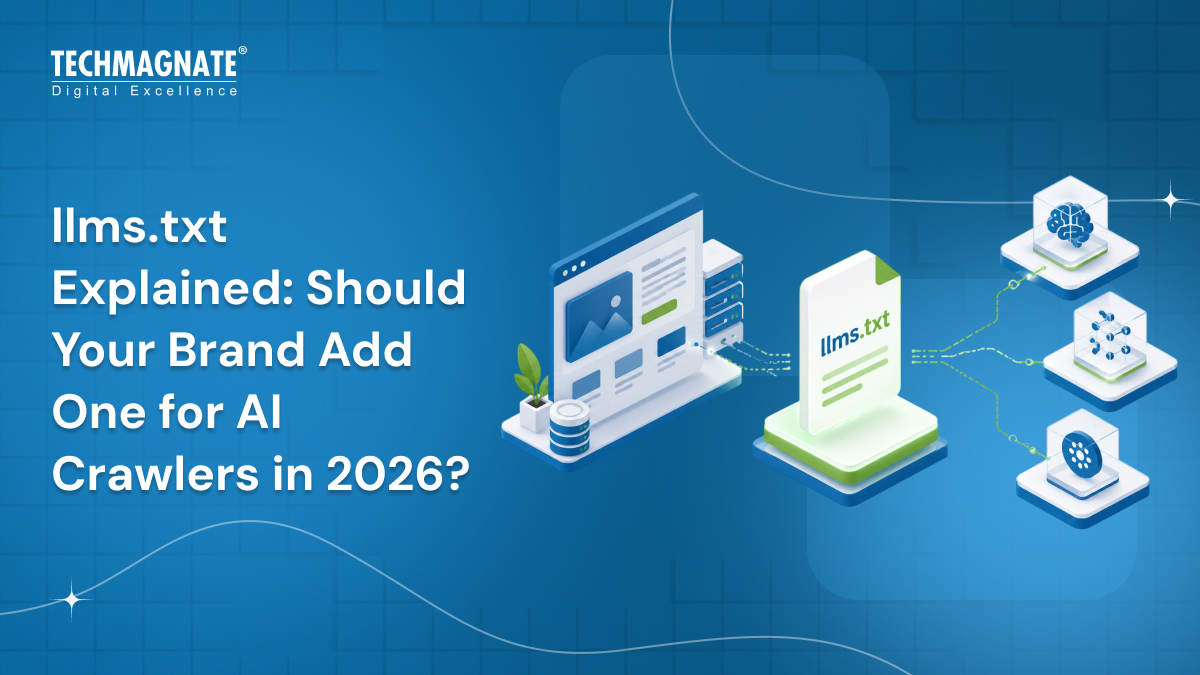
An llms.txt file is a simple text file that helps AI tools understand the most important content on your website, but AI crawlers face the same rendering hurdles as regular ones; see our common JavaScript SEO issues guide. It is written in Markdown, a simple formatting style that uses basic text and symbols to organize information. The llms.txt format was proposed in 2024 by Jeremy Howard, co-founder of fast.ai, as a community-led standard for helping AI tools navigate website content. Website owners place this file in the root directory of a website, meaning it sits at the main level of the domain, usually here:
yourdomain.com/llms.txt
The purpose of the file is to highlight and organize the pages, resources, and topics that matter most. Instead of making AI tools scan hundreds or thousands of pages, it gives them a curated list of content the website considers important.
The file is also machine-readable, which simply means it is designed for software to understand rather than people. Anyone can open it in a browser, but its main purpose is to help automated tools process website information more easily.
A typical llms.txt file may include:
The website or brand name
A short description of the site
Links to important pages
Topic categories
Summaries explaining each page
It is important to understand what llms.txt does not do, it does not control crawler access like robots.txt, and for that, see noindex a webpage or PDF instead.
Instead, llms.txt serves more as a guide, pointing AI tools toward the content you want them to notice and understand.
llms.txt vs robots.txt vs sitemap.xml
Many website owners come across discussions about llms.txt vs robots.txt and assume these files do the same thing. In reality, each serves a different purpose. Understanding those differences can help you decide whether llms.txt is worth adding to your website.
Here is a quick comparison to understand how each file works and where it fits:
File
Purpose
Format
Who Typically Honors It
robots.txt
Controls crawler access to content
Plain text
Search engine crawlers such as Googlebot and Bingbot
sitemap.xml
Lists URLs for discovery and indexing
XML
Search engines
llms.txt
Curates important content for AI systems and language models
Markdown
AI tools and LLM platforms that choose to support it
A robots.txt file tells search engine crawlers which areas of a website they can or cannot access. Website owners often use it to prevent crawlers from visiting pages that are not important for search.
A sitemap helps search engines discover and index content. It provides a structured list of URLs, making it easier for search engines to understand a site’s content and structure.
Robots.txt and sitemap.xml are widely accepted web standards. Support for llms.txt remains optional, and major AI companies have not officially confirmed consistent support.
If we talk about an AI crawler, it has a different goal. Rather than simply indexing pages, it may analyze, summarize, interpret, or cite information. This is where llms.txt becomes relevant. Rather than listing every page or controlling access, it helps organize the content you consider most valuable and adds context around it.
Rather than replacing other files, llms.txt works alongside them as an additional way to organize content for AI tools.
How to Create an llms.txt (and llms-full.txt)
If you are wondering how to create llms.txt, the process is relatively simple. You do not need advanced development skills to get started. The goal is to create a file that highlights your most important content for AI systems.
Step 1: Create the File
Open a plain text editor such as Notepad, VS Code, or a similar application. Save the file as llms.txt.
Step 2: Add Basic Website Information
Start with a few details about your website, including:
Brand or website name
Short description of what the business does
Main topics or areas of expertise
This helps provide context about your business and the type of content available on the website.
Step 3: Add Your Most Important Pages
List the pages you want AI systems to prioritize. Focus on content that best represents your expertise and provides value to users.
Include pages such as:
Core service pages
Product or solution pages
Key blog content
Resource hubs or guides
Important company pages
Add a short, clear description beside each page, so AI tools can better understand what it covers.
Step 4: Upload the File
Upload the completed file to your website’s root directory so it appears at:
yourdomain.com/llms.txt
Placement matters. If the file is uploaded in the wrong location, AI crawlers may not find it. Brands that need help with setup often work with technical SEO services to make sure technical files and website structure are implemented correctly.
You may also come across llms-full.txt.
A standard llms.txt usually includes links and short descriptions. llms-full.txt is a longer version that can include the actual content from selected pages, giving AI tools more context without visiting every URL.
For most websites, starting with a standard file is usually the simpler option.
A basic structure may look like this:
# Brand Name
> Brief company description
## Key Pages
– Homepage: Main overview
– Services: Core offerings
– Resources: Educational content
A few simple best practices can help:
Include only your most valuable pages
Keep descriptions short and factual
Organize content into clear categories
Update the file when major content changes happen
A simple, organized file is often easier to maintain and more useful than an overly detailed one.
At Techmagnate, we recommend treating llms.txt as part of a broader technical setup rather than a standalone task. Correct placement, clean implementation, and alignment with existing SEO foundations can make it easier for crawlers to understand website content. For brands focused on digital excellence, getting the technical basics right remains important.
Does llms.txt Actually Work? An Honest Look
This is the question that matters most, and it deserves a straightforward answer.
Right now, the evidence remains limited. Many discussions around llms.txt SEO assume that AI systems actively use these files to discover, prioritize, or cite content. However, there is currently very little public evidence to support that assumption.
As of 2026, major AI platforms have not officially confirmed that llms.txt influences how content is selected or surfaced in AI-generated responses. For example:
Google: There is no official confirmation that Google uses llms.txt in Search, AI Overviews, or other AI features. This remains one of the most common questions: Does Google use llms.txt?
OpenAI: OpenAI has not publicly confirmed that ChatGPT or its crawlers consistently read llms.txt files.
Anthropic and Other Platforms: Similar platforms have not officially confirmed support either.
That does not mean the file has no value.
Some developers, smaller AI tools, and technical SEO communities have started experimenting with llms.txt, and interest in the format continues to grow. However, growing interest is not the same as proven impact.
The same caution applies to discussions around the llms.txt standard. While the format has gained visibility since its introduction, it remains a community-led proposal rather than an officially recognized web standard. Support is voluntary, and there is no requirement for AI crawlers to follow it.
Many website owners also ask whether llms.txt helps AI visibility. The most honest answer today is: possibly, but the impact is hard to measure. There are currently no large-scale studies showing that adding an llms.txt file consistently improves the number of mentions, citations, or visibility in AI-generated answers.
If you want a deeper understanding of how AI tools discover and cite content, the guide on How to Get Cited by LLMs covers the mechanics of LLM seeding in more practical detail.
Verdict Box: Current Reality of LLMs.txt
Here is the most practical way to look at where llms.txt stands today:
Factor
Assessment
Effort Required
Low
Cost
Minimal
Technical Complexity
Low
Risk
Very Low
Proven Visibility Impact
Limited Evidence
Future Potential
Moderate
Future potential is rated Moderate because adoption is growing among smaller AI tools and developer communities, but no major platform has committed to supporting it yet.
The bottom line is simple. Adding an llms.txt file is a low-effort, low-risk step with potential upside. It is reasonable to implement, especially since maintenance requirements are minimal. However, brands should not expect it to move the needle on its own. Real AI visibility still depends on strong content, topical authority, site structure, expertise, and trust. For now, llms.txt is best viewed as an emerging practice rather than a proven driver of visibility. Strong content, site structure, trust, and authority still matter far more than a single file.
Should Your Brand Add One in 2026?
By now, the bigger question is whether your brand should add an llms.txt file in 2026. For most websites, the answer is yes, but with realistic expectations.
An llms.txt file takes little time to create, carries minimal risk, and may become more useful if AI crawlers adopt the format more widely in the future. Because the effort is low, many brands may see it as a practical addition.
That said, the value depends on your website’s size and complexity.
Small and Mid-Sized Businesses
For smaller websites, the decision is usually straightforward:
Setup requires minimal time and resources.
Ongoing maintenance is simple.
The file helps highlight your most important content.
Wider adoption of AI tools could increase their value over time.
For many small and mid-sized businesses, the potential llms.txt benefits make it a worthwhile addition. It is also worth understanding how llms.txt relates to broader AI visibility – the guide on What is LLM SEO? provides useful context on where this file fits within a wider strategy.
Enterprise Organizations
Large websites require a more strategic approach. An enterprise may manage thousands of pages, making content selection and maintenance more complex.
A practical llms.txt implementation guide for enterprise teams should focus on:
Identifying authoritative content hubs.
Prioritizing key landing pages and resources.
Assigning ownership for updates.
Reviewing and refining the file regularly.
For enterprise brands, governance and content strategy often matter more than the file itself. It is also important to think about effort versus potential value. Adding an llms.txt file does not require major development work, expensive tools, or ongoing maintenance for most websites. In many cases, it can be created and updated alongside existing technical SEO practices. Even if adoption remains limited today, some brands may prefer to implement it early rather than revisit the process later as AI crawlers continue to develop.
Focus on the Bigger Picture
Regardless of company size, LLMs.txt SEO should not be treated as a standalone solution. Real AI visibility depends on several foundational factors:
High-quality content
Strong technical website health
Structured data implementation
Topical authority
Brand trust and credibility
Consistent publishing and updates
At Techmagnate, we see llms.txt as one small part of a much larger AI visibility strategy. While the file may offer some value, stronger results usually come from better content structure, technical SEO, topical authority, and trust signals. For brands working toward transformational growth, the greater opportunity lies in our LLM SEO Services, improving how AI tools come to understand and trust your website over time.
Conclusion
The honest verdict is straightforward: llms.txt is worth considering, but it should be viewed as a low-risk experiment rather than a proven visibility tactic. It is easy to set up, simple to maintain, and may become more useful if AI crawlers adopt it more widely over time.
At the same time, one file will not determine how visible your brand becomes. Strong content, technical foundations, site structure, and trust still play a much bigger role. If you want a clearer picture of how prepared your website is for AI-driven discovery, exploring SEO Audit Services can help identify practical next steps.
Frequently Asked Questions
Is llms.txt official?
No. llms.txt is not an official web standard. It is an emerging format proposed in 2024 by Jeremy Howard of fast.ai as a community-led initiative. Support depends entirely on whether AI platforms choose to adopt it.
Does ChatGPT read llms.txt?
OpenAI has not officially confirmed that ChatGPT or its crawlers actively read llms.txt files. Some developers believe it may help, but there is no solid proof yet. Treat it as possible, not guaranteed.
Do I need an llms.txt file?
No, it is not required. But because it takes very little time to create and carries minimal risk, many website owners see it as a sensible step – especially if they want to prepare for potential future adoption by AI crawlers.
What is the difference between llms.txt and robots.txt?
robots.txt controls which pages crawlers can or cannot access. llms.txt does not block or allow anything – it simply curates your best content and adds context, so AI tools can better understand what your site offers.
What is llms-full.txt?
llms-full.txt is an extended version of llms.txt that includes the actual content of your selected pages, not just links and descriptions. It gives AI tools deeper context without requiring them to crawl each URL individually.
Sarvesh Bagla is an enterprise SEO expert and industry leader who has driven transformational digital growth for India’s top brands across the BFSI, Healthcare, Automotive, and ECommerce industries. As the Founder and CEO of Techmagnate, he leads large-scale organic search strategies and performance marketing campaigns for businesses looking to succeed in today’s AI-driven search landscape.
A strong advocate for thought leadership, Sarvesh is deeply involved in SEO evangelism and regularly contributes to industry discussions through LinkedIn, webinars, and CMO roundtables. His focus today is on helping brands prepare for an AI-first SEO future (AEO, GEO) and strategies for Large Language Models (LLMs) at the core.
Get the most valuable search related insights about leading brands, trending keywords, search volumes, fastest growing categories, city-level insights and much more!
It has come to our notice that fraudulent job offers are being circulated on the internet through messaging apps like WhatsApp and Telegram, which falsely claim to be from Techmagnate. We take this matter seriously and would like to caution all candidates to be wary of such postings.
Please Note That –
We do not charge any fees/security deposit/payment from candidates, irrespective of the professional experience they hold, for job applications or interviews
Official communication channels include our website and verified social media accounts, primarily LinkedIn.
Kindly double-check the domain name – @techmagnate.com – in the email address
We follow a transparent and ethical approach for hiring/onboarding supported by proper documentation.
Ensure that you only apply through verified channels to avoid being scammed. We also recommend that you exercise caution when sharing personal information or financial details with any job posting or recruitment agencies claiming to represent us.
We want to ensure that potential candidates interested in joining Techmagnate have a safe and positive experience.
If you find that someone that fits the description above has reached out to you, please notify us immediately at jobs@techmagnate.com.
Team @Techmangate
Build a Better Digital Marketing Strategy with Techmagnate’s Search Trends Reports
 Important Alert: