Beware of fake job offers and payment requests. We only use official email IDs and never conduct interviews on messaging apps.Beware of fake job offers and payment requests. We only use official email IDs and never conduct interviews on messaging apps.
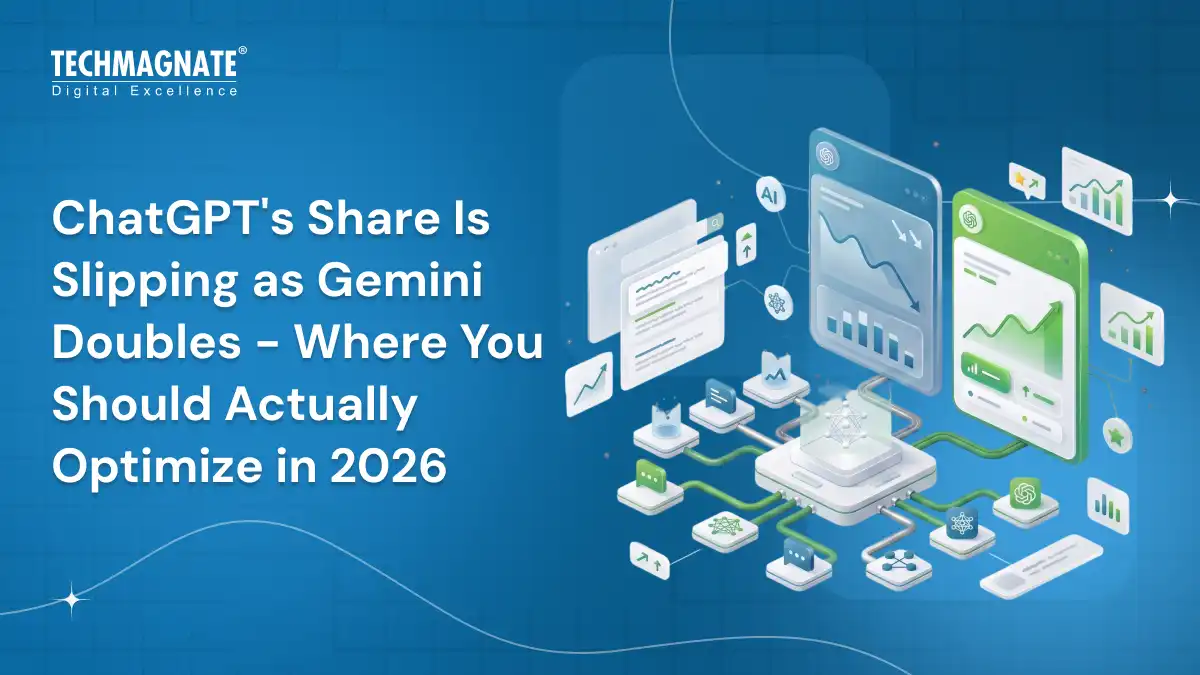
Most marketers assume ChatGPT has a commanding lead in AI search. However, the latest ChatGPT vs Gemini market share trends show that the market is changing faster than many expected. While ChatGPT continues to lead in most major usage and traffic metrics, Gemini has gained momentum over the past year, increasing its share across several datasets and expanding its presence across Google’s ecosystem.
The key takeaway is not that one platform is replacing the other. Instead, the AI search is becoming more competitive and fragmented. For marketing leaders, the real question is not which platform is winning but where customers search for and discover brands.
Table of Contents
The Numbers: What’s Actually Changing?
Before discussing optimization priorities, it is important to understand what the latest data actually shows, including how ChatGPT recommends products to shoppers. The AI engine market share picture in 2026 is shifting, but the biggest development is not that ChatGPT is becoming irrelevant. Instead, Gemini is expanding at a pace that few marketers anticipated.
According to Similarweb market analysis published in June 2026, ChatGPT accounted for approximately 54.7% of measured web visits among major AI chatbot platforms, while Gemini captured roughly 27.4%. The two platforms represented more than 80% of tracked traffic across leading AI assistants. These two figures differ because they measure different things – the 54.7%/27.4% split covers a seven-app set (April 2026 data, published June), while the 64.5%/21.5% split is the January 2026 Global AI Tracker. Both point the same way: ChatGPT down, Gemini up.
A separate Similarweb Global AI Tracker report released earlier in 2026 showed a similar trend. ChatGPT’s share of tracked AI platform traffic declined from around 86.7% a year earlier to approximately 64.5%, while Gemini grew from 5.7% to more than 21% during the same period. Although ChatGPT continues to lead, the gap between the market leader and its closest challenger is narrowing.
To put these figures into context, it helps to understand two commonly used metrics. Market share refers to the percentage of activity a platform captures within a specific category or dataset. MAU (Monthly Active Users) measures the number of unique people who actively use a product during a 30-day period.
Recent reports also highlight significant growth in Gemini users. Similarweb data published in 2026 indicates that Gemini’s app MAU increased by more than 1,100% between late 2024 and early 2026. Much of this growth can be attributed to Google’s ability to introduce AI experiences through products that millions of people already use every day.
Taken together, these numbers point to a clear trend. ChatGPT remains the largest player in most web traffic metrics, but Gemini is growing faster. For marketers, that means opportunities for visibility are becoming increasingly distributed across multiple AI platforms rather than concentrated within a single assistant.
Volatility Caveat
Market-share estimates can vary significantly depending on what researchers choose to measure. Different studies may focus on:
Web visits
Referral traffic
App activity
Enterprise usage
Embedded AI experiences
For that reason, marketers should focus less on any single percentage and more on the direction of the trend. While exact figures may differ across datasets, most recent reports suggest that AI discovery is becoming increasingly fragmented, with user attention spreading across multiple platforms rather than remaining concentrated in one ecosystem.
Why Gemini Is Growing So Fast
Many people assume the rapid shift to Gemini is driven solely by model quality. While improvements in performance and capabilities certainly play a role, one of the biggest drivers of adoption is distribution. Simply put, distribution means making a product available where people already spend their time. The easier it is for users to access a tool, the more likely they are to try it and incorporate it into their daily routines.
Google has a unique advantage in this area. Unlike standalone AI platforms that require users to seek them out, Gemini benefits from Google’s vast ecosystem of products and services. This allows Google to introduce AI experiences to users through tools they already use regularly. Several factors are contributing to Gemini’s growth in 2026:
Google Search: Google increasingly uses Gemini models to power AI experiences such as AI Overviews and AI Mode, exposing users to AI-generated answers during everyday searches.
Android Ecosystem: Android remains the world’s most widely used mobile operating system, giving Google significant reach across global markets.
Google Workspace: Gemini capabilities are integrated into products such as Gmail, Docs, Sheets, and Meet, making AI accessible within existing workflows.
Google Services: Users can access Gemini through multiple Google products, reducing the need to adopt a completely separate platform.
Lower Adoption Friction: Familiar interfaces and connected experiences make it easier for users to experiment with AI tools without changing their habits.
The key takeaway is that distribution often accelerates adoption. When AI capabilities are embedded into products people already trust and use, engagement can grow quickly. This helps explain why the shift to Gemini has gained momentum and why Gemini’s growth in 2026 remains one of the most closely watched trends in the AI market.
Does This Mean You Should Drop ChatGPT?
The short answer is no. Gemini’s rapid growth does not make ChatGPT irrelevant. In fact, one of the biggest mistakes marketers can make is reacting to market-share headlines by shifting all their attention to a single platform.
A common question is whether ChatGPT is losing market share. Several usage and traffic datasets suggest that ChatGPT’s share has declined as competitors such as Gemini continue to gain traction. However, a decline in share does not mean a decline in influence. In fact, ChatGPT’s absolute web visits grew roughly 84% between late 2024 and early 2026 – its share fell only because the whole market grew faster around it. ChatGPT remains one of the most widely used AI platforms and continues to shape how people research products, evaluate solutions, and discover brands.
Another frequently asked question is: Is Gemini bigger than ChatGPT now? Based on the most widely cited usage and traffic measurements available as of mid-2026, the answer is no. Gemini has grown rapidly, supported by Google’s reach across Search, Android, Chrome, and Workspace. Even so, ChatGPT continues to lead many major usage metrics and remains deeply embedded in professional and business workflows.
These trends highlight that AI visibility is not a winner-take-all game. Brands do not need to choose between ChatGPT and Gemini. Different audiences engage with different AI platforms, often for different reasons. For example:
Many B2B professionals use ChatGPT for research, analysis, content ideation, and problem-solving.
Consumer audiences increasingly encounter Gemini through Google’s products and services.
Users frequently move between multiple AI tools depending on the task they want to complete.
So, which AI should I optimize for? For most brands, the answer is more than one. The strongest approach is to build visibility across major AI platforms and then allocate additional effort based on where your target audience spends the most time. Audience behavior, not platform headlines, should guide your optimization strategy.
Where Your Audience Actually Is
When deciding where to optimize AI search, the most important factor is not which platform has the largest market share – for the full picture, see our GEO vs SEO comparison. It is where your target audience spends its time. While ChatGPT, Gemini, and Perplexity differ in how they deliver answers, the core principles of visibility remain largely the same across platforms.
Strong performance in AI search starts with a solid foundation. Brands should focus on creating authoritative content, demonstrating expertise, earning trusted mentions, maintaining factual accuracy, structuring information clearly, and strengthening entity recognition. These signals help AI systems understand, trust, and reference your content. To determine your optimization priority, use this checklist:
Identify whether your audience is primarily B2B, professional, or consumer-focused.
Analyze Android versus iOS usage patterns in your target market.
Review referral traffic and engagement from AI platforms.
Track lead quality and conversions by acquisition source.
Monitor AI adoption trends within your industry.
This framework helps establish practical multi-platform AI optimization priorities without overreacting to short-term market shifts.
For example, enterprise software brands may place greater emphasis on ChatGPT visibility due to its widespread adoption among professionals. Consumer brands in Android-dominant markets may find growing opportunities within Gemini-powered experiences. Many organizations benefit from a balanced, cross-engine approach rather than focusing on a single platform.
At Techmagnate, we often recommend this strategy because it aligns with long-term visibility goals and helps brands remain discoverable across evolving AI ecosystems. Businesses pursuing this approach frequently invest in AI SEO Services to strengthen visibility across multiple AI engines and adapt to changing user behavior.
A Per-Engine Optimization Priority Matrix
One of the most common questions marketers ask today is: Should I prioritize Gemini or ChatGPT for AI search in 2026? The answer depends on your audience, device preferences, and how customers discover information. Rather than focusing exclusively on one platform, most brands benefit from building visibility across multiple AI engines while allocating additional effort where their audience is most active.
Engine
Audience Fit
Optimization Effort
Suggested Priority for Most Brands
ChatGPT
Professionals, researchers, knowledge workers, and many B2B decision-makers
Medium
High
Gemini
Consumer audiences, Android-heavy markets, and Google Workspace users
Medium-High
High
Perplexity
Research-focused users looking for cited information and source transparency
Medium
Moderate
Shared Foundation
Regardless of the platform, visibility depends on trusted brand signals, expert content, strong topical authority, clear site architecture, and authoritative brand mentions. These fundamentals support a successful multi-engine GEO strategy and help brands remain discoverable across AI-powered search experiences.
Engine-Specific Priorities
For ChatGPT, focus on comprehensive content, digital PR, expert insights, and authoritative brand mentions. Organizations looking to strengthen visibility within OpenAI’s ecosystem often explore ChatGPT SEO Services.
For Gemini, prioritize structured data, entity optimization, brand authority, and alignment with Google’s broader ecosystem. Businesses increasing their Gemini SEO priority frequently evaluate Gemini SEO Services. Effective Gemini vs ChatGPT optimization requires understanding audience behavior and maintaining visibility across the AI platforms that matter most to your customers.
Conclusion
The latest ChatGPT vs Gemini market share trends show one clear pattern: AI discovery is spreading across multiple platforms. Gemini is growing within Google’s ecosystem, while ChatGPT still matters in both consumer and professional use cases.
The smarter move is not to chase one engine. Build the shared foundation first, with authoritative content, trusted brand signals, clear site structure, and consistent entity recognition. Then shift effort toward where your audience actually spends time and keep tracking the trend.
A multi-engine GEO strategy helps brands stay visible as the landscape shifts. If you are exploring next steps, Techmagnate can help with AI SEO Services and a search strategy built for what comes next.
Frequently Asked Questions
Is Gemini bigger than ChatGPT now?
Most current datasets still show ChatGPT leading overall usage and traffic. However, Gemini has grown substantially and continues to gain share across multiple measurements.
Which AI should I optimize for?
Most brands should optimize for multiple platforms. Start with audience behavior, referral data, and market characteristics rather than assuming one engine matters most.
Is ChatGPT losing market share?
In several independent datasets, ChatGPT’s share has declined as competitors gain traction. However, it remains the largest AI platform in most measurements and continues to play a central role in AI search and discovery.
What is ChatGPT's market share in 2026?
As of 2026, ChatGPT leads AI chatbot web traffic with roughly 54.7% of visits across major assistants (Similarweb, April 2026 data). Its share has fallen from around 87% a year earlier, but its actual visit numbers still grew – the share dropped because the whole market expanded faster around it.
Why is Gemini growing so fast?
Gemini’s growth is driven less by model quality alone and more by distribution. Google places it inside products billions already use – Search, Android, and Workspace – so people encounter Gemini without seeking it out. That built-in access is the main reason its share rose from about 5.7% to over 21% in a year.
Should I optimize for Gemini or ChatGPT in 2026?
For most brands, the answer is both. Build a shared foundation of authoritative, well-structured content first, then put extra effort where your audience actually is. Consumer and Android-heavy brands often lean toward Gemini; B2B and professional brands often lean toward ChatGPT.
Does a lower market share mean ChatGPT is less important?
No. A falling share doesn’t mean falling influence – ChatGPT’s absolute usage kept growing through 2026. It remains the most-used AI assistant for research, product discovery, and professional workflows, so it stays a priority for visibility.
How do I know which AI platform my customers use?
Look at your own data rather than headlines. Check referral traffic by source, whether your audience is B2B or consumer, and Android-versus-iOS usage in your market. Tracking lead quality by acquisition source tells you which platform actually drives business, not just visits.
What does optimizing for AI search actually involve?
The core work is the same across engines: authoritative content, clear structure, factual accuracy, trusted brand mentions, and strong entity recognition. These signals help every AI system understand and reference your brand, which is why a multi-engine foundation matters more than chasing one platform.
Get the most valuable search related insights about leading brands, trending keywords, search volumes, fastest growing categories, city-level insights and much more!
It has come to our notice that fraudulent job offers are being circulated on the internet through messaging apps like WhatsApp and Telegram, which falsely claim to be from Techmagnate. We take this matter seriously and would like to caution all candidates to be wary of such postings.
Please Note That –
We do not charge any fees/security deposit/payment from candidates, irrespective of the professional experience they hold, for job applications or interviews
Official communication channels include our website and verified social media accounts, primarily LinkedIn.
Kindly double-check the domain name – @techmagnate.com – in the email address
We follow a transparent and ethical approach for hiring/onboarding supported by proper documentation.
Ensure that you only apply through verified channels to avoid being scammed. We also recommend that you exercise caution when sharing personal information or financial details with any job posting or recruitment agencies claiming to represent us.
We want to ensure that potential candidates interested in joining Techmagnate have a safe and positive experience.
If you find that someone that fits the description above has reached out to you, please notify us immediately at jobs@techmagnate.com.
Team @Techmangate
Build a Better Digital Marketing Strategy with Techmagnate’s Search Trends Reports
 Important Alert: