Beware of fake job offers and payment requests. We only use official email IDs and never conduct interviews on messaging apps.Beware of fake job offers and payment requests. We only use official email IDs and never conduct interviews on messaging apps.
Summary: The content explains how the travel industry will grow in 2025, driven by higher incomes, digital improvements, and changing traveler preferences. It covers trends like mobile bookings and eco-friendly tourism while highlighting challenges like economic uncertainty and cybersecurity risks. Businesses that use technology and adapt to customer needs will succeed in this evolving market.
Key Takeaways:-
The travel industry will grow in 2025 with rising incomes and digital advancements.
Mobile bookings and personalized experiences will drive consumer choices.
Sustainable and eco-friendly tourism is gaining demand.
Economic uncertainty and cybersecurity remain key challenges.
AI and better digital experiences will help businesses stay competitive.
Understanding market trends and consumer needs is crucial for success.
The travel industry is rapidly evolving, shaped by changing consumer behavior, technological innovations, and a strong push toward sustainability. As we move into 2025, travel businesses must adapt to new trends that are redefining how people explore the world. From personalized experiences powered by AI to the rise of eco-friendly tourism, staying ahead of these changes is crucial for success. In this blog, we explore the top travel industry trends and market insights to help you navigate the future of travel with confidence.
Table of Contents
Know About the Travel Industry in 2025
An important sector of the world economy is the travel and tourism sector. It covers everything, from lodging options like hotels and resorts to modes of transportation like trains and airplanes.
Discover What Your Customers Search ForDiscover What Your Customers Search For
Get insights on evolving customer behaviour, high volume keywords, search trends, and more.
In addition, there are tourism-related experiences including adventure travel, guided tours, and cultural events. The travel industry market size will continue to be a significant economic factor in 2025. In addition to creating jobs, it will boost local economies. This is done by assisting establishments like dining establishments and entertainment centers that depend on tourism.
Travel industry trends contribute significantly to a country’s economic prosperity. It makes a considerable contribution to global GDP and creates millions of jobs globally. It also promotes growth in other industries, such as hotels, transportation, and digital services.
As the global economy evolves, firms and stakeholders must grasp the travel industry’s market size. Knowing the size of the market allows organizations to plan, estimate revenue, and find chances for expansion.
Understanding Travel Industry Market Size
Market size refers to how large or small an industry is. It’s measured by looking at several factors like the total revenue earned, the number of people traveling, and the popularity of different types of travel services.
In the travel industry, key metrics used to measure market size include:
Revenue
This refers to the overall revenue generated by travel-related industries. This includes earnings from flights, hotels, transportation, excursions, and activities. The market size grows in proportion to how much money people are prepared to spend on travel.
Market Segmentation
The travel industry growth is divided into different segments such as transportation, accommodation, travel agents, and experiences. Each segment has its own growth rate, consumer demand, and competitive landscape. Market segmentation helps businesses understand which parts of the travel industry are growing and where to focus resources.
Growth Rates
Growth rates indicate the speed at which a sector or business is growing. Online reservations are one sector that is expanding more quickly than others. Businesses can use growth rates to choose where to focus their resources in order to capitalize on expanding markets. The scale of the travel market is influenced by a number of variables, including customer preferences, technology improvements, and economic situations.
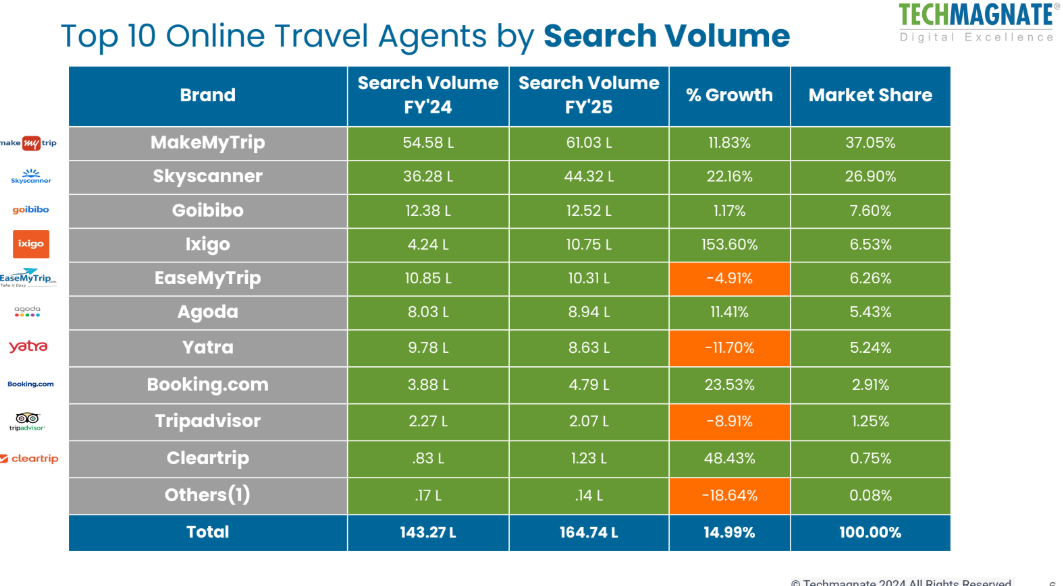
As per Techmagnate’s Search Trends Report, the online travel agent market grew by 14.99% from FY’24 to FY’25, with Average search volume reaching 164.74 lakh. Other major players include Skyscanner, Goibibo, and Ixigo, showing strong growth in the competitive landscape.
Key Drivers of Growth in the Travel Industry and Strategies for Leveraging Them
As per the Travel Industry Insights, the industry continues to grow. This is because of several key factors. Understanding these drivers can help businesses develop strategies to tap into new opportunities and meet changing customer needs.
Travel has grown more inexpensive as people’s incomes have increased. This is particularly true in developing nations like Asia and Africa, where a large number of people are becoming middle class. More individuals are able to reserve flights, stay in hotels, and engage in other activities when traveling because they have more money to spend.
Planning a trip is now a lot simpler thanks to technology. Booking a vacation is now easier and faster thanks to websites, apps, and online travel agents. People may now plan and schedule their vacation at any time and from any location thanks to smartphones.
Today’s tourists want experiences that align with their unique interests. Instead of traditional holidays, people choose experiences tailored to their own tastes. Some people seek thrilling adventure vacations, while others choose relaxing health getaways. The rising need for personalized travel is fueling the expansion of the travel industry, as more consumers seek journeys that are tailored to their specific requirements.
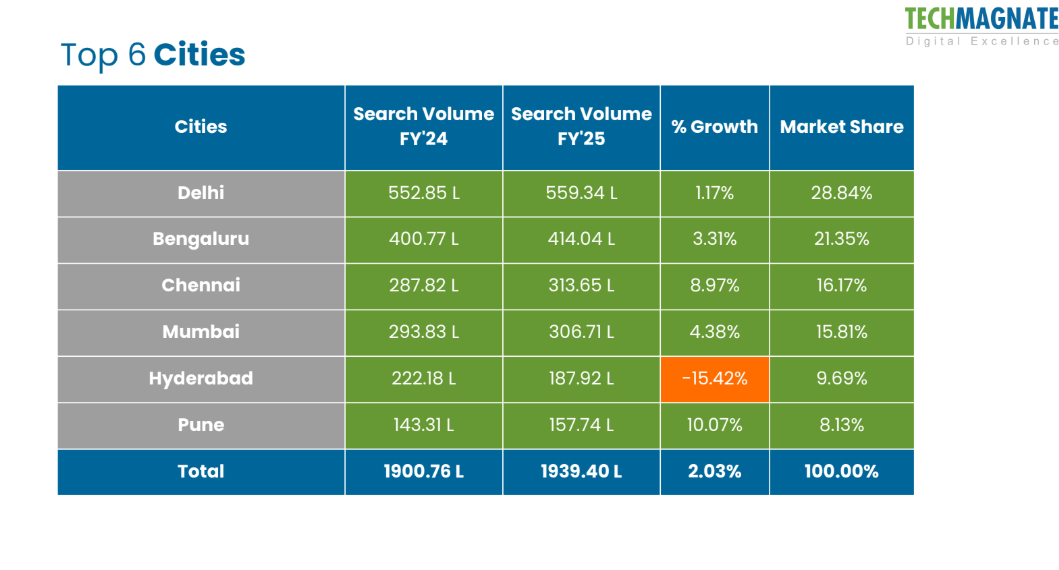
Cities like Bengaluru, Chennai, and Pune led growth with rises in search traffic, according to the Techmagnate’s Search Trends Report. Hyderabad showed a drop in search volume, but Delhi and Mumbai held firm.
Also, to take advantage of these growth drivers, businesses can adopt the following strategies:
Leverage Artificial Intelligence (AI)
AI may be used to make tailored trip suggestions. For example, AI might suggest places, hotels, or activities based on a traveler’s prior reservations or interests. This enhances the consumer experience and increases sales.
Focus on Emerging Demographics
One of the main forces behind the tourism industry’s expansion is younger tourists, especially Millennials and Gen Z. These groups frequently seek for distinctive and customized travel experiences. Businesses can attract new clients by concentrating on this group.
Enhance the Digital Experience
As more customers book vacations via mobile devices, businesses should have a solid mobile presence. Easy-to-use applications and websites that allow clients to book and organize vacations while on the go are critical for attracting today’s tech-savvy tourists.
Travel Industry Market Trends and Projections for 2025
In 2025, the travel industry will continue to grow, with several key trends shaping the future. Understanding these trends will help businesses adapt to changing consumer demands and position themselves for success.
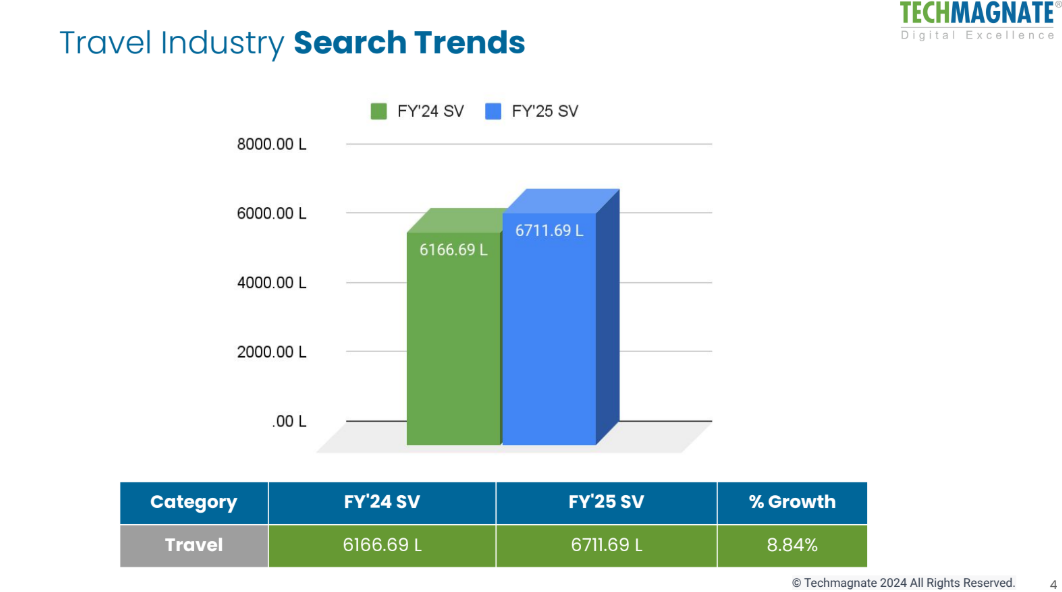
According to Techmagnate’s Search trends report, the travel industry’s search volume increased by 8.84% between FY24 and FY25. The search volume rose from 6166.69 L in FY24 to 6711.69 L in FY25.
This expansion shows the sustained high interest in travel, showing an increase in consumer demand. The growth in search traffic presents considerable opportunity for businesses to enter a developing industry and acquire more clients in the future year.
Regional growth will vary, with emerging markets in Asia-Pacific, Europe, and North America seeing continued expansion. In particular, the Asia-Pacific region is expected to experience the fastest growth due to its large population, rising incomes, and increasing middle-class spending.
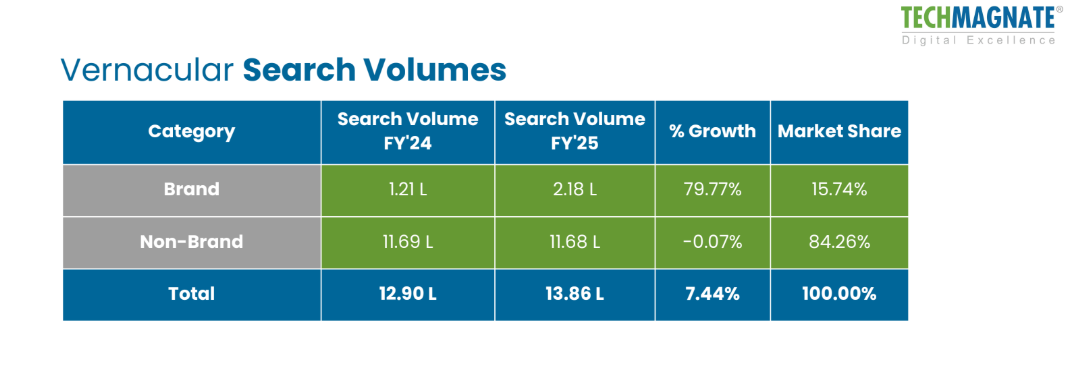
As per Techmagnate’s Travel Industry Search Trends Report for Vernacular Search Volumes, in FY’24, Brand search volume was 1.21 L, rising to 2.18 L in FY’25, with a growth of 79.77%. Non-Brand remained stable at 11.69 L.
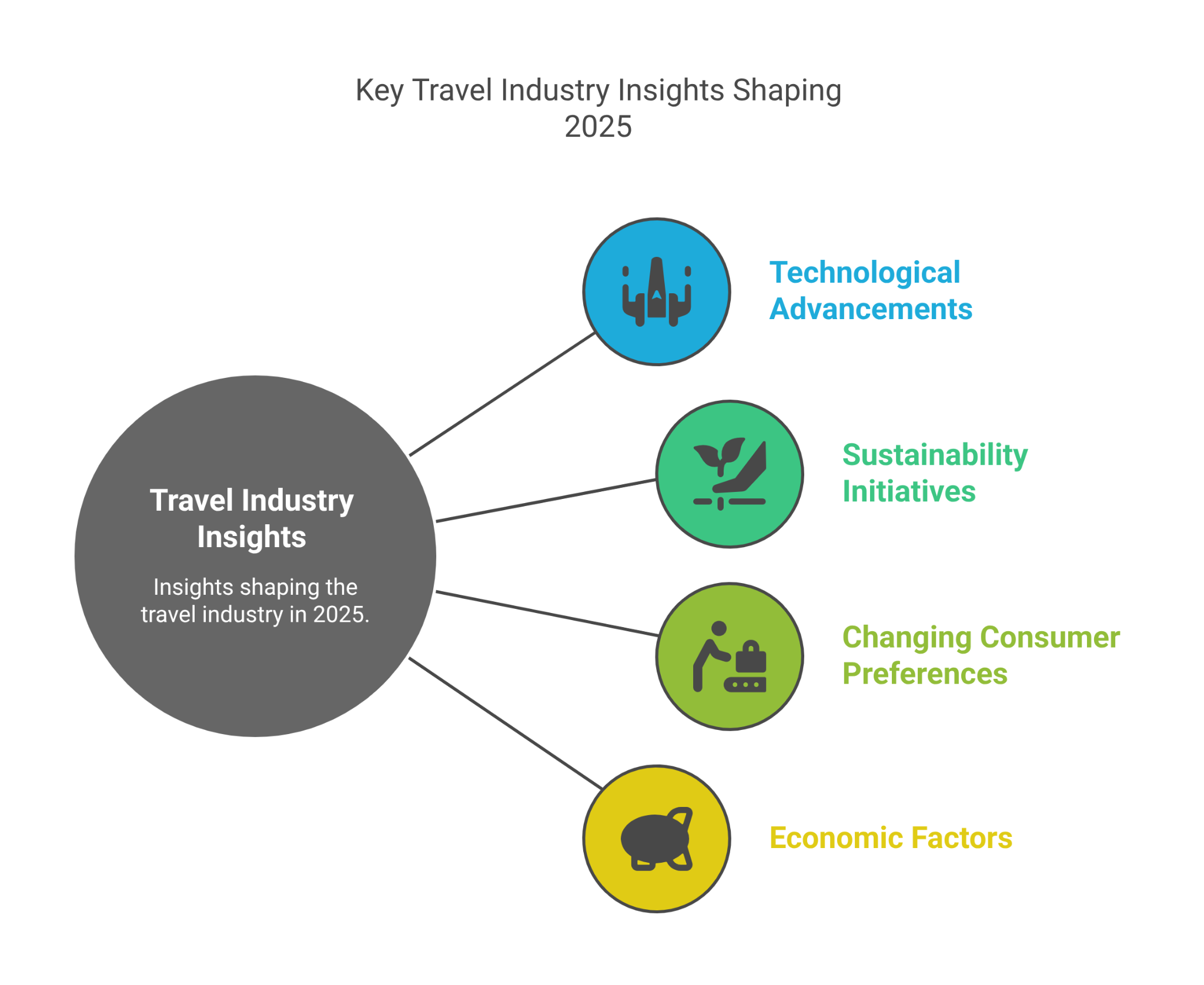
Key Travel Industry Insights Shaping 2025
There are several key insights that can shape the future of the travel industry:
Mobile-First Approach
The rise of mobile devices has changed how people plan and book travel. Mobile apps and websites that offer seamless, fast, and easy-to-use booking processes will continue to grow in importance.
Nature-Based Travel
Nature-based tourism, such as visits to national parks, beaches, and mountains, will continue to rise in popularity. Travelers are seeking outdoor experiences and are becoming more interested in eco-friendly destinations.
Experience-Driven Travel
Modern travelers want unique, meaningful experiences. They are looking for travel opportunities that allow them to explore new cultures, try new activities, or enjoy authentic local experiences. This trend will continue to drive demand for specialized tours and off-the-beaten-path destinations.
Challenges Facing the Travel Industry in 2025
The travel industry faces several challenges as it grows. Understanding these challenges can help businesses prepare and adapt to changing conditions. Some of the main challenges include:
Economic Uncertainty
Travel expenses may increase due to inflation, economic uncertainty, and growing expenses. People may be less inclined to spend money on travel if they are worried about their financial situation. To remain competitive, businesses must keep an eye on the economy and modify their pricing policies.
Environmental Concerns
As environmental concerns rise, the tourism sector must devise strategies to lessen its carbon impact. Sustainable travel strategies, such as providing eco-friendly accommodations and utilizing green energy, will be critical in addressing customer demand for responsible tourism.
Cybersecurity
The danger of data breaches and cyberattacks rises as the tourism sector depends more on digital platforms. Businesses will place a high premium on safeguarding client information and making sure reservation systems are safe.
Consumer Behavior Insights for 2025
As we approach 2025, consumer behavior is evolving rapidly, driven by technological advances, shifting priorities, and global events. Understanding these trends is crucial for businesses to stay relevant and effectively meet the needs of their customers. Here are the key consumer behavior insights shaping 2025:
Increased Focus on Sustainability – Consumers are more conscientious about the environmental impact of their purchases and prefer brands that prioritize sustainability.
Personalization Becomes a Standard Expectation – With AI and data analytics, consumers expect highly personalized experiences and offers tailored to their unique preferences and behaviors.
Rise of Conscious Spending – Budget-conscious and value-driven consumers are looking for smarter, long-term spending choices, often opting for quality over quantity.
Health and Wellness Take Center Stage – Consumers are prioritizing mental and physical well-being, seeking products and services that support healthy lifestyles and self-care.
Emphasis on Convenience and Instant Gratification – The demand for convenience is soaring, with consumers opting for fast, easy, and accessible solutions, especially in shopping, delivery, and entertainment.
Shift Towards Remote Work and Hybrid Models – With remote and hybrid work becoming permanent for many, consumers are seeking products and services that cater to home offices and digital lifestyles.
Increased Use of Social Media for Purchasing Decisions – Social commerce is booming as consumers turn to platforms like Instagram and TikTok for recommendations, reviews, and impulse buys.
Growing Preference for Experiential Purchases – Rather than focusing solely on material goods, consumers are investing in unique, experience-based purchases like travel, entertainment, and workshops.
Digital-First Consumer Behavior – Consumers increasingly engage with brands through digital platforms, with mobile apps and e-commerce sites taking precedence over in-store shopping.
Demand for Transparency and Authenticity – Consumers are increasingly expecting brands to be transparent about their practices, values, and the sourcing of products.
Bottom Line
The travel sector is expected to continue growing in 2025 with efficient Travel Industry Strategies. New trends, such as sustainable tourism, wellness travel, and tailored experiences, will fuel demand. However, firms will face hurdles like economic instability, environmental concerns, and cybersecurity dangers.
Businesses may thrive in this rapidly changing market by concentrating on client preferences, harnessing technology, and providing flexible and tailored services. The travel market in 2025 offers great potential for those who can adapt to satisfy the expectations of today’s passengers.
Neha Bawa is the Director of Brand Marketing at Techmagnate. She has worked in Digital Marketing since 2012 and has specialised in content creation. She has earned a Master’s degree in Interactive Communications from Quinnipiac University in Connecticut, U.S.A. Her interests lie in creating great content, docs, and working towards sustainability through biodiversity.
Get the most valuable search related insights about leading brands, trending keywords, search volumes, fastest growing categories, city-level insights and much more!
It has come to our notice that fraudulent job offers are being circulated on the internet through messaging apps like WhatsApp and Telegram, which falsely claim to be from Techmagnate. We take this matter seriously and would like to caution all candidates to be wary of such postings.
Please Note That –
We do not charge any fees/security deposit/payment from candidates, irrespective of the professional experience they hold, for job applications or interviews
Official communication channels include our website and verified social media accounts, primarily LinkedIn.
Kindly double-check the domain name – @techmagnate.com – in the email address
We follow a transparent and ethical approach for hiring/onboarding supported by proper documentation.
Ensure that you only apply through verified channels to avoid being scammed. We also recommend that you exercise caution when sharing personal information or financial details with any job posting or recruitment agencies claiming to represent us.
We want to ensure that potential candidates interested in joining Techmagnate have a safe and positive experience.
If you find that someone that fits the description above has reached out to you, please notify us immediately at jobs@techmagnate.com.
 Important Alert:
 Important Alert:


















 6th Feb | Invite-only


