Beware of fake job offers and payment requests. We only use official email IDs and never conduct interviews on messaging apps.Beware of fake job offers and payment requests. We only use official email IDs and never conduct interviews on messaging apps.
Summary: This 2026 guide to Search Engine Marketing (SEM) has all the information businesses need to get more people to see their websites and make purchases. Find out what SEM is, how it works, and the most important sites, such as Google, Bing, and Yahoo. Find out about SEM strategies like keyword research, making ads, targeting, optimising landing pages, and A/B testing. Learn the most important SEM and PPC terms, keep an eye on performance with key metrics and KPIs, and follow best practices to get the most out of your investment, draw in users with high intent, and stay ahead of the competition.
Did you know that a whopping 63% of search engine users click on a paid advertisement on Google?
This means you have a 63% chance of getting your content noticed by your target audience over the Google search engine platform. All because you happened to have, your ads displayed to the right people at the right time through search engine marketing
Such advertisements come under the umbrella term of Search Engine Marketing or SEM. If you don’t know what SEM is or want to know how it can help your business. SEM, or search engine marketing, is one of the most successful tools to expand your business and attract new clients.
While organic techniques are important for attracting visitors in the long run, you can’t always compete on the SERPs without putting money behind it – and that’s where SEM comes in. Coupling this with remarketing and retargeting ensures that potential customers who visited your site but didn’t convert get another chance to engage with your business.
In this blog, we will cover the A to Z of SEM, tell you what it is, and how search engine marketing works, talk about some common terms you should be familiar with, illustrate how SEM can benefit your business, and offer tips you can follow to run a successful SEM campaign. Let’s begin.
Table of Contents
What is Search Engine Marketing?
Source: abstraktmg
Search Engine Marketing (SEM) is a digital marketing technique that involves promoting websites through paid advertising in search engine results pages (SERPs). By working with search engine marketing strategies, businesses can attract high-intent users, drive website traffic, and generate measurable leads and conversions.
Keyword bidding, in which companies compete to rank their advertising for particular target keywords, is the foundation of SEM. The company’s ads appear at the top or bottom of the search engine results pages (SERPs) when consumers search for these terms.
What makes SEM a unique and highly powerful digital marketing tactic is the quick visibility a company attracts from search engines. Moreover, the company simply has to pay for each click. This is why search engine marketing is also infamously known as Pay Per Click Advertising (PPC).
Modern SEM also considers factors like ad relevance, landing page experience, and audience targeting. These are evaluated by search engines like Google, Bing, and Yahoo to determine ad ranking, cost-per-click, and overall campaign performance. Implementing a strong search engine marketing plan with best practices ensures maximum ROI and a competitive edge in 2026 digital landscape.
Discover What Your Customers Search ForDiscover What Your Customers Search For
Get insights on evolving customer behaviour, high volume keywords, search trends, and more.
How SEM Works: Bids, Ad Auctions, and Quality Scores
Search Engine Marketing (SEM) uses a system of ad auctions, bids, and quality scores that change all the time to decide which ads show up on search engine results pages (SERPs). To make a good search engine marketing plan, you need to know how these parts work together.
Ad Bids
When someone searches, search engines like Google or Bing hold an ad auction to decide which ads to show. Advertisers try to get their ads in front of people by targeting certain keywords. The auction takes into account more than just the bid amount; it also looks at how relevant and good the ad is. This makes sure that users see ads that are most likely to meet their needs.
Bids
A bid is the most an advertiser is willing to pay for a click on their ad. This is also called cost-per-click (CPC). You can set specific bids for each keyword by hand, or you can let platforms automatically optimize bids based on how well they do and what your campaign goals are. Smart bidding helps businesses get the most out of their investments while staying visible in markets with a lot of competition.
Quality Score
Search engines use Quality Score to see how relevant and useful an ad is. It looks at things like the click-through rate (CTR), how relevant the ad is, and how good the landing page is. A higher Quality Score not only helps your ads show up more often, but it can also lower your CPC, which means you pay less for better visibility.
Businesses can get the most out of their search engine marketing campaigns, get high-intent traffic, and see measurable conversions by properly managing ad auctions, bids, and quality scores. Using SEM tools, reports, and ongoing optimization will help you stay successful in the competitive digital world of 2026.
Major Platforms for Search Engine Marketing:
An SEM platform is a search engine where you can place advertisements. Your ads appear to a user when they perform a search. Here are the two most common platforms for search engine marketing:
Google
Google is the biggest and most widely used platform for search engine marketing. The search engine gets billions of searches every day, making it a potent platform for displaying your ads and targeting the right audience.
Bing
Another platform that you can use for SEM is Bing. When you invest in SEM with Bing ads, they display your ads on partner sites like Yahoo and MSN, thus helping you connect with users who do not use Google for their search queries.
Key component of search engine marketing
Creating a successful search engine marketing strategy requires understanding the core components of SEM. In 2025, SEM broadly consists of five critical elements:
Search engine optimization
Keyword research: Identifying relevant and high-performing keywords that potential customers might use when searching for products or services.
On-Page optimization: Optimizing various elements on the website, such as meta tags, headings, and content, to align with targeted keywords and improve search engine rankings.
Content development: Developing high-quality, relevant, and engaging content that not only satisfies user intent but also helps improve search rankings.
Link building: Acquiring high-quality backlinks from reputable websites enhances the website’s authority and trustworthiness in the eyes of search engines.
Paid advertising (Pay-per-click – PPC)
Keyword bidding: Advertisers use keyword bidding to bid on particular terms related to their company. The bid amount, together with other variables such as ad relevancy and quality, influences the position of the ad in the search results.
Ad creation: Creating appealing and relevant advertising with appealing headlines, ad content, and call-to-action (CTA) features.
Ad extension: Adding more information to ads such as site URLs, geographical information, phone numbers, and more to give users more context.
Targeting and placement: Refining audience targeting based on demographics, location, device, and other criteria. Advertisements may show not just in search results, but also on other platforms in the search engine’s advertising network.
Analytics and monitoring
Performance tracking: Monitoring the performance of both organic and paid efforts via tools such as Google Analytics.
Conversion tracking: Setting up and tracking particular activities that users do on the website, such as form submissions or product sales, in order to assess campaign effectiveness.
Data analysis: Analyzing performance data in order to make educated judgments regarding keyword strategy, ad expenditure, and overall campaign optimization.
Landing page optimization
User experience: Ensure that the landing pages that consumers encounter after clicking on an ad are relevant, easy to browse, and conversion-optimized.
A/B testing: Experiment with various components on landing pages (for example, headlines, graphics, and forms) to find the most successful combination for attaining desired results.
Conversion optimization: Seamless landing pages reduce bounce rates and improve quality scores in SEM campaigns.
Landing page experience is critical in SEM, as it directly impacts how users engage with your ads and convert. Ensuring a smooth landing page experience can lead to higher conversions and lower bounce rates, optimizing your SEM efforts for better results.
Mobile optimization
Responsive design: Ensure that websites and landing pages are optimized for multiple devices, particularly mobile devices, as a large share of internet consumers access material via smartphones and tablets.
Fast Loading Speed: Optimize images, scripts, and server response times to improve user experience and reduce bounce rates.
Mobile Ad Optimization: Design ad creatives and formats specifically for mobile users to maximize engagement and conversions.
Common SEM and PPC terms
Search Engine Marketing is a diverse topic. If you’re interested to know more about it, here are some terms that you should be familiar with:
Impressions
In the SEM world, impression refers to the number of times your ad appears on a search result. It does not consider the number of times people saw your advertisement or clicked on it.
CTR (click-through rate)
The CTR refers to the number of clicks you get to your website from people who saw your advertisement. It is a metric of assessment for keyword & ad performance. Formula:
CTR (%)=Number of clicks/Number of impressions×100
Here’s a breakdown of the components of the formula:
Number of clicks: The total count of clicks on a specific link or advertisement.
Number of impressions: The total number of times the link or advertisement was displayed or viewed.
Multiply by 100: This step is to express the ratio as a percentage.
Cost Per Click (CPC)
Of the many people who see your advertisement appear on their screen, only some would actually click on it. When a company engages in SEM, they pay for the number of clicks they get on their ad. Hence, the term ‘cost per click’. Before setting your campaign, your in-house marketing team can adjust this cost to moderate how much money goes into the campaign. You can control the cost by setting a budget limit and selecting your target groups.
Conversion goal
Every ad you run through an SEM or PPC campaign will have a conversion goal. In simple terms, it refers to a desired action that a person takes after clicking your ad. Be it a business inquiry, email subscription, or sales – the conversion goal can be different for different businesses that engage in PPC advertising.
The term “conversion” implies that a visitor has completed a desired action, transitioning from being a potential customer to an engaged one. Conversion goals are crucial in assessing the success of a website or digital marketing campaign.
Cost Per Acquisition (CPA)
When you divide your ad campaign’s total cost by the number of conversions you receive, you get the cost per acquisition. CPA is calculated by dividing the total cost of a campaign by the number of conversions it generates. Formula:
CPA=Number of conversions/Total campaign cost
Here’s a breakdown of the components:
Total cost of campaign: This includes all expenses associated with a marketing campaign, such as advertising costs, agency fees, design costs, and any other relevant expenditures.
Number of conversions: This represents the total number of desired actions taken by users as a result of the campaign. Conversions could be purchases, sign-ups, form submissions, or any other predefined goal.
Bid
In SEM, a ‘bid’ refers to the maximum amount you are willing to pay per click on your ad. Marketers generally outbid their competitors to ensure that the search engine prioritizes their PPC ad over theirs.
If you set your bid at INR 10/click, the search engine cannot charge you more than this amount for each click. In most cases, your CPC might even be lower than your ad bid.
Tracking and performance reporting: This simply refers to tracking your advertisement’s performance and making adjustments to meet your conversion goals at a minimum CPA.
Quality Score
Quality Score is Google’s measure of your ad relevance, expected CTR, and landing page experience. Higher scores can lower CPC and improve ad placement.
Benefits of search engine marketing
Source: businessmodulehub
We live in the digital age where almost every business enjoys an online presence. This means that to make your online presence a success and outrank competitors, you need to stand out.
While SEO has proven to be a time-tested tactic for attracting website visibility, it takes too long to get tangible results from this digital marketing practice. For companies that want instant results,
SEO might not be a practical solution. This is where SEM proves to be extremely handy.
Listed below are the top benefits of Search Engine Marketing:
Outranks high DA Websites
Search Engine Marketing (SEM) helps you outrank high DA websites that have been trending on the first page of search engines.
DA refers to domain authority. It is the score that you get for sustained SEO performance over time. It considers factors like content quality, SEO friendliness, page loading speed, link-building initiatives, etc.
Websites with a higher domain authority rank faster than those with low domain authority. For example, you might have noticed that established websites like Hubspot, Neil Patel’s blog, Search Engine Land, and Ahrefs always feature on the top spots for marketing queries.
They are able to guarantee these top spots because of their years of hard work and SEO perfection. Even if your content is better than those published by these websites, you won’t be able to outrank them in search engines automatically.
With SEM, this trouble gets resolved for good. You can easily outrank these websites and scale your website’s visibility with one PPC campaign.
Helps target potential customers
With search advertising, a company can quickly target website visitors and turn them into potential customers for their products or business services.
For example, people searching for the ‘best patisserie in New York’ are doing so because they want to visit the best patisserie in this city. Ranking for this keyword with SEO can take months and years, but you can instantly appear on top of SERPs for this search query with SEM. All you have to do is bid on the right keyword and launch your SEM campaign to see the magic unfold.
Allows non-intrusive targeted advertising
Thirdly, unlike social media advertising which has a more intrusive advertising nature, advertising with SEM would help you market to a niche audience that is ready to make a purchase.
SEM marketing helps you target people who are in some stage of their buyer’s journey. It makes you visible to users who are explicitly looking for the products & services you specialize in.
Thus, SEM is conversion-friendly. Its importance lies in helping you get one step closer to your conversion goals
Affordable and cost-effective
Another benefit of investing in SEM is the affordability that comes with it. You can set your ad budget to as limited as $10 a day.
The beauty of SEM marketing lies in its CPC model. You only have to pay when someone clicks on your ad. Whether you want to post an advertisement on Google or Bing, your ads won’t cost you anything unless someone clicks on them.
If your PPC ad does not convert quickly or has a low conversion rate, you can go to your campaign account and make adjustments.
On the contrary, a traditional TV commercial Ad cannot be changed or tweaked as quickly or easily. You can’t pull back a TV commercial once it has gone live. Print advertisements are also hard to redact once you have made the payment, and they are already printed and circulated.
Scope for targeted marketing
Targeted marketing is one of the many reasons we advocate the use of SEM for your marketing strategy. Not only does SEM help you capture the attention of users who are potentially looking to buy your niche products and services, but it also helps you make your ads as targeted as you want.
From choosing the time for displaying your advertisements to helping you target people from a specific location, gender, and age category – you have an ocean of options you can explore with SEM.
Flexibility and customization
Advertisers have the flexibility to create and modify ad campaigns quickly. This includes adjusting ad copy, changing targeting parameters, and testing different strategies to see what works best.
Brand awareness
Even if users don’t click on your ads, the visibility of your brand in search results can contribute to increased brand awareness. Users may become familiar with your brand even if they don’t convert immediately.
Improved ROI
Improved ROI: By monitoring performance metrics and optimizing campaigns based on data, businesses can maximize their ROI. This involves allocating the budget to the most effective keywords and strategies. To evaluate the financial success of your campaigns effectively, use the PPC ROI Calculator.
Adaptability to market changes
SEM allows businesses to quickly adapt to changes in the market, industry trends, or shifts in customer behavior. Campaigns can be adjusted in real-time to reflect these changes.
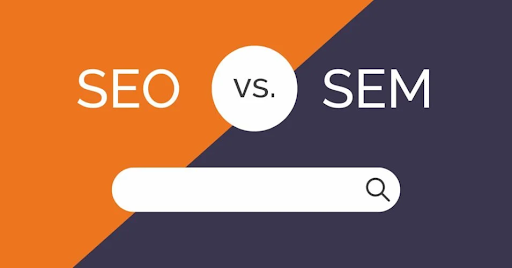
What is the difference between SEO and SEM?
Source: zerogravitymarketing
Are you curious to know how SEM is different from SEO and vice versa? If the answer is yes, read on. Here are some critical differences between SEO and Search Engine Marketing:
Difference #1: SEM is paid, and SEO is organic
SEM Search Engine Marketing & optimization or SEM Marketing refers to the process of attracting website visibility and scaling traffic through paid means. On the contrary, SEO short form of Search Engine Optimization is a process that achieves the same goals through organic means. So the first difference between SEM and SEO is the involvement of monetary investment.
When one engages in SEM, they have to invest money to get website traffic.
When one participates in SEO, they can get website traffic without investing money.
Difference #2: SEM attracts instant traffic while SEO takes time
SEM offers immediate exposure. As soon as campaigns launch, ads show up on the first page, drawing in visitors who are actively looking for your goods or services. SEO requires time. Consistent content production, on-page optimization, backlink development, and technical advancements are necessary for high organic rankings; results are frequently not noticeable for months or years.
Difference #3: SEO & SEM focus on different conversion goals
SEO prioritizes sustained expansion. It progressively turns visitors into clients, increases domain authority, and draws steady traffic. SEM emphasizes immediate conversions. Campaigns are intended to produce quantifiable outcomes in real time, like as leads, purchases, or other targeted activities, rapidly.
Difference #4: Cost and flexibility
Through CPC bidding, targeting, and real-time campaign management, SEM provides exact control over ad expenditure. SEO requires ongoing investment in content, technical improvements, and link-building, with returns realized gradually over time.
Difference #5: Best strategy
The best course of action is a combined approach. The optimal digital marketing plan for 2026 makes use of SEM for short-term gains and SEO for long-term success. By maximizing traffic, conversions, and return on investment, they guarantee both short-term and long-term success. Companies can work with seasoned SEM and SEO service providers or implement these tactics internally.modifications. Continuous investment in link-building, technical advancements, and content is necessary for SEO, with results being seen gradually over time.
We recommend that you implement SEM in your marketing practices to ensure that your immediate goals are quickly met. Choosing one over the other does not make sense from a business perspective.
Implement both practices to reap the benefits of SEO and SEM. You can execute these content marketing practices in-house or hire the SEM and SEO Services of a reputed marketing agency to meet your conversion goals.
Tips for an effective SEM strategy
Source: 4hk
Do you want to run a successful SEM campaign and meet your conversion goals sooner? Do you want to reduce the cost per click for your PPC campaigns but don’t know how? If the answer is yes, read on.
We have put together a list of search engine marketing best practices to help you run a successful SEM campaign.
Examples of SEM goals include:
Increasing website traffic by 30% in 3 months
Generating 100 qualified leads per month
Driving sales for a seasonal product launch
Clear objectives also help in measuring campaign success, optimizing ads, and justifying marketing spend to stakeholders. Without defined goals, your SEM campaign can become unfocused and inefficient.
Set clear goals
Define specific, measurable, and realistic goals for your SEM campaigns. Whether it’s increasing website traffic, generating leads, or driving sales, having clear objectives will guide your strategy.
Identify your target audience
Investing in SEM ad campaigns means reaching out into your company’s marketing budget. You need results. You need to make smart investments. Knowing how to run a PPC campaign is not enough. You need to know who your target audience is.
Knowing who to advertise to will increase the likelihood of campaign success as it will help you understand your prospective buyer’s psyche. This understanding puts you at an advantage as you can tailor your ads to match your buyer’s needs.
Perform keyword research
Keyword research is the foundation of SEM. Choosing the right keywords ensures your ads are shown to users with high purchase intent.
Steps for effective keyword research:
Identify short-tail and long-tail keywords relevant to your product/service
Use tools like Google Keyword Planner, SEMrush, Ahrefs, or Moz to analyze search volume and competition
Group keywords based on user intent: transactional, informational, or navigational
Regularly review and refine keywords to capture trends and changing search behavior
Example: For an e-commerce website selling shoes, target long-tail keywords like “buy women’s leather sneakers online” instead of just “shoes” to attract a more qualified audience.
Relevant and compelling ad copies
To ensure that your SEM ads are impactful and your CTR is high, people should want to click on your advertisements. Here are some tips that can help you make a compelling ad copy:
Write catchy ads that satisfy the user’s search intent.
Use the keyword in the ad copy for search engine effectiveness.
Avoid long copies to ensure ad copy success. Be concise
Description: “Shop the latest collection of durable, stylish sneakers. Limited stock – order now!”
Well-written ad copy aligns with search intent and improves quality score, lowering CPC while increasing conversions.
Conversion-friendly landing page
When you make a compelling ad copy, the user clicks on your ads. Perfect. Now what? What happens next is the user gets directed to your landing page. This is where the real action happens.
As such, you need to perfect your landing page to the best of your ability. Here’s what you can do to make a high-conversion landing page:
Do not add more information than you need to.
Your landing page should swiftly communicate the desired message.
Communicate the benefits of your product or service listings effectively.
Have a clear CTA (call to action), so your users know what action to take.
Give a freebie. Whether it is an eBook or other relevant resources, being generous always helps.
Display pop-ups to leads that make it to the end of your landing page. Doing so will ensure that you don’t lose out on potential customers because of ill-timed and frequent pop-up displays.
Set your price bids
Now that you know how to make compelling ad copies, and landing pages, and know which keywords to target, all that’s left now is to make your price bids for your chosen keywords.
While making PPC keyword bids, you should focus on targeting those bids that meet your marketing budget, not exceed it.
Pro tip: Choose moderately competitive keywords that help you target your niche audience. They tend to be more budget-friendly than those keywords with too much competition.
Launch targeted ads
After making your price big, create highly targeted ads for more sophisticated and targeted results.
Setting relevant parameters to optimize your ad campaign is called Ad targeting. Also known as SEM and PPC Ad targeting, you can use it to tell the search engine who to show your ads to and what time to display your ads to your chosen audience.
Here are the four types of ad targeting you can do:
1. Location targeting
You can choose the country, city, locality, to a particular zip code you want to target for your ads. This is highly powerful for a business that is targeting customers in their immediate geolocation. For example, a cafe in south Delhi would get more inquiries and table reservations if the ad is shown to people who live in the south Delhi region.
2. Ad schedule targeting
If you have an excellent idea of your target audience and know when they’re likely to go online, ad schedule targeting can come in handy. Using it, you can display your ad to people only on specific days a week or even particular hours a day!
3. Demographic targeting
A cosmetic company’s target audience mainly consists of women. Similarly, a bike retailer will primarily target men. If you have a product or service that caters to a niche audience, demographic targeting is the tool for you. Using it, you can adjust your ads and display them to distinct demographic categories based on age and gender.
4. Device targeting
Many businesses are making mobile-first websites and e-commerce stores because people tend to browse and shop more using their mobile devices. Using device targeting, you can tweak your ads and show them to users on specific devices such as desktops, tablets, and mobile phones.
5. Behavioral targeting
Behavioral targeting is a strategy that allows you to show ads to users based on their previous behavior online. In the context of SEM, this usually means tracking users who have visited your website, interacted with your content, or abandoned a shopping cart, and then displaying targeted ads to them later to encourage them to convert.
Run A/B Tests before the SEM campaign launch
A/B testing your landing pages before launching your campaign is a great way to ensure conversions. Make 2 or 3 landing pages and show them to different ad groups on platforms like Facebook and other social media channels before running your PPC ads.
Track their response. Ask questions. See what type of audience best responds to your landing page. Ask them which of the two landing pages they prefer. Or what changes you can make to them.
Based on the responses you get from different groups, you can redo your landing page or use the one that performs well. Once you’re confident that everything is perfect, launch your PPC campaign.
Track campaign performance
After the last step, it is time to launch your ads. You can see results in a month or two. Track the progress after at least a month of running your PPC ad campaign. If your ads are not performing well, identify the problem areas and rectify the situation.
Here are some of the problems you might encounter:
If the CTR is low, it means that you are either targeting the wrong keywords or the wrong audience or that your ads are just not click-worthy enough.
If the CTR is high, but your conversion rate is low, it means that your landing page is probably not performing well. Add CTAs if you haven’t. Revamp your landing page if needed. Trim down the content if it is too long. Then run the tests all over again.
Let’s say that you are meeting your conversion goals, but you are spending way too much on your ad bids; it might be time to review your keyword bids, make bid adjustments, or perhaps target less competitive keywords that cost less.
The idea is to improve your PPC ads as much as you can. The closest you can get to perfection is when you know when to change your strategy when the occasion presents itself.
Improve your quality score
With a high-quality score, your CPC reduces. So optimizing your SEM campaigns has twin benefits: 1) helping you meet your conversion goals and 2) keeping your cost per click low. The performance of your ads in these critical areas decides your quality score:
1. Keyword relevance
When your ad appears for a certain keyword but people don’t click on your ad, the search engine takes it as a sign that your ad is not relevant to your target keyword. As a result, your quality score goes down. To remedy this, ensure that you are targeting relevant keywords for your SEM or PPC campaign.
2. Click-Through Rate (CTR)
The percentage of impressions that result in a click is called a click-through rate. The better your CTR, the better your quality score.
3. Quality of landing page
Google uses metrics like the number of conversions you get after someone clicks on your ad to determine your quality score. If people are clicking on your ads but not taking the call to action (CTA) or are leaving your website instantly, it means that the website was probably misleading or people did not have a good user experience.
When this happens, your quality score goes down. So make sure that your landing page is a continuation of your advertisements. Do not write something irrelevant on your landing page. Keep it strictly relevant and concise for maximum effectiveness and a higher quality score.
4. Ad text relevance
Is your ad text relevant to the user’s search query? Does it satisfy the user’s search intent? If it does, then your quality score goes up. If it doesn’t, your quality score goes down. So make sure that your ad text is relevant.
5. Historical performance
Search engines look at how your ads perform over time. So before you track your ad performance, make sure that you have run your campaign for at least one month before you make tweaks and adjustments to your PPC ad campaigns.
Avoid negative keywords
Negative keywords are irrelevant search terms that you should strictly exclude from your PPC campaigns because they are less likely to result in conversions. They are semantically similar to your keywords but are unrelated to your target keyword’s search intent, ad copy, and ad campaign.
For example, if you’re strictly selling leather shoes for women, you might want to exclude the keywords ‘men leather shoes’ or ‘leather shoes for men’ from your ad campaign. Why? Because users searching for men’s leather shoes are unlikely to buy your product.
In this scenario, these keywords are negative keywords. Avoid using them in your Ad campaigns.
For better results, avoid targeting a generic keyword like ‘leather shoes’. Bidding on a generic keyword like ‘leather shoes’ can make your ads visible to men looking for leather shoes online, resulting in a negative quality score for showcasing irrelevant ads. Instead, target highly relevant and niche keywords like ‘leather shoes for women.’
To reduce the chances of appearing in irrelevant searches, review your campaign thoroughly and remove those keywords that attract the wrong type of traffic. Mark low-performing or irrelevant search terms as negative keywords in your campaign account.
Measuring SEM Success: Key Metrics & KPIs
To ensure your search engine marketing (SEM) campaigns are effective, it’s essential to track the right metrics and key performance indicators (KPIs). Measuring SEM success helps you identify what’s working, optimize campaigns in real-time, and maximize ROI. Here are the most important SEM metrics to monitor in 2025:
1. Click-Through Rate (CTR):
CTR calculates the proportion of users who view your advertisement and then click on it. A higher CTR shows that your audience is responding favourably to your targeting, keywords, and ad language.
2. Cost Per Click (CPC):
CPC is the price you pay for each ad click. By optimising CPC, you can make sure that your SEM campaigns continue to reach your target audience at a reasonable cost.
3. Conversion Rate (CVR):
CVR calculates the proportion of consumers who click on your advertisement and go on to complete a desired activity, such buying something, subscribing to a newsletter, or filling out a form. Your landing pages and ad messaging are successfully converting traffic if your CVR is high.
4. Cost Per Acquisition (CPA):
CPA determines how much it costs to bring on a new client or lead. You may optimise ad expenditure to concentrate on campaigns that provide the most conversions at the lowest cost by keeping an eye on CPA.
5. Quality Score:
Relevance, CTR, landing page experience, and past performance are the factors that search engines like Google use to determine your advertising’ Quality Score. Campaign efficiency is increased with a higher Quality Score since it lowers CPC and enhances ad placement.
6. Impressions & Ad Reach:
Monitor the number of unique users reached and the impressions (the number of times your ads are displayed). You may better grasp the scope and visibility of your SEM efforts with the aid of these metrics.
7. Return on Ad Spend (ROAS):
ROAS measures the revenue generated for every dollar spent on SEM. This KPI is critical for evaluating overall campaign profitability. The income gained for each dollar spent on SEM is measured by the Return on Ad Spend (ROAS). When assessing the total profitability of a campaign, this KPI is essential.
8. Bounce Rate:
The bounce rate measures the percentage of users who leave your landing page without interacting. A high bounce rate signals potential issues with landing page relevance or user experience.
9. Engagement Metrics:
Track metrics such as time on site, pages per session, and repeat visits to gauge how effectively your SEM campaigns attract and engage users.
10. Impression Share:
This indicates the percentage of total available impressions your ads receive compared to competitors. Low impression share suggests opportunities to improve bidding, targeting, or ad quality.
Conclusion
In this blog, we have tried to answer questions like what is SEM and how it works, what is SEM in marketing, and what is SEM in digital marketing to the best of our knowledge. We believe that SEM is a powerful tool when used effectively, which is why it is important to be open to rework and update your existing strategies to make the most of SEM marketing.
With an effective SEM strategy, you can grow your business and meet your conversion goals faster than conventional marketing allows. Follow the tips that we have mentioned in this blog to leverage SEM to your best advantage.
If you want to outsource it to a company with proven experience in delivering successful SEM campaigns, please contact us. We have been rated the 7th Best Integrated Search Marketing (SEO & PPC) Company in India. Read our case studies to learn about our digital marketing achievements.
Besides SEM, as a leading digital marketing company in India, we have covered your back with complete digital marketing services like SEO, online reputation management, website designing, and social media marketing, and more.
Frequently Asked Questions
What is SEM, and how does it differ from SEO?
In order to improve exposure in search results, Search Engine Marketing (SEM) uses paid advertising on search engines such as Google. This covers tactics such as Pay-Per-Click (PPC) marketing.
Optimising your website to appear higher in organic (non-paid) search results is the main goal of search engine optimisation, or SEO.
SEM offers instant visibility and is frequently used for targeted marketing, whereas SEO is a long-term approach.
How can I identify the right keywords for my SEM campaign?
Start by using keyword research tools such as Google Keyword Planner, SEMrush, or Ahrefs to discover relevant keywords with substantial search volume and manageable competition. Incorporate both broad and long-tail keywords to capture a wider audience and address specific search intents.
What is Quality Score in Google Ads, and why is it important?
Quality Score is a metric used by Google Ads to determine the relevance and quality of your ads, keywords, and landing pages. It affects your ad position and cost-per-click (CPC).
A higher Quality Score can lead to lower CPC and better ad placements, improving the overall efficiency of your SEM campaign.
How do I measure the success of my SEM campaign?
The following are some key performance indicators (KPIs) to keep an eye on:
The percentage of users who click on your advertisement after seeing it is known as the click-through rate, or CTR.
The percentage of clicks that lead to a desired action (such as a purchase or sign-up) is known as the conversion rate.
Cost Per Acquisition (CPA): The price paid to bring on a new client.
Revenue produced for each dollar spent on advertisements is known as return on ad spend, or ROAS.
Analysing these metrics on a regular basis aids in campaign optimisation for improved results.
What is behavioral targeting, and how can it improve my SEM campaign?
Retargeting individuals who have already interacted with your website but did not convert is known as behavioural targeting. You can boost conversion rates by showing these users customised advertisements.
For example, displaying an advertisement for a product or a related offer to a user who has viewed it but not yet made a purchase can persuade them to do so.
How can I optimize my SEM campaign for mobile users?
Ensure your ads and landing pages are mobile-friendly. Use responsive ad formats and design landing pages that load quickly and are easy to navigate on mobile devices.
Additionally, consider using device targeting to tailor your ads specifically for mobile users, enhancing user experience and potential conversions.
What are negative keywords, and why should I use them?
In order to keep your advertisements from appearing for irrelevant searches, you should eliminate negative keywords from your SEM campaigns.
To prevent drawing in customers who are unlikely to convert, you may, for instance, omit phrases like “cheap leather shoes” if you sell high-end leather shoes.
How does ad scheduling work in SEM?
Ad scheduling allows you to display your ads at specific times or days when your target audience is most active.
For example, if your analytics show that your audience is more active in the evenings, you can schedule your ads to run during those hours to maximize engagement and conversions.
What is the role of landing pages in SEM success?
A well-designed landing page is crucial for converting visitors into customers.
Ensure your landing page aligns with your ad’s message, loads quickly, and includes a clear call-to-action (CTA). A seamless user experience on the landing page can significantly improve your conversion rates.
How can I leverage the 'People Also Ask' (PAA) feature in SEM?
You can get more traffic by using the People Also Ask feature, which shows relevant queries in search results.
Use this to your advantage by identifying frequently asked questions about your company and including succinct responses in your content. You may improve your site’s exposure in search results and get more visitors by optimising for these queries.
Sarvesh Bagla is an enterprise SEO expert and industry leader who has driven transformational digital growth for India’s top brands across the BFSI, Healthcare, Automotive, and ECommerce industries. As the Founder and CEO of Techmagnate, he leads large-scale organic search strategies and performance marketing campaigns for businesses looking to succeed in today’s AI-driven search landscape.
A strong advocate for thought leadership, Sarvesh is deeply involved in SEO evangelism and regularly contributes to industry discussions through LinkedIn, webinars, and CMO roundtables. His focus today is on helping brands prepare for an AI-first SEO future (AEO, GEO) and strategies for Large Language Models (LLMs) at the core.
Get the most valuable search related insights about leading brands, trending keywords, search volumes, fastest growing categories, city-level insights and much more!
It has come to our notice that fraudulent job offers are being circulated on the internet through messaging apps like WhatsApp and Telegram, which falsely claim to be from Techmagnate. We take this matter seriously and would like to caution all candidates to be wary of such postings.
Please Note That –
We do not charge any fees/security deposit/payment from candidates, irrespective of the professional experience they hold, for job applications or interviews
Official communication channels include our website and verified social media accounts, primarily LinkedIn.
Kindly double-check the domain name – @techmagnate.com – in the email address
We follow a transparent and ethical approach for hiring/onboarding supported by proper documentation.
Ensure that you only apply through verified channels to avoid being scammed. We also recommend that you exercise caution when sharing personal information or financial details with any job posting or recruitment agencies claiming to represent us.
We want to ensure that potential candidates interested in joining Techmagnate have a safe and positive experience.
If you find that someone that fits the description above has reached out to you, please notify us immediately at jobs@techmagnate.com.
 Important Alert:
 Important Alert: