Beware of fake job offers and payment requests. We only use official email IDs and never conduct interviews on messaging apps.Beware of fake job offers and payment requests. We only use official email IDs and never conduct interviews on messaging apps.
Summary: In FY 2025, India’s hotel industry experienced remarkable growth, with hotel-related searches reaching over 1424 lakh, highlighting increasing consumer interest and evolving online hotel search insights in India. The hotel industry market in India is shifting as Tier 2 and Tier 3 cities emerge as key growth centers, while metros maintain high search volumes. These trends underscore the importance of digital marketing strategies for the hospitality industry in India, offering actionable insights for hotel marketing solutions in India and understanding the hotel industry growth rate in India.
Key Takeaways:-
Total hotel search volume in India reached 1424 lakh in FY 2025.
Top 6 cities accounted for 44.59% of total searches.
The next 10 cities contributed 14.69%, while Tier 3 and emerging cities added 40.72% share.
‘Near Me’ hotel searches saw a 19.71% year-on-year increase.
Brand searches contributed 33.31%, while non-brand searches dominated at 66.69%.
Vernacular searches grew 18.02% year-on-year, indicating rising local language preferences.
India’s hotel industry is experiencing significant growth in 2025, driven by changing consumer behavior and the rise of digital platforms as the primary channel for discovery and bookings. Techmagnate’s latest Hotel Industry Trends report provides deep insights into the growth of the hotel industry in India, online hotel search trends, and the evolving hospitality industry trends 2025 India. Key drivers include non-brand discovery, vernacular search growth, hyper-local queries, and emerging patterns in the hotel industry market in India, highlighting opportunities for effective hotel digital marketing trends and strategic hotel marketing solutions in India.
Table of Contents
Overall Growth in Hotel and Resort Searches in India
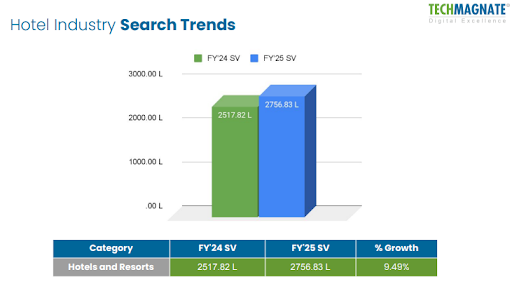
In FY 2025, hotel-related searches in India reached 2756.8 lakh, reflecting the strong expansion of the hotel industry in India. While metros continue to contribute a significant share of total search volume, the most dynamic growth is now clearly shifting toward Tier 2 and Tier 3 cities.
Top 6 metros: contributed 44.59% of total hotel search volume
Next 10 cities: contributed 14.32%
Tier 3 and emerging cities: accounted for 40.72% the fastest-growing segment
This regional surge highlights not only broader travel aspirations but also a fundamental shift in how travelers discover hotels online. Consumers in emerging cities are increasingly adopting detailed, long-tail search behavior, using highly specific queries related to amenities, proximity, seasonal offers, and local events.
Implications for Hotel Brands and Marketers
To capture this growing demand, hotel brands must move beyond generic keywords and implement granular, intent-driven strategies:
Hyper-local keyword targeting Focus on city-level and neighborhood-level searches to capture high-intent traffic.
Content clusters around travel intent Create pages and blogs targeting weekend trips, staycations, destination weddings, and regional festivals.
Schema markup and structured data Enable search engines to display rich property details directly in SERPs, improving visibility and click-through rates.
Mobile-first optimization A significant portion of Tier 2 and Tier 3 search traffic comes from mobile users researching on the go.
Vernacular and discovery-focused SEO Include Hindi and regional keywords as vernacular searches grew by 11.77%, capturing non-brand queries that make up the majority of search volume.
For marketers, these hotel industry trends in India 2025 demand a strategic, localized, and digital-first SEO approach. By targeting hyper-local intent, optimizing for mobile and vernacular queries, and leveraging rich content formats, hotels can attract highly qualified traffic across diverse cities and travel motivations.
Discover What Your Customers Search ForDiscover What Your Customers Search For
Get insights on evolving customer behaviour, high volume keywords, search trends, and more.
Brand vs Non-Brand Hotel Searches: Understanding Consumer Intent
A key insight from the FY 2025 report is how travelers in India discover hotels online. Most searches don’t start with a specific hotel chain in mind; they begin with a need or intent.
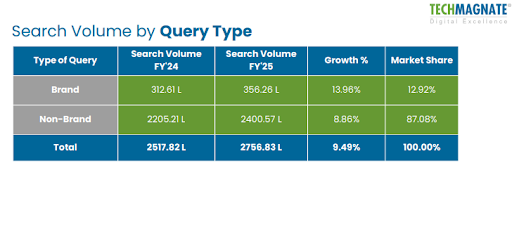
Non-brand searches: 87.08% of total hotel search volume
Brand searches: 12.92%
In practical terms, nearly nine out of ten searches are generic, with travelers querying terms like “budget hotels near me,” “boutique resorts in Jaipur,” or “hotels with spa in Udaipur.” Their focus is on price, location, amenities, or occasion, rather than a specific brand.
This represents a huge opportunity for hotels. Early visibility in the search journey;through detailed property pages, comparison guides, or rich destination content;can significantly increase the likelihood of being considered.
Notably, while non-brand queries dominate, brand searches are showing a positive growth trend. As travelers gain familiarity with hotel chains;either via past stays or marketing campaigns they increasingly search for brands directly. This demonstrates that consistent visibility, excellent customer experience, and strong brand reputation translate into direct demand over time.
Key takeaway for hotel marketers: Capture traveler attention early during the discovery phase, then build trust and brand recall so that future searches begin with your hotel name already in mind. Optimizing for both non-brand and brand keywords is essential to succeed in the growing India hospitality market.
The Hotel Brands Dominating India’s Search Volumes FY’25
Techmagnate’s Hotel Industry Trends India FY’25 report highlights which hotel brands are successfully capturing online attention in India. These brands are not only widely recognized but also excel at maintaining visibility across Google Search where travelers are actively seeking accommodations.
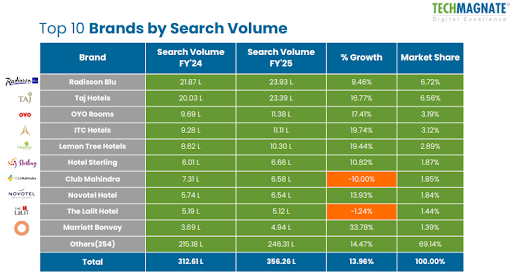
Radisson Blu and Taj Hotels lead the charts, reflecting strong brand visibility and digital presence.
OYO Rooms and ITC Hotels are among the fastest-growing brands, showing high year-over-year growth (~17–20%).
Marriott Bonvoy recorded the highest growth percentage at 33.78%, highlighting the impact of aggressive digital marketing strategies.
Smaller chains like Club Mahindra and The Lalit show negative or minimal growth, emphasizing the need for more robust online visibility.
Cumulative “Others” category contributes 69.14% of search volume, showing that emerging and niche brands collectively drive significant search demand.
Takeaways for Marketers and Emerging Brands
Align content strategy with city-level searches, destination guides, and amenity-focused queries.
Invest in SEO, local listings, and review optimization to capture both branded and non-branded traffic.
Smaller brands can gain visibility by creating localized, informative content targeting hyper-local searches.
Consistency across all search stages;from discovery to booking;remains key for capturing booking intent.
What Travelers Are Searching For: Hotel Segments Driving Growth
1. Overall Trend
The search volume for hotel-related keywords shows significant growth from FY24 to FY25, highlighting a rising interest in hotel bookings online.
2. Top Keywords by Search Volume
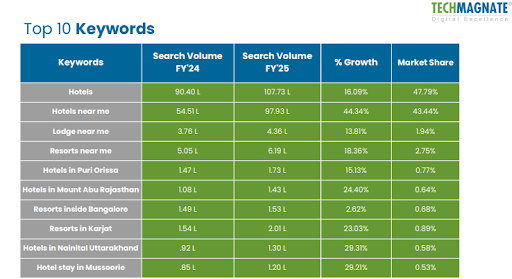
Hotels lead with 107.73 L searches in FY25 (up 16.09%).
Hotels near me show the highest growth at 44.34%, reaching 97.93 L searches.
3. High-Growth Regional Keywords
Hotels in Nainital, Uttarakhand: 29.31% growth.
Hotel stay in Mussoorie: 29.21% growth.
Hotels in Mount Abu, Rajasthan: 24.40% growth.
Resorts in Karjat: 23.03% growth.
4. Low Search Volume, Niche Keywords
Keywords like Hotels in Puri Orissa, Hotels in Mount Abu Rajasthan, and Resorts inside Bangalore have low search volumes (0.5–1.5 L) but still show healthy growth, indicating emerging interest in these destinations.
5. Market Share Insights
Generic keywords like Hotels and Hotels near me dominate the market, with 47.79% and 43.44% share respectively.
Location-specific and niche searches make up less than 2% each, suggesting potential for growth in regional marketing strategies.
6. Key Takeaways for Hotel Brands
Focus on “near me” searches since they’re growing fastest.
Invest in destination-specific content (like Nainital, Mussoorie, Mount Abu) to capture niche traffic.
Maintain visibility for high-volume generic terms to dominate overall market share.
Optimize for local SEO and regional searches to target emerging growth areas.
Vernacular Searches Are Gaining Momentum in Hotel Discovery
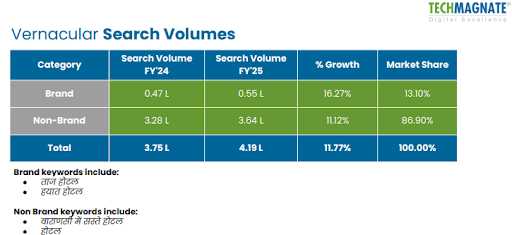
Vernacular hotel searches in India are witnessing steady growth, expanding by 11.77% year-on-year to reach 4.19 lakh searches in FY25. The majority of this demand continues to come from non-branded queries, which account for 86.90% of the market share, highlighting how travelers remain open to exploring new hotels when starting their search journey. Examples include generic terms like होटल or queries such as पासपासी में सबसे होटल.
Interestingly, branded vernacular searches;for keywords such as ताज होटल and हयात होटल- though smaller in share at 13.10%, are growing faster at 16.27% YoY. This signals a rising preference for trusted hospitality names among digital users who are searching in their native languages.
For hotel brands, this presents a dual opportunity: capitalize on the dominance of non-branded searches by creating localized, vernacular content to capture discovery-stage traffic, while also strengthening brand presence through regional language SEO and advertising. As more tier-2 and tier-3 travelers adopt digital platforms, offering native language content and visibility will become a key differentiator in winning bookings.
Vernacular and Hyper-Local Searches Are Changing How Travelers Discover Hotels
The latest search data shows how language preferences and location-based queries are significantly reshaping hotel search behavior in India. Vernacular search queries grew by 18.02 percent year-on-year as more travelers turned to regional languages like Hindi, Tamil, Telugu, and Bengali while researching hotels. For many first-time digital users in Tier 2 and Tier 3 cities, searching in their native language feels more natural, especially when comparing room options, pricing, and availability.
At the same time, hyper-local “Near Me” searches recorded a strong 19.71 percent growth. Travelers are increasingly searching for hotels based on proximity, using highly specific queries such as:
“hotels near airport”
“hotels near railway station”
“resorts near me with swimming pool”
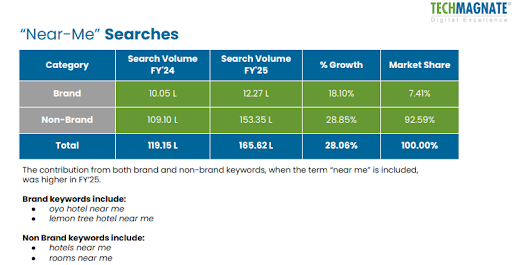
Notably, 81.66% of these Near Me searches were non-branded, further reinforcing how open travelers remain to discovering new hotels when starting their search.
For hotel brands, these shifts mean that traditional marketing approaches are no longer enough. Travelers expect relevant results based on their language and their immediate location. Hotels that offer regional language content, maintain accurate business profiles, and build strong location-level visibility stand a better chance of capturing travelers when they are actively looking to book.
India’s Hotel Industry Is Set for Continued Digital-Led Growth Through 2025
India’s hotel industry is on a steady upward trajectory, propelled by digital bookings, tier-2 and tier-3 demand, and evolving consumer behavior. Here’s how the landscape is shaping up in FY 25:
Expanding reach beyond metros: While major cities saw a decline in search activity (Top 6 cities dropped by 10.7%, Next 10 by 12.5%), emerging and non-metro destinations grew by 18.1%, now accounting for a commanding 69.1% share of total search volume.
“Near Me” searches surging: Location-based searches jumped by 28.06%, led by non-branded queries rising 28.85% (comprising 92.6% of “near me” traffic), while branded variants saw a solid 18.1% uptick.
Vernacular searches gaining ground: Searches in Hindi rose by 11.77%, with brand searches growing 16.27% and non-brand searches growing 11.12%, reaffirming the importance of regional language content.
Event-driven hotel demand rising: Interest in banquets and wedding hall searches surged by 49.46%, indicating strong growth in event and MICE-related hospitality segments.
Brand vs Non-brand dynamics: Branded queries grew faster (13.96%) than non-branded ones, although non-brand still dominates overall search volume.
Conclusion
India’s hotel sector is being reshaped by truly digital-first consumer behavior;and success belongs to those brands who anticipate and adapt. As Techmagnate’s Hotels Industry Trends Report underscores, mastering regional search trends, non-brand discovery, vernacular search, and hyper-local optimization will define the winners in this dynamic landscape.
By integrating learnings from Techmagnate’s PPC case study with a leading hotel chain;such as targeting high-intent paid campaigns, optimizing for brand vs long-tail keywords, and driving ROI-focused ad performance, hotel brands can effectively capture direct bookings and reduce reliance on OTAs.
For broader digital dominance, partnering with Techmagnate’s digital marketing services, which include SEO services, PPC management, content marketing, social media marketing, App Store Optimization, conversion rate optimization, and video & YouTube SEO, enables brands to craft a robust, multi-channel presence.
Hotels that move early and invest in city-level SEO, localized content, vernacular visibility, and optimized paid campaigns will lead the next phase of growth in India’s rapidly evolving travel market.
Frequently Asked Questions
How is digital marketing transforming India’s hotel industry?
Digital marketing is enabling hotels to capture demand earlier in the traveler’s journey through SEO, PPC, localized content, and vernacular optimization;helping brands attract direct bookings and reduce dependency on OTAs.
Why are “near me” searches important for hotel brands?
“Near me” searches grew over 28% YoY, showing travelers now rely on hyper-local queries to book stays. Optimizing for these searches through local SEO and Google Business Profiles ensures higher visibility when intent is strongest.
What role do Tier 2 and Tier 3 cities play in hotel growth?
Tier 2 and 3 cities now drive over two-thirds of hotel search volume, reflecting rising digital adoption, domestic tourism, and demand for weddings, leisure trips, and family vacations beyond metros.
How can hotels benefit from SEO campaigns?
SEO helps hotels achieve sustained visibility on Google search results, capturing both branded and non-branded queries. By optimizing for city-level keywords, “near me” searches, and vernacular queries, hotels can attract high-intent travelers organically, reduce reliance on OTAs, and generate more direct bookings at lower acquisition costs.
Why partner with Techmagnate for hotel digital marketing?
Techmagnate offers end-to-end digital marketing services, SEO, PPC, content, social media, and CRO, designed to help hotels dominate search visibility, attract high-intent travelers, and sustain long-term growth.
Sarvesh Bagla is an enterprise SEO expert and industry leader who has driven transformational digital growth for India’s top brands across the BFSI, Healthcare, Automotive, and ECommerce industries. As the Founder and CEO of Techmagnate, he leads large-scale organic search strategies and performance marketing campaigns for businesses looking to succeed in today’s AI-driven search landscape.
A strong advocate for thought leadership, Sarvesh is deeply involved in SEO evangelism and regularly contributes to industry discussions through LinkedIn, webinars, and CMO roundtables. His focus today is on helping brands prepare for an AI-first SEO future (AEO, GEO) and strategies for Large Language Models (LLMs) at the core.
Get the most valuable search related insights about leading brands, trending keywords, search volumes, fastest growing categories, city-level insights and much more!
It has come to our notice that fraudulent job offers are being circulated on the internet through messaging apps like WhatsApp and Telegram, which falsely claim to be from Techmagnate. We take this matter seriously and would like to caution all candidates to be wary of such postings.
Please Note That –
We do not charge any fees/security deposit/payment from candidates, irrespective of the professional experience they hold, for job applications or interviews
Official communication channels include our website and verified social media accounts, primarily LinkedIn.
Kindly double-check the domain name – @techmagnate.com – in the email address
We follow a transparent and ethical approach for hiring/onboarding supported by proper documentation.
Ensure that you only apply through verified channels to avoid being scammed. We also recommend that you exercise caution when sharing personal information or financial details with any job posting or recruitment agencies claiming to represent us.
We want to ensure that potential candidates interested in joining Techmagnate have a safe and positive experience.
If you find that someone that fits the description above has reached out to you, please notify us immediately at jobs@techmagnate.com.
 Important Alert:
 Important Alert:






















 6th Feb | Invite-only


