Beware of fake job offers and payment requests. We only use official email IDs and never conduct interviews on messaging apps.Beware of fake job offers and payment requests. We only use official email IDs and never conduct interviews on messaging apps.
Summary: Your website incurs a Google penalty when you receive a manual website flagging from a reviewer working at Google. But it is not permanent. Through this article we will tell you how you can detect these penalties, fix them and avoid them in the future.
Key Takeaways:-
A Google penalty is the search engine’s way of punishing a website for violating Google’s quality and usage guidelines.
Such a penalty can negatively impact your website’s search results, organic traffic, conversion rate and credibility.
There are several reasons for penalties such as poor-quality content, unnatural links to and from your website, sneaky redirects and keyword stuffing.
The best ways to avoid Google penalties is by building a natural backlink profile, creating high-quality content and ensuring your website is secure.
Table of Contents
What is a Google Penalty?
When a website doesn’t adhere to Google’s webmaster guidelines, it gets punished in the form of a Google penalty. These penalties are listed under manual actions in Google’s documentation and can significantly lower your website’s SERP ranking or even remove your website from Google’s search results altogether.
The changing Google algorithm can also negatively impact your website’s search ranking. However, a Google penalty is entirely different. A Google penalty is a manual action by a human reviewer, not an AI-driven algorithm. The machine learning models at Google can catch 99% of all spam content, which comes up to about 40 billion spam pages flagged every day. For the last 1%, Google uses manual reviewers who levy penalties to the remaining pages.
Discover What Your Customers Search ForDiscover What Your Customers Search For
Get insights on evolving customer behaviour, high volume keywords, search trends, and more.
Google penalties drastically reduce your website’s visibility and negatively impact your search rankings. Often business websites try to find loopholes to manipulate the search engine algorithm to rank higher, which could draw penalties. You might be following some of these processes without intending to, so you need to know what could attract a Google penalty and best practices to avoid it.
The best way to address website penalties is by partnering with industry experts.Techmagnate, a leading provider of Google Penalty Recovery Services, handles the entire penalty removal process, ensuring your site returns to peak performance on search engine results pages.
Causes of Google Penalties
There are many reasons for Google to levy a penalty on your website. It could be due to,
Unnatural links to your website: This includes links on third-party sites that lead to your website, aiming at manipulating SERP rankings.
Unnatural links from your site: This includes links that redirect people away from your website which Google could deem manipulative, irrelevant, unnatural or paid.
Low-quality content: Pages with little or insufficient information or extremely generic content that don’t really provide any value to the end user.
Cloaked images: Images that appear one way to the end user and a different way to the search engine often intend to manipulate search engine rankings.
Sites filled with spam from third parties: If third-party users or entities use your platform to post content that seems like spam, usually through user forums or comments, Google is likely to levy a penalty on your website.
User-generated spam: Spam created by your website’s visitors, for example in user forums or comment sections can lead to a penalty.
Spammy website host: This refers to issues with a hosting service that has a history of hosting spammy content.
Structured data issue: Your schema markup not to be implemented in a way that would manipulate or mislead a search engine algorithm.
Cloaking or sneaky redirects: This includes techniques that show different URLs or content links to search engines or users, intended to manipulate the search engine algorithm.
Mobile-only redirects: This refers to when pages on your website redirect mobile users to a different destination as compared to the search engine or a desktop user.
Violations of the Google News and Discover policy: Website or content practices violating Google’s guidelines on how to appear on News or Discover pages.
Keyword stuffing: When you overload websites and pages with keywords, Google sees it as an attempt to manipulate the search engine and penalizes the site.
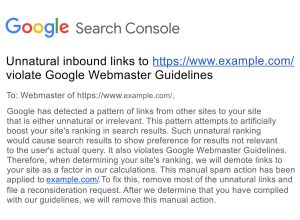
Depending on the type of policy violation, manual actions can affect entire websites or a few specific web pages. If Google levies a penalty on your website, you will be informed via Google Search Console, which will look something like this:
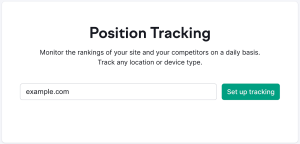
Another way to discover whether you have been penalised or not is using the Position Tracking Tool by SEMrush.
This tool will monitor your website’s ranking every day. So if you notice a sudden drop in rankings or if your website disappears from the SERPs, you might want to check for penalties.
How Long Will It Take to Recover Your Website From a Google Penalty?
By now you know that there are different kinds of penalties that Google levies. Recovering from such a penalty could take less or more time depending on the individual case and the level of policy violation, which could range from several months to a few weeks. The penalty notice that you receive on your Google Search Console would usually indicate the exact issue and how you have violated Google’s search essentials, formerly called Google’s webmaster guidelines. However, you need an SEO specialist or consutltant to investigate the issue in depth.
Google says that if a website loses its ranking after a key update, it could be due to revised E-E-A-T guidelines. In other words, your website might lack expertise, experience, authority or trust – or any combination of these.
How Can You Avoid Google Penalties?
3 simple tips can help you avoid Google penalties in the future.
1. Create high-quality website content
High-value content that is relevant, engaging, helpful and useful to your target audience provides value to the user as well as search engines.
Google’s umbrella objective is to provide end users with high-quality content that answers their queries. So, good content will appeal to both the SEO algorithm and end users. To maintain this standard, it’s important to optimize low-quality content so that every page contributes effectively to your site’s authority and performance.
2. Build a natural backlink profile
Your natural backlink profile should include a host of relevant, earned links from various platforms directly to your content. Having such a backlink profile tells Google that you’re adhering to its guidelines. Attracting inbound links that cite your website as a reliable source of information positively impacts your search rankings.
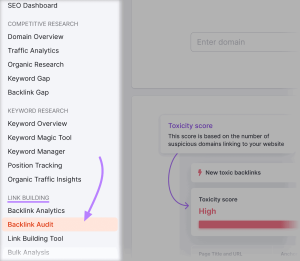
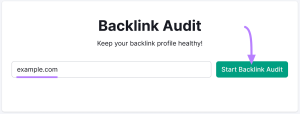
● You can find out how your backlink profile looks by running a backlink audit. You can do this using the SEMrush Backlink Audit tool.
● Next, click on the ‘backlink audit’ button.
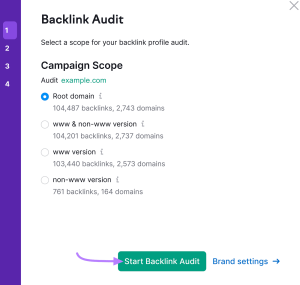
● Then, configure your link audit settings and ‘Start Backlink Audit’.
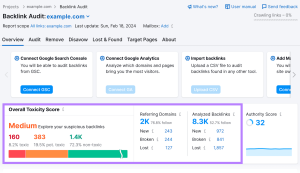
● Once the audit is complete, you will see a report like this:
This might look like a lot of statistics, so here’s what you need to look for:
Overall toxicity score:The higher the score, lower the quality of your backlinks
Analysed backlinks: Way too many backlinks means a quantity over quality backlinks
Referring domains: The diversity of your domains is more important than multiple links from one domain
Audit tab insights: Go deeper into detail using the ‘Audit’ tab.
To clean up any harmful backlinks, you may need to use the Google Disavow Tool, which helps prevent these toxic links from affecting your rankings.
You can continually monitor your backlink profile using your profile’s insights that appear above the report, right below your ‘Overview’ tab.
3. Make sure your website is secure and has no technical issues
There are two key benefits of a technically perfect website:
Technical SEO ensures search engines can easily crawl and index your website and its individual pages.
People stay longer on your website if your user experience is great, which gives you a higher SERP ranking.
Some of the factors you need to always optimise are:
Page loading speed
Avoiding content duplication
Using HTTPS websites instead of HTTP
Crawability and indexability of your webiste
A well-structured XML sitemap for improved indexability
Fix Technical SEO Issues to improve crawlability, user experience, and search rankings.
Want to Keep Your Website Penalty-free?
Following the best SEO practices, creating high-quality content and continually monitoring your website’s health and backlink profile can keep your website penalty-free and keep your ranking secure.
Managing the website in-house can be a challenging part. It’s best to partner with an experienced SEO services company to keep your website healthy and updated at all times.
Sarvesh Bagla is an enterprise SEO expert and industry leader who has driven transformational digital growth for India’s top brands across the BFSI, Healthcare, Automotive, and ECommerce industries. As the Founder and CEO of Techmagnate, he leads large-scale organic search strategies and performance marketing campaigns for businesses looking to succeed in today’s AI-driven search landscape.
A strong advocate for thought leadership, Sarvesh is deeply involved in SEO evangelism and regularly contributes to industry discussions through LinkedIn, webinars, and CMO roundtables. His focus today is on helping brands prepare for an AI-first SEO future (AEO, GEO) and strategies for Large Language Models (LLMs) at the core.
Get the most valuable search related insights about leading brands, trending keywords, search volumes, fastest growing categories, city-level insights and much more!
It has come to our notice that fraudulent job offers are being circulated on the internet through messaging apps like WhatsApp and Telegram, which falsely claim to be from Techmagnate. We take this matter seriously and would like to caution all candidates to be wary of such postings.
Please Note That –
We do not charge any fees/security deposit/payment from candidates, irrespective of the professional experience they hold, for job applications or interviews
Official communication channels include our website and verified social media accounts, primarily LinkedIn.
Kindly double-check the domain name – @techmagnate.com – in the email address
We follow a transparent and ethical approach for hiring/onboarding supported by proper documentation.
Ensure that you only apply through verified channels to avoid being scammed. We also recommend that you exercise caution when sharing personal information or financial details with any job posting or recruitment agencies claiming to represent us.
We want to ensure that potential candidates interested in joining Techmagnate have a safe and positive experience.
If you find that someone that fits the description above has reached out to you, please notify us immediately at jobs@techmagnate.com.
 Important Alert:
 Important Alert:




















 6th Feb | Invite-only


