Beware of fake job offers and payment requests. We only use official email IDs and never conduct interviews on messaging apps.Beware of fake job offers and payment requests. We only use official email IDs and never conduct interviews on messaging apps.
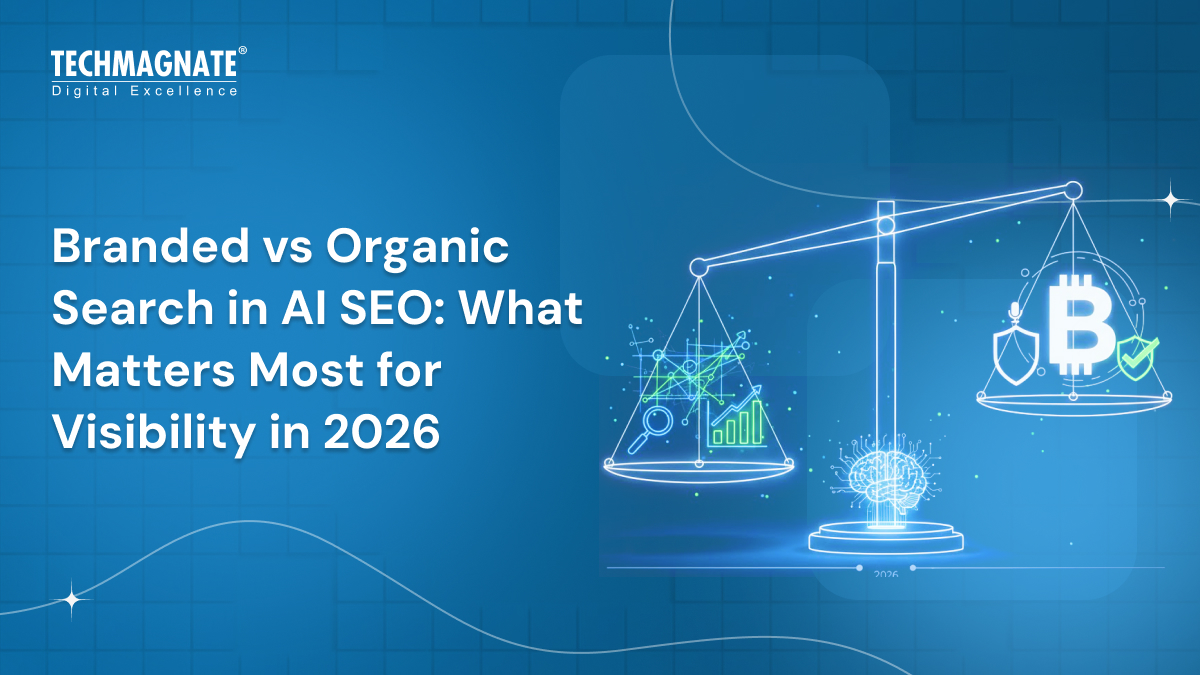
Summary: AI-powered search is reshaping how brands compete online, making both branded and organic visibility more critical than ever. As AI-generated answers dominate SERPs, brands must strengthen entity authority and intent-driven content to stay discoverable, trusted, and competitive.
Key Takeaways:-
AI search prioritizes entity authority, making branded search visibility crucial for trust and conversions.
Organic search success relies on deep topical expertise, semantic coverage, and intent alignment.
Structured data and schema markup help AI systems understand brand identity and content relevance.
E-E-A-T plays a central role in determining both branded and organic AI rankings.
Balanced strategies across branded and non-branded search ensure long-term resilience in AI-powered SERPs.
AI-driven search is changing how people discover information online. Tools like Google SGE often display AI-generated results before traditional search results, making it harder for brands to stand out. That is why understanding the branded search impact on AI SEO is so important, as it directly affects how visible and discoverable a brand is.
Brands now face a challenge: balancing the need to dominate branded search results while still maintaining strong organic reach. Adapting strategies to this new AI-driven environment is essential for staying relevant and competitive.
Table of Contents
How AI and LLMs Are Changing Search Behavior
Large Language Models (LLMs) interpret search queries through contextual understanding rather than exact keyword matching. This shift represents a fundamental change in how search behavior and AI SEO results interact across enterprise marketing strategies.
Traditional search engines relied on keyword density and anchor text signals. AI-powered search engines analyze:
Entity relationships: How brands connect to topics, products, and user needs.
Contextual relevance: Whether the content addresses the specific user intent comprehensively.
Semantic coherence: How well content maintains topical authority across related queries.
Trust indicators: Reviews, mentions, and authoritative source citations.
At Techmagnate, we focus on AI-powered SEO for branded searches to help enterprises achieve transformational growth. By combining AI insights with strategic content planning and optimisation, we ensure brands maintain strong visibility and authority. Our focus on digital excellence enables consistent, measurable performance across both branded and organic queries.
Research shows 67% of AI-generated search results favor content with clear entity authority over generic keyword pages, creating opportunities for brands to improve visibility.
Branded vs Organic Search in the AI Context
Understanding branded vs organic search AI optimization requires recognizing how AI algorithms categorize and prioritize different types of search queries and content.
Search Type
AI Processing Method
Ranking Factors
Business Impact
Branded Search
Entity recognition and brand authority signals
Reviews, mentions, official content, schema markup
Higher conversion rates, brand protection
Organic Search
Intent matching and topical authority
Content quality, semantic relevance, and user engagement
Broader reach, new customer acquisition
How AI Identifies Branded Entities
AI-powered SEO for branded searches operates through sophisticated entity recognition systems that connect brand names to their associated topics, products, and user intents. For Example, when someone searches for “Nike running shoes,” AI algorithms don’t simply match keywords; they understand Nike as a sports apparel entity with specific expertise in athletic footwear.
This recognition system relies on multiple signals:
Knowledge graph connections: How your brand relates to industry topics and competitors.
Mention frequency and context: Where and how your brand appears across authoritative sources.
Official content verification: Schema markup and structured data that confirms brand ownership
Review and rating aggregation: Customer feedback that validates brand authority in specific categories
Consider how Nike benefits from this entity understanding. If someone searches for “best running shoes,” Nike products may show up not because of keyword optimization, but because AI models recognize Nike’s established authority in athletic footwear based on accumulated entity signals.
How AI Rewards Organic Authority
Organic search’s influence on AI rankings operates through demonstrating topical expertise rather than brand recognition. AI systems evaluate whether content comprehensively addresses user questions, regardless of the publishing brand’s market recognition.
Successful organic content in AI search results typically exhibits:
Comprehensive topic coverage: Content that addresses multiple aspects of a user’s potential questions.
Original research and insights: Data, case studies, or unique perspectives that add value beyond existing content.
Semantic keyword integration: Natural use of related terms that demonstrate topical understanding.
User engagement signals: Comments, shares, and time-on-page metrics that indicate content value.
E-E-A-T & Entity Building in AI SEO
Experience, Expertise, Authoritativeness, and Trustworthiness (E-E-A-T) principles guide how AI systems evaluate both branded and organic content. This evaluation framework is particularly crucial for an AI SEO strategy aimed at brand visibility in regulated industries like healthcare, finance, and legal services.
AI algorithms assess E-E-A-T through:
Author credentials: Professional backgrounds, certifications, and industry recognition.
Content accuracy: Fact-checking against authoritative sources and knowledge bases.
Source citations: References to credible research, data, and expert opinions.
User feedback: Reviews, ratings, and engagement patterns that validate content quality.
Schema markup enhances E-E-A-T signals by explicitly defining author expertise, organization credentials, and content relationships. This structured data helps AI systems understand why your content deserves authority in specific topic areas.
Content Relevance and Intent Matching
AI-driven search prioritizes content that precisely matches user intent over content that simply contains relevant keywords. This shift requires understanding how search behavior and AI SEO results connect through conversational, question-based content formats.
Effective intent matching strategies include:
Question-answer formats: Content structured to address specific user questions directly.
Conversational language: Natural phrasing that mirrors how users actually speak and think.
Multi-intent coverage: Single pieces of content that address related user needs comprehensively.
Progressive information disclosure: Content organized from basic to advanced concepts
For instance, instead of optimizing for “project management software,” create content that answers “How do I choose project management software for a remote team?” This approach aligns with how users interact with AI search interfaces and increases the chances of appearing in AI-generated responses.
Structured Data & Schema for AI Understanding
Schema markup from Schema.org serves as a crucial communication layer between your content and AI systems. This structured data helps AI algorithms better understand content context, brand relationships, and topic authority than text analysis alone.
Priority schema implementations for branded vs organic search AI optimization include:
Organization schema: Defines brand identity, contact information, and business relationships.
Article schema: Establishes content authorship, publication dates, and topic classification.
FAQ schema: Structures common user questions and answers for direct retrieval by search engines.
Product schema: Clarifies key product details, features, and variations for better discovery.
By using advanced schema and structured data, brands can improve their visibility and relevance in both branded and organic AI search contexts.
Case Insight: Balancing Brand and Organic in AI Search
A small fitness equipment company aimed to compete with major brands in the “home gym setup” niche. By using AI-powered SEO for branded searches, they created detailed, user-focused content addressing space constraints, budget options, and exercise variety, topics often overlooked by larger competitors. Within three months, the brand achieved a 35% increase in organic traffic and outranked key competitors for several branded and non-branded queries.
Key Takeaways:
Develop comprehensive, user-centric content that fills gaps larger brands ignore.
Optimise for both branded and non-branded searches to boost visibility.
Track AI-driven performance metrics regularly to refine and scale SEO efforts.
Measuring the ROI of Branded vs Organic Visibility
To effectively measure the ROI of branded versus organic visibility in AI search, enterprises must use advanced analytics to track key indicators.
First, monitor impressions in AI SERPs like ChatGPT or Gemini. AI-powered analytics can reveal how often your brand appears in response to user queries. Use tools such as SEMrush to monitor impressions, track performance in AI-driven SERPs, and identify key opportunities for visibility enhancement.
Next, calculate your visibility share compared to competitors. This metric helps gauge how well your content captures customer touchpoints in both AI and traditional search results.
Lastly, analyze branded versus non-branded conversions. Branded conversions highlight existing audience loyalty, while non-branded conversions show your ability to attract new customers through organic reach.
By focusing on these metrics, marketing leaders can align their SEO investments with measurable outcomes and prepare for the growth of AI search.
Common Mistakes in AI-Driven SEO Strategies
As businesses adapt to AI-driven search, avoiding common pitfalls is essential for maintaining performance:
Ignoring Structured Data: Without schema markup, you miss rich results. Implement relevant schemas like FAQ or Product.
Thin Content: Shallow content weakens authority. Focus on in-depth, high-quality articles that answer user queries.
Neglecting Core Web Vitals: Slow, unoptimized sites hurt rankings. Improve speed with tools like Google PageSpeed Insights and prioritise mobile-first design.
Keyword Overstuffing: Forced keywords reduce readability. Use semantic, natural language aligned with user intent.
Ignoring AI Updates: Outdated strategies fail fast. Stay updated on AI changes, such as Google’s SGE, and adapt quickly.
The Future of Search: Brand Equity Meets AI Intelligence
Search is changing as AI algorithms reshape how results are delivered, blending brand reputation with organic search signals. As a result, a brand’s visibility now directly influences personalized, AI-driven search outcomes.
Here’s what’s driving this shift:
Voice Search: With more people using smart devices for hands-free, conversational searches, brands must optimize for natural language to stay relevant.
Multimodal Search: AI now processes text, images, and voice. Brands need to create cohesive multimedia content to meet this demand.
Contextual Ranking: Search engines use location, user behavior, and real-time data to tailor results. A consistent brand narrative across all platforms is essential for ranking in these AI-powered results.
In short, the future of search depends on creating meaningful, personalized, and context-aware experiences that work across all search formats.
Conclusion: Balancing Brand Trust and Organic Reach in the AI Era
In the AI era, enterprises must balance brand trust with organic reach to stay competitive. Using AI-driven SEO strategies helps strengthen brand authority while improving visibility in search results. By combining data insights, content optimization, and AI tools, businesses can deliver more relevant experiences and maintain a strong presence. Explore our AI SEO Services and LLM SEO Services to harness the power of AI and elevate both your brand authority and organic reach.
Sarvesh Bagla is an enterprise SEO expert and industry leader who has driven transformational digital growth for India’s top brands across the BFSI, Healthcare, Automotive, and ECommerce industries. As the Founder and CEO of Techmagnate, he leads large-scale organic search strategies and performance marketing campaigns for businesses looking to succeed in today’s AI-driven search landscape.
A strong advocate for thought leadership, Sarvesh is deeply involved in SEO evangelism and regularly contributes to industry discussions through LinkedIn, webinars, and CMO roundtables. His focus today is on helping brands prepare for an AI-first SEO future (AEO, GEO) and strategies for Large Language Models (LLMs) at the core.
Get the most valuable search related insights about leading brands, trending keywords, search volumes, fastest growing categories, city-level insights and much more!
It has come to our notice that fraudulent job offers are being circulated on the internet through messaging apps like WhatsApp and Telegram, which falsely claim to be from Techmagnate. We take this matter seriously and would like to caution all candidates to be wary of such postings.
Please Note That –
We do not charge any fees/security deposit/payment from candidates, irrespective of the professional experience they hold, for job applications or interviews
Official communication channels include our website and verified social media accounts, primarily LinkedIn.
Kindly double-check the domain name – @techmagnate.com – in the email address
We follow a transparent and ethical approach for hiring/onboarding supported by proper documentation.
Ensure that you only apply through verified channels to avoid being scammed. We also recommend that you exercise caution when sharing personal information or financial details with any job posting or recruitment agencies claiming to represent us.
We want to ensure that potential candidates interested in joining Techmagnate have a safe and positive experience.
If you find that someone that fits the description above has reached out to you, please notify us immediately at jobs@techmagnate.com.
 Important Alert:
 Important Alert:
















 6th Feb | Invite-only


