Beware of fake job offers and payment requests. We only use official email IDs and never conduct interviews on messaging apps.Beware of fake job offers and payment requests. We only use official email IDs and never conduct interviews on messaging apps.
Summary: Accurate marketing analytics is a must to check what propelled your app installs. However, deciding which mobile attribution tool can be confusing. To help you leverage robust analytics, this guide will compare the features of Adjust vs Branch vs AppsFlyer to streamline business procedures.
Key Takeaways
AppsFlyer is superior in multi-touch attribution, Adjust is superior in fraud prevention, and Branch is superior in user-friendly interface and cross-platform tracking.
Monthly Active Users (MAU) determine pricing for Adjust and AppsFlyer, with customized plans available for high-volume users. Transparent MAU-based plans are the branch’s main focus.
AppsFlyer supports sophisticated integrations and analytics, Branch is user-friendly with quick service, and Adjust provides robust support and scalability.
Imagine having the capability and quick accessibility to pinpoint areas and marketing channels that drive users to engage with your app or perform any action. By consistently monitoring user journeys throughout campaigns, app store searches, social media mentions, app storte marketing and more, businesses can streamline marketing expenses and accelerate business success with the right data analytics.
However, with diverse attribution tools and differentiating features, how can one integrate suitable tools into their system? We understand your concern, and hence, in this blog, we will explore varied aspects of 3 significant tools, Adjust vs Branch vs AppsFlyer, for your better understanding.
Table of Contents
Adjust vs Branch vs AppsFlyer – Overview
Factors
Adjust
Branch
AppsFlyer
Tool Focus
Effective mobile measures & attribution
Robust mobile marketing management
Attribution & data-drive mobile marketing analytics
Adjust is a leading mobile attribution and analytics platform that helps application marketers determine users’ journeys marketing. Tends to use cookies, mobile applications rely on app attribution measurements to monitor user events and actions and consistently improve offerings.
Additionally, Adjust offers a central suite of tools to measure, streamline, and scale an app’s growth easily. Its diverse capabilities enable marketers to connect user actions, such as clicks and installs, to certain advertising sources. This enables them to determine which campaign or channel drives users.
Furthermore, Adjust provides robust data analytics like fraud prevention, customer segmentation, and data visualization to make informed decisions. With this platform, marketers can gain visibility over marketing performance and accelerate ROI.
Branch
The Branch is another leading mobile attribution and linking platform. It assists marketers in measuring app conversion rate, streamlining marketing campaigns, and building user experience across channels. Its top capabilities include cross-platform attribution, which monitors user journeys across the web, email, advertisements, affiliates, QR codes, and more.
Furthermore, the Branch also provides configurable attribution windows to personalize attribution timeframe for each media source and analytics dashboards to segment data by device, channel, campaigns, and more.
Additionally, the platform’s linking feature ensures that users are directed to the right source or action within the application to elevate user experience and minimize bounce rates — functioning as part of a deep linking strategy that enhances user journey continuity.
AppsFlyer
AppsFlyer is another renowned mobile attribution platform that aids marketers in measuring the effectiveness of mobile ad campaigns. It offers a comprehensive suite of tools to simplify monitoring and evaluating user acquisition, retention, and engagement across diverse channels.
Additionally, AppsFlyer’s capabilities include multi-touch attribution, which is ideal for evaluating customer touchpoints to offer a comprehensive view of marketing performance. It further provides robust features such as retargeting attribution, configurable attribution lookback windows, and an audience builder for user acquisition campaigns. Furthermore, AppsFlyer offers detailed reports, fraud detection, and SDK integration across platforms.
Adjust vs Branch vs AppsFlyer – Feature Comparison
To help you understand the differences in the features of these three platforms and make informed decisions, we are listing a head-to-head comparison stating features in detail below.
Feature
Adjust
Branch
AppsFlyer
Attribution
– Robust mobile attribution capabilities
– Protects ad frauds proactively
– Unlimited callbacks and data accessibility
– Provide people-based mobile attribution
– Comprehensive built-in fraud suite to detect for all customer ads
– Detailed mobile attribution platform
– trusted fraud detection solution, but lacks identifying frauds in real-time
Integration
Provides APIs for seamless integration with external platforms
Offers open-source SDK for effortless integration
Integrate with extweernal apps and SaaS using APIs
Automation
– It is first MMP that introduced complete marketing automation
– Enables varied campaign management directly through centralized dashboard
Does not have capability of in-buildt marketing campaign management
It lacks in offering mature, and standalone automation solutions
Infrastructure
Leverages private cloud infrastructure
It utilizes third-party cloud infrastructure such as AWS
It utilizes private robust cloud infrastructure
Customer Support
Offers excellent and consistent customer support
Provides responsive, prompt, and reliable customer support
Popular for continuous, reliable and excellent customer support
Usability
– Comprehensive report & analytics capabilities
– User-friendly interface, but can be complex or difficult for teams to utilize it completely
Popular for its user-friendly interface, easy-to-use platform, and its intuitive design
It offers user-friendly interface, but includes steep learning curve
Data Privacy
– Meets with stringent data privacy regulations
– Provides comprehensive data privacy features for added protection
– Prioritizes on data privacy and security primarily
– Offers complete transparency for data usage for varied data touchpoints
– Effortlessly compiles with data privacy regulations
– It provides features like data privacy controls for limiting user visibility
Report & Analytics
– Includes advanced report & analytics capabilities
– Offers customizable insights and dashboards for easy comparison & decision making
– Simplifies measuring results with in-depth reporting & analytics
– Provides user-friendly data visualization tools for swift decision making process
– Advanced reporting & analytics with varied data touchpoints
– Offers customizable reporting features backed with user-friendly data visualizations
Scalability
– Includes capabilities of managing large scale campaigns and data volumes
– Offers enterprise-level scalability
– Best suited for medium-sized organizations
– Larger enterprises may face a few scalability based challenges with this platform
– Ideal for all business size and offers robust scalability features
Robust fraud detection source for all ads customers
Depends on blacklisting, lacks in blocking 16% of incoming frauds
Adjust vs Branch vs AppsFlyer – Pricing Plan
Adjust – Provides a free plan with a basic set of features. Paid plans are based on Monthly Active Users (MAU) or customized event-based pricing models. This platform offers custom plans for high-volume data users with specific business needs.
Branch – This platform does not have free plans, but provides transparent MAU-based plans similar to Adjust – custom plans for high-volume users
AppsFlyer – Provides a limited free plan called ” Essential, ” including basic features. Paid plans are based on MAU or conversions. This platform also offers custom plans based on high-volume users for enterprise-level solutions
Adjust vs branch vs AppsFlyer – Perks & Drawbacks
As we discussed in this blog, every mobile attribution platform has its strengths and weaknesses differentiating with varied capabilities. Based on your digital marketing campaigns, business size, data volume needs, and more you must select a tool that meets with your objectives. To help you make the right decision, we are highlighting the perks and drawbacks of these platforms.
Factors
Adjust
Branch
AppsFlyer
Perks
Offers robust attribution, post-app installation measurements to track user journey, offers high accuracy with analytics and fraud detection in real-time
Provides user-friendly interface, fosters seamless user engagement, boost user retention with through cross-platform tracking, and provides responsive customer support
It is a feature-rich platform, provides convenient integration with other marketing tools, and provides comprehensive mobile attributions in real-time
Drawbacks
It includes complicated dashboards, which means it becomes difficult to adopt in real-time, and it includes limited measurement options
Comparatively, this platform has lesser effective attribution based features, and it has lower focus on fraud detection
Compared to other two platforms, this platform has robust features with multiple capabilities but it includes high pricing
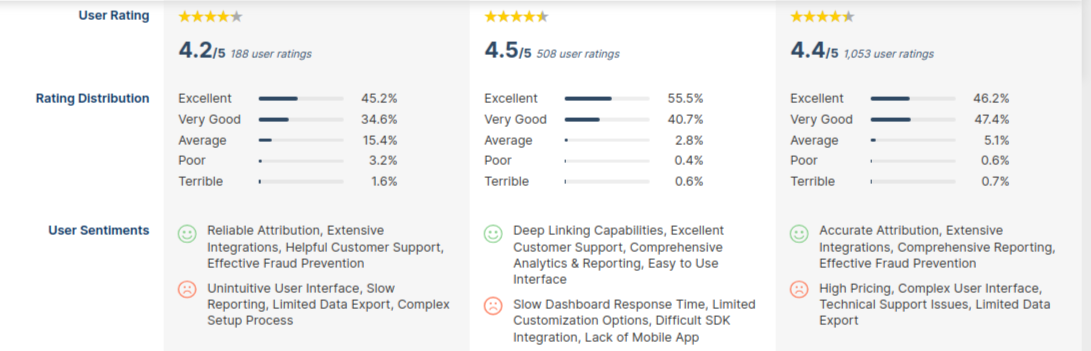
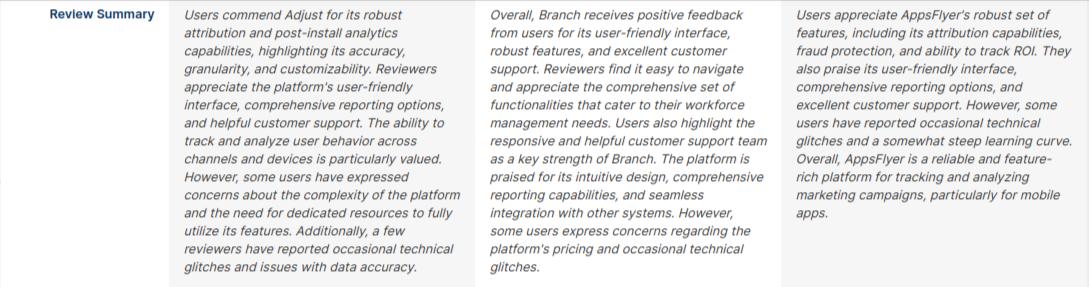
Adjust vs Branch vs AppsFlyer – User Review
Still confused? Check out the reviews and decide what best suits with your business requirements.
Choose the tool according to your martech needs
Have you explored the features, capabilities, and strengths of Adjust, AppsFlyer, and Branch? Now, it’s time to make decisions. While it may seem overwhelming, once you’ve set your priorities, you will know how to proceed further. For instance, if you want enhanced security, fraud detection, and post-installation measurements, then Adjust is your ideal platform.
If you want a user-friendly interface, cross-platform integration, or improved user engagement, Branch can be your best platform. If you are looking for an all-arounder platform that covers every aspect, there’s no better platform than AppsFlyer.
Techmagante also provides martech consulting services which can help you make informed decisions on your mobile apps.
Frequently Asked Questions (FAQs)
What is Mobile Attribution?
Mobile attribution tracks where your app installs come from, like social media, ads, or email marketing. It shows which parts of your campaign are effective.
How do Adjust, Branch, and AppsFlyer Differ in Terms of Pricing?
Adjust, Branch, and AppsFlyer offer free plans with limited features and capabilities. Their paid plans are based on monthly active users, event-based, and include customized plans, too.
Which Tool Offers the Best Fraud Prevention Features?
Adjust is renowned for having strong fraud prevention capabilities among Branch, AppsFlyer, and Adjust; it provides real-time fraud detection and all-encompassing protection. Although it might not be as successful in blocking all forms of fraud, AppsFlyer likewise has robust fraud detection. Branch is less sophisticated in this regard, but it does offer some basic fraud prevention features.
Can these Tools Integrate with my Existing Marketing Stack?
Yes, these tools integrate with external and cross-platforms by offering APIs and SDks. They also enable data to flow easily across the platforms.
How does Customer Support Compare Between Adjust, Branch, and AppsFlyer?
All three platforms provide customer support but vary significantly. All platforms provide guides and documentation for added support, but comparatively, Branch has better & responsive support.
Neha Bawa is the Director of Brand Marketing at Techmagnate. She has worked in Digital Marketing since 2012 and has specialised in content creation. She has earned a Master’s degree in Interactive Communications from Quinnipiac University in Connecticut, U.S.A. Her interests lie in creating great content, docs, and working towards sustainability through biodiversity.
Get the most valuable search related insights about leading brands, trending keywords, search volumes, fastest growing categories, city-level insights and much more!
It has come to our notice that fraudulent job offers are being circulated on the internet through messaging apps like WhatsApp and Telegram, which falsely claim to be from Techmagnate. We take this matter seriously and would like to caution all candidates to be wary of such postings.
Please Note That –
We do not charge any fees/security deposit/payment from candidates, irrespective of the professional experience they hold, for job applications or interviews
Official communication channels include our website and verified social media accounts, primarily LinkedIn.
Kindly double-check the domain name – @techmagnate.com – in the email address
We follow a transparent and ethical approach for hiring/onboarding supported by proper documentation.
Ensure that you only apply through verified channels to avoid being scammed. We also recommend that you exercise caution when sharing personal information or financial details with any job posting or recruitment agencies claiming to represent us.
We want to ensure that potential candidates interested in joining Techmagnate have a safe and positive experience.
If you find that someone that fits the description above has reached out to you, please notify us immediately at jobs@techmagnate.com.
 Important Alert:
 Important Alert:




















 6th Feb | Invite-only


