Beware of fake job offers and payment requests. We only use official email IDs and never conduct interviews on messaging apps.Beware of fake job offers and payment requests. We only use official email IDs and never conduct interviews on messaging apps.
For years, earning visibility in Google Search meant convincing Google’s algorithms that your content deserved to rank. Now, Google Preferred Sources is adding a new factor to the equation: user choice. People can select the websites and publishers they trust and want to see more often across Search experiences, including preferred sources, AI Overviews and AI Mode. For brands, this creates a new opportunity to strengthen their presence in AI-powered search.
The feature also changes an important aspect of competition online. It is no longer enough to simply appear in search results; brands must give users a reason to prefer them over other sources covering the same topics. When users actively choose certain publishers, those choices can influence the information they encounter. As a result, authority, credibility, and consistent content quality may play an even bigger role in determining which brands stand out in the AI era.
Table of Contents
What Are Google’s Preferred Sources?
Google Preferred Sources are a new personalization feature that allows users to choose the websites, publishers, and creators they trust and want to see more often across Google Search experiences. As Google continues to expand AI-powered features such as AI Overviews and AI Mode, these preferences can influence how trusted sources are highlighted when relevant information is presented to users.
The Google Preferred Sources feature is designed around user choice. Unlike traditional ranking factors, brands and publishers cannot enable it for themselves. Instead, users decide which sources they trust and want Google to prioritize within their own search experience. This means visibility through Preferred Sources is earned through audience trust rather than direct participation.
Think of it as a “follow” mechanism within Search:
Users select websites, publishers, or creators they trust
Google remembers those preferences
Selected sources may receive greater visibility when relevant
Google may highlight preferred sources in supported AI-powered experiences
Preferences apply only to the individual user who made the selection
Users can also remove or change their preferred sources at any time – preferences are not permanent.
Together, these actions help personalize Search based on each user’s trusted sources. As a result, Preferred Sources functions as a personalization feature rather than a ranking feature.
To understand why this matters, it is helpful to look at how Google chooses sources for AI-generated answers. Google uses a process known as source selection to determine which websites appear alongside AI responses. Factors such as relevance, content quality, authority, and user preferences. Preferred Sources adds a personalization signal to this process, but it does not replace Google’s existing ranking systems.
For publishers and brands, this creates a new opportunity to build visibility. Traditional SEO focuses on earning relevance and authority, while Preferred Sources introduces an additional layer based on user preference. Brands that consistently publish useful and trustworthy content are more likely to build loyal audiences. Over time, those users may choose to add the brand as a preferred source, creating additional opportunities for visibility across AI Overviews, AI Mode, and other eligible Google Search experiences.
Understanding where Preferred Sources appear is the next step in evaluating their potential impact on search visibility and audience engagement.
Where Preferred Sources Show Up
Google has expanded Preferred Sources into its AI-powered search experiences, allowing users to personalize the sources they see across Google Search. The feature currently extends to AI Overviews and AI Mode, helping users discover content from publishers they already trust.
For brands and publishers, this creates an additional opportunity to strengthen visibility within AI-generated search experiences. When users choose a publisher as a preferred source, Google may highlight that source more prominently when its content is relevant to the query. As AI-powered search becomes a larger part of the search journey, building trust and audience loyalty may play an increasingly important role in maintaining visibility.
AI Overviews
AI Overviews provide AI-generated summaries directly within Google Search results. These summaries often include citations and links to supporting sources that help users explore a topic further.
As part of the AI Overview source selection process, Google may highlight a user’s preferred source when relevant content from that publisher contributes to the generated answer. This makes it easier for users to identify and access information from sources they have already chosen to follow.
To understand how AI Overviews select and display sources more broadly, the guide on AI Overview’s Impact on CTR covers how AI Overviews affect click-through rates and content visibility.
AI Mode
AI Mode offers a more conversational search experience, allowing users to ask follow-up questions and explore topics in greater depth. Instead of viewing a single result page, users can continue refining their searches through an ongoing interaction.
Within this experience, AI Mode’s preferred sources may be highlighted when content from those selected publishers helps answer a user’s query. This can increase visibility among audiences who have already expressed trust in a particular source.
This additional visibility is one reason the feature is attracting attention from marketers and publishers.
Why This Matters
The growing role of preferred sources in AI search offers several potential benefits:
Users can find trusted sources more easily.
Familiar publishers may gain greater visibility within AI-generated responses.
Brand recognition becomes increasingly valuable in AI-driven discovery.
Trusted sources can build stronger engagement with their audiences.
These benefits illustrate why Preferred Sources is becoming increasingly relevant for publishers and brands. While preferred sources do not guarantee inclusion in AI answers, they can help trusted publishers maintain a stronger presence in personalized search experiences when their content is relevant to a user’s needs.
How Users Add a Preferred Source
Users can add trusted publishers and websites to their Preferred Sources list directly through Google Search, where the feature is available. Once added, Google may highlight content from those sources when it is relevant to a user’s query across supported search experiences.
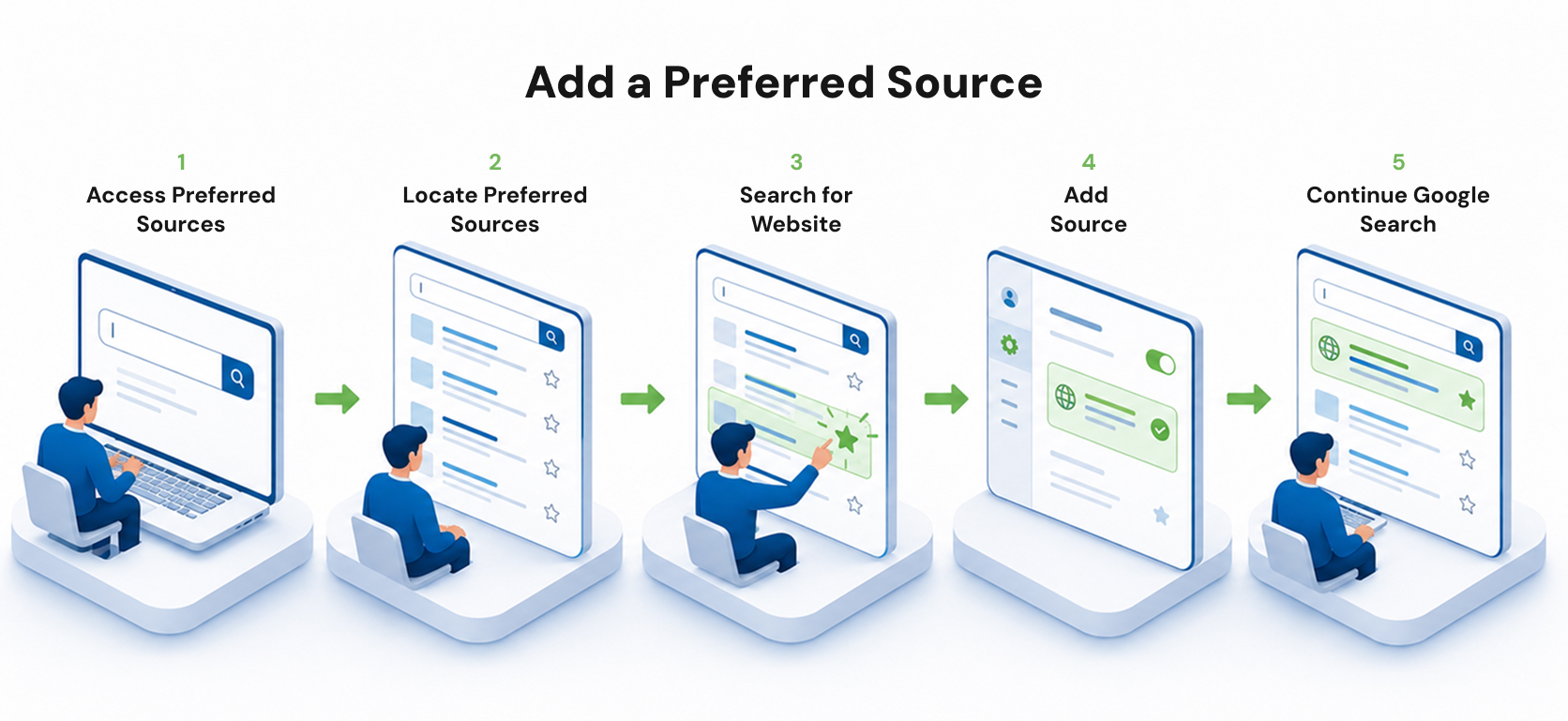
The Google Preferred Sources setup process is simple and can be completed in just a few steps:
Access the Preferred Sources feature in Google Search where available.
Locate the Preferred Sources option.
Search for a website, publisher, or publication you trust.
Add the source to your preferred list.
Continue using Google Search as usual.
Note: The Preferred Sources feature is being rolled out gradually and may not be available to all users or in all regions at this time. Availability may vary based on your Google account, location, and device.
Once a source is added, Google may highlight content from that publisher when it appears in supported Search experiences, including AI Overviews and AI Mode. However, selecting a preferred source does not guarantee that its content will appear for every search. Google still determines which sources are relevant to a user’s query.
For brands, the challenge is how to become a preferred source Google users actively choose. Since users decide which publishers to follow, brands must earn visibility through credibility, consistency, and audience trust.
Brands can strengthen their appeal to potential followers by taking several practical steps:
Use a consistent brand name across all channels
Publish helpful content on topics your audience cares about
Maintain a recognizable and reliable editorial voice
Encourage loyal readers to follow and engage with your content
Share original insights, research, and expertise
Build relationships through newsletters, communities, and social media
Consistent engagement helps strengthen audience familiarity and long-term brand recall. Publishers that consistently demonstrate expertise and reliability are often better positioned to earn audience preference.
Building that level of recognition requires consistency. Many organizations invest in Content Marketing Services to create a regular, followable content presence that keeps audiences engaged and encourages repeat visits.
How to Qualify and Improve Your Odds
Google has not published a formal checklist that guarantees eligibility for preferred sources’. Since users choose the sources they want to follow, selection is largely influenced by trust, recognition, and content quality. While there is no official approval process, several factors can increase the chances that users view your brand as a source worth following.
A strong foundation starts with E-E-A-T, which stands for Experience, Expertise, Authoritativeness, and Trustworthiness. These principles help Google evaluate content quality and also influence how users assess credibility. Brands that consistently demonstrate real-world experience, subject matter expertise, and trustworthy information are more likely to earn audience confidence.
Your identity as a publisher also matters. Users are more likely to follow sources they can easily recognize and verify. Important trust signals include:
A clear About Us page
Detailed author biographies
Transparent editorial policies
Credible sourcing and references
Consistent branding across channels
These elements help users understand who is behind the content and why they should trust it.
Establishing credibility across multiple channels can help reinforce your reputation and visibility. Authority often grows through efforts such as:
Publishing original research and industry insights
Sharing expert commentary
Earning media coverage and mentions
Participating in conferences and industry discussions
Together, these activities can help build brand recognition and establish industry expertise.
Building audience trust can also support visibility in AI-powered search experiences. This has led to growing interest in preferred sources GEO, a concept often associated with Generative Engine Optimization (GEO). The goal is to improve visibility within AI-generated responses. As AI search continues to evolve, strategies such as Answer Engine Optimization are becoming increasingly important. Techmagnate’s Answer Engine Optimization Services are designed to help brands improve content discoverability and visibility across emerging AI-powered search environments. The following practices can help increase the likelihood of being chosen as a preferred source:
Publish original, valuable content
Demonstrate real-world expertise
Keep information accurate and updated
Highlight author credentials
Build a recognizable brand identity
Earn mentions from reputable sources
Maintain consistency over time
Consistently applying these practices can strengthen both audience trust and brand recognition over time.
No single factor guarantees selection. The objective is to establish your brand as a reliable and authoritative source within your area of expertise. These signals help increase the likelihood that users will view your brand as a trusted source worth following. That relationship between trust, authority, and user preference is central to the Preferred Sources feature.
Preferred Sources, E-E-A-T, and Brand Authority
The connection between Preferred Sources, E-E-A-T, and brand authority is simple. People follow sources they trust and return to them regularly. Google also aims to provide helpful, reliable, and high-quality information across Search, AI Overviews, and AI Mode. While users ultimately control Preferred Sources, the qualities that build trust can make a brand more memorable and more likely to be selected.
This is why a strong preferred sources strategy for brands should focus on building credibility, consistency, and recognition. When users repeatedly find value in your content, they are more likely to view your brand as a trusted source of information. Here are some practical ways to strengthen both trust and authority:
Publish content created or reviewed by subject matter experts
Share real-world experience, original research, or unique insights
Maintain clear editorial standards and factual accuracy
Support key claims with credible references and sources
Build thought leadership around topics relevant to your audience
Encourage repeat engagement through consistent, useful content
These efforts help strengthen audience confidence while reinforcing the expertise and authority associated with trusted publishers.
These practices help audiences recognize your brand and develop confidence in the information you provide. They also help demonstrate the experience, expertise, authoritativeness, and trustworthiness associated with strong E-E-A-T signals.
For brands wondering how to get added as a Google preferred source for AI Overviews, there is no direct application process or guaranteed path. The most effective approach is to become a source that people genuinely trust and choose to follow. Over time, consistent quality and a clear brand identity can help increase that chance.
As Techmagnate has observed across content and search initiatives, trust is rarely earned through a single campaign. It develops through consistent delivery of accurate, valuable, and distinctive content over time.
Conclusion
Google Preferred Sources adds a new layer to AI search visibility. Brands cannot force inclusion or guarantee that users will select them, but they can improve their chances by building trust, publishing consistently, and creating content people genuinely value. Since the feature is driven by user choice, success depends on becoming a source audiences recognize and prefer. Brands that consistently deliver credible information and maintain a distinct identity are better positioned to earn long-term audience preference. As AI search continues to evolve, investing in authority and audience trust remains essential. Learn how our AI SEO Services can help strengthen your visibility across AI-powered search experiences.
Frequently Asked Questions
How do I become a preferred source on Google?
There is no direct application process to become a preferred source on Google. Users choose which websites, publishers, and creators they want to follow through the Preferred Sources feature. Building credibility, demonstrating expertise, and consistently publishing valuable content can improve your chances of being selected.
Can I choose sources in AI Overviews?
Yes. Google allows users to select preferred sources, and those preferences can influence how sources are highlighted in AI-powered experiences. When relevant content is available, Google may highlight a user’s preferred sources within AI Overviews and AI Mode.
Who's eligible to be a preferred source?
There is no formal eligibility application or approval process. Any website, publisher, creator, or organization can potentially become a preferred source if users choose to follow it. The likelihood of being selected often depends on trust, authority, content quality, and brand recognition.
Does being a preferred source guarantee my content appears in AI Overviews?
No. Being selected as a preferred source means Google may highlight your content when it is relevant to a user’s query, but it does not guarantee inclusion in every AI-generated answer. Content still needs to be relevant, high-quality, and appropriate for the topic being searched.
How long does it take to build enough trust to become a preferred source?
There is no set timeline. Trust is built through consistent publishing, demonstrated expertise, and positive user engagement over time. Brands that already have an established content presence and loyal audience are better positioned to earn preferred source selections, but for most brands, it is a long-term investment rather than a short-term outcome.
Sarvesh Bagla is an enterprise SEO expert and industry leader who has driven transformational digital growth for India’s top brands across the BFSI, Healthcare, Automotive, and ECommerce industries. As the Founder and CEO of Techmagnate, he leads large-scale organic search strategies and performance marketing campaigns for businesses looking to succeed in today’s AI-driven search landscape.
A strong advocate for thought leadership, Sarvesh is deeply involved in SEO evangelism and regularly contributes to industry discussions through LinkedIn, webinars, and CMO roundtables. His focus today is on helping brands prepare for an AI-first SEO future (AEO, GEO) and strategies for Large Language Models (LLMs) at the core.
Get the most valuable search related insights about leading brands, trending keywords, search volumes, fastest growing categories, city-level insights and much more!
It has come to our notice that fraudulent job offers are being circulated on the internet through messaging apps like WhatsApp and Telegram, which falsely claim to be from Techmagnate. We take this matter seriously and would like to caution all candidates to be wary of such postings.
Please Note That –
We do not charge any fees/security deposit/payment from candidates, irrespective of the professional experience they hold, for job applications or interviews
Official communication channels include our website and verified social media accounts, primarily LinkedIn.
Kindly double-check the domain name – @techmagnate.com – in the email address
We follow a transparent and ethical approach for hiring/onboarding supported by proper documentation.
Ensure that you only apply through verified channels to avoid being scammed. We also recommend that you exercise caution when sharing personal information or financial details with any job posting or recruitment agencies claiming to represent us.
We want to ensure that potential candidates interested in joining Techmagnate have a safe and positive experience.
If you find that someone that fits the description above has reached out to you, please notify us immediately at jobs@techmagnate.com.
 Important Alert: