Beware of fake job offers and payment requests. We only use official email IDs and never conduct interviews on messaging apps.Beware of fake job offers and payment requests. We only use official email IDs and never conduct interviews on messaging apps.
72% Reduction in Paid Ad Costs for a Healthcare Retail Chain
72% Reduction in Paid Ad Costs for a Healthcare Retail Chain
Category
PPC
Share
About the Client
Fortis Healthworld (operated by RWL Healthworld Ltd., formerly Religare Wellness Ltd.) is one of India’s largest multi-city healthcare retail networks, with 100+ physical stores across Delhi NCR, Pune, and Bangalore, making it one of the few healthcare chains operating at scale across Northern and Western India simultaneously.
Challenges
Healthcare digital marketing in India presents a set of challenges that generic ecommerce marketing agencies are not equipped to handle. For Fortis Healthworld, these challenges combined sector-specific complexity with the scale of a multi-city operation:
Category-level competition from Amazon and Flipkart Health: Unlike hospital marketing where the patient relationship drives loyalty, wellness and healthcare retail requires competing on price and trust simultaneously, against platforms that subsidize discounts at a loss.
Multi-city demand variation: Consumer health demand in Delhi NCR differs significantly from Pune and Bangalore due to seasonal factors, pollution-driven demand spikes (e.g., respiratory and air-quality products), and city-specific product preferences.
4,500+ SKU complexity: Managing PPC efficiently across a healthcare product catalog of this size requires automated campaign architecture, not manual bid management.
Brand-to-digital trust transfer: Indian healthcare consumers who trust a brand in-store do not automatically extend that trust online. Building digital credibility for a healthcare brand requires different tactics than building it for an apparel or electronics brand.
These challenges are common to hospital chains, diagnostic networks, and pharmacy chains that are scaling their digital presence across Indian metros.
Solutions
Techmagnate’s approach to this healthcare marketing challenge was built on a principle relevant to all multi-location healthcare providers i.e., to spend where trust already exists, and earn digital trust where it does not yet.
GEO-TARGETING BY BRAND FOOTPRINT: PPC campaigns were restricted to Delhi NCR, Pune, and Bangalore, the cities with physical Fortis Healthworld stores. In healthcare marketing, the offline-to-online trust transfer is highest in markets where the brand has physical presence. This reduced wasted spend and improved conversion rates in high-intent geographies.
HEALTHCARE PRODUCT STRATEGY: Rather than running uniform campaigns across 4,500+ SKUs, we identified high-ticket healthcare products with strong margins and focused budget there. For healthcare chains, this mirrors the logic of promoting high-value procedures or diagnostic packages over commodity services.
COMPETITIVE INTELLIGENCE FOR HEALTHCARE: We monitored competitor pricing and availability in real time, a critical capability in the healthcare sector, where a competitor’s stock-out or price change can represent a 48–72 hour window to capture high-intent patients or buyers.
REMARKETING FOR HEALTHCARE AUDIENCES: We built audience segments based on browsing history across product categories (immunity, respiratory health, chronic care). In hospital marketing, the equivalent is retargeting users who visited specific service pages (orthopedics, cardiology) but did not book an appointment.
SEASONAL HEALTHCARE DEMAND CAMPAIGNS: Indian healthcare demand is highly seasonal. We built pre-planned campaign triggers for predictable demand spikes: anti-pollution demand surged in the days immediately after Diwali 2016 in Delhi NCR, and campaigns for respiratory and air-quality products were activated proactively, resulting in one of the highest-performing periods of the engagement.
DEVICE SEGMENTATION FOR HEALTHCARE USERS: Mobile and desktop users in healthcare behave differently. Mobile users tend to search for immediate care or symptoms, while desktop users research products and services more deliberatively. Campaigns were optimized separately by device, with distinct bid strategies and landing page experiences.
Result
Hard work always pays, and in this case also, the continuous, comprehensive and controlled efforts taken by our team paid rich dividends. In the last one year, goals of our campaigns exceeded the expectations of the client as overall spends-to-sale dropped drastically while maintaining our sales targets.
Spend-to-Sales Ratio
Over a 12-month period (March 2016 to February 2017), Techmagnate delivered the following measurable results for Fortis Healthworld:
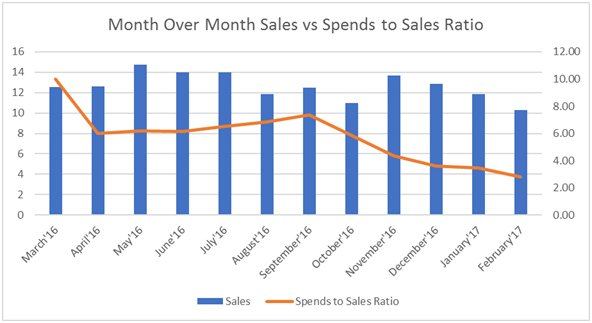
Overall PPC spend-to-sales ratio reduced by 72% (from indexed base of 10.0 in March 2016 to 2.8 in February 2017)
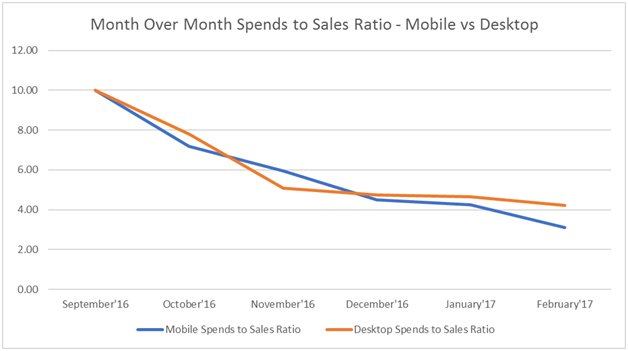
Mobile spend-to-sales ratio reduced by 69% over a 6-month period (October 2016 to March 2017)
Desktop spend-to-sales ratio reduced by 58% over the same 6-month period
Sales volume maintained above client-defined targets throughout the optimization period (cost reduction did not come at the expense of topline revenue)
A sharp initial decline in Spend-to-sales ratio was achieved in Month 1 of the campaign, holding through Month 6, followed by a steady month-over-month decline from September 2016 onward as planned seasonal campaigns compounded gains
For healthcare networks running multi-city PPC campaigns, these results translate into a clear financial principle: profitability in healthcare digital marketing requires product-level and geography-level granularity, not blanket budget management.
As the below chart shows, we were able to bring a sharp decline in ratio in the first month itself, which we were able to maintain over the next six months. And after September 2016, our planned campaigns have witnessed a steady decline in spend-to-sales ratio month-over-month.
Overall Spends-to-Sales Ratio – 72% drop in one year
NOTE: The absolute numbers have been indexed, with Mar. ‘16 set equal to 10, in order to facilitate the comparison of growth over the next 12 months.
Device-wise Performance:
We witnessed a considerable decrease in spends-to-sales ratio on both mobile and desktop – on mobile devices an impressive decrease of 69 percent was witnessed while on the desktop the decrease was slightly less, but still impressive at 58 percent.
NOTE: The absolute numbers have been indexed, with Sept. ‘16 set equal to 10, in order to facilitate the comparison of growth over the next 6 months.
Our Learnings:
Five healthcare digital marketing principles validated by this engagement:
GEO-TRUST ALIGNMENT: In Indian healthcare, digital campaigns perform best when they reinforce existing geographic trust, but not when they attempt to build trust in markets where the brand has no physical presence. Healthcare chains considering digital expansion should sequence digital investment behind physical presence, not ahead of it.
HEALTHCARE SEASONALITY IS PREDICTABLE: In India, healthcare product and service demand follows identifiable seasonal triggers: post-monsoon respiratory demand, post-Diwali pollution-linked demand, flu season in January–February, summer heat-related health concerns. Campaigns that pre-load seasonal creative and budget see significantly lower cost-per-acquisition than reactive campaigns.
DEVICE BEHAVIOR DIFFERS IN HEALTHCARE: Mobile healthcare searches skew toward symptom lookup and ‘near me’ intent. Desktop skews toward product comparison and chronic care research. A single campaign architecture for both devices systematically underperforms. Separate bid strategies, ad copy, and landing pages for mobile and desktop are not optional in healthcare PPC.
COMPETITIVE INTELLIGENCE DRIVES MARGIN IN HEALTH RETAIL: Unlike FMCG, healthcare product pricing changes create narrow but high-value windows of opportunity. Real-time monitoring of competitor stock and pricing enabled Techmagnate to scale spend in windows where Fortis Healthworld had a 10–20% price advantage.
HEALTHCARE BRANDS EARN DIGITAL TRUST DIFFERENTLY: Patients and health consumers apply significantly higher scrutiny to digital healthcare brands than to retail brands. Reviews, product authenticity signals, and brand consistency across online and offline channels are not optional, as they are conversion prerequisites.
Get the most valuable search related insights about leading brands, trending keywords, search volumes, fastest growing categories, city-level insights and much more!
It has come to our notice that fraudulent job offers are being circulated on the internet through messaging apps like WhatsApp and Telegram, which falsely claim to be from Techmagnate. We take this matter seriously and would like to caution all candidates to be wary of such postings.
Please Note That –
We do not charge any fees/security deposit/payment from candidates, irrespective of the professional experience they hold, for job applications or interviews
Official communication channels include our website and verified social media accounts, primarily LinkedIn.
Kindly double-check the domain name – @techmagnate.com – in the email address
We follow a transparent and ethical approach for hiring/onboarding supported by proper documentation.
Ensure that you only apply through verified channels to avoid being scammed. We also recommend that you exercise caution when sharing personal information or financial details with any job posting or recruitment agencies claiming to represent us.
We want to ensure that potential candidates interested in joining Techmagnate have a safe and positive experience.
If you find that someone that fits the description above has reached out to you, please notify us immediately at jobs@techmagnate.com.
Team @Techmangate
Build a Better Digital Marketing Strategy with Techmagnate’s Search Trends Reports
 Important Alert: