Beware of fake job offers and payment requests. We only use official email IDs and never conduct interviews on messaging apps.Beware of fake job offers and payment requests. We only use official email IDs and never conduct interviews on messaging apps.
Summary: This blog focuses on the critical role of user search intent in SEO and digital marketing. It emphasizes that understanding and aligning with the user’s query purpose is essential for online business credibility and marketing success.
The blog defines user search intent as the motivation behind search queries, crucial for effective SEO. It categorizes search intent into four main types: informational, navigational, transactional, and commercial.
Capturing web traffic to drive conversions is the ultimate goal for any digital marketer. While many focus on website optimization and ranking higher on Google, an often overlooked but crucial element of a successful SEO strategy is user search intent. It’s the driving force behind search queries, and understanding it is vital to ensure that your content aligns with what users are truly searching for.
Understanding and creating content that serves the user intent is key to creating your business presence online, building credibility, and ensuring marketing success. In this article, we’ll discuss search intent, its what, why, how, and tips on optimizing search intent for maximum effectiveness.
Table of Contents
What is User Search Intent?
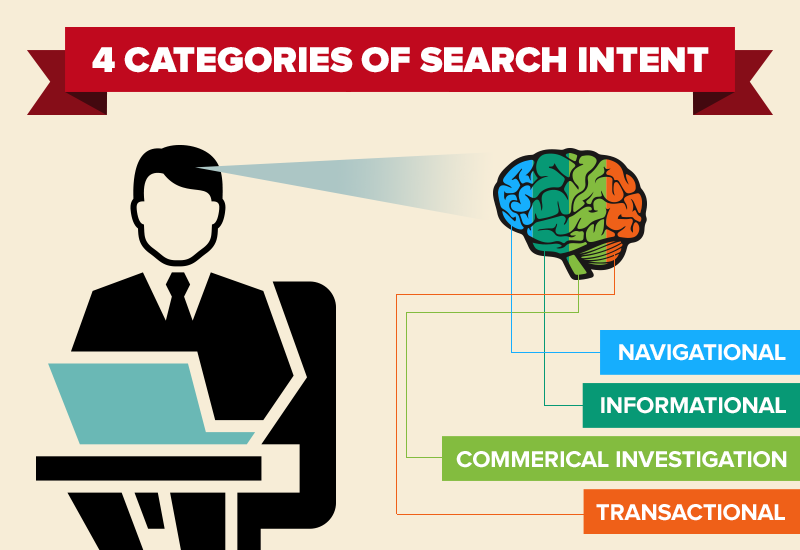
Image Source: liveabusinesslife
In simple terms, search intent refers to the purpose behind a user’s search query. For example, if someone searches for ‘black hiking boots,’ their intent could be to buy (transactional intent), research (informational intent), or find a store (navigational intent). Understanding search intent helps you create content that matches users’ needs, which ultimately improves SEO performance. There are typically four main types of search intent:
Discover What Your Customers Search ForDiscover What Your Customers Search For
Get insights on evolving customer behaviour, high volume keywords, search trends, and more.
In search type, the user typically searches for information or knowledge on a specific topic. These queries are often phrased as questions or may include words like:
How to
What is
Guide
Why
What is
Best way to
Navigational intent
This search intent type is aimed at reaching a specific webpage or website. For example, typing “Facebook” or “Amazon login” indicates a desire to visit these particular sites directly.
Transactional intent
With search intent type, the user is typically looking to make a purchase or conduct a commercial transaction. Such searches might be very specific product searches or often include terms like:
Buy + (product name)
(product name) + price
Product name
Discount + (product name)
Commercial intent
This search intent type revolves around a user’s interest in products or services, minus the purchase decision. It’s more like window shopping, but online.
Why Search Intent is Important in SEO?
Understanding search intent is crucial in various contexts, particularly online marketing, search engine optimization (SEO), and user experience design. Here’s why it’s so important:
Improved user experience
By identifying and understanding search intent, you can create highly relevant, tailored content that resonates with your audience, improving engagement and reducing bounce rates. This not only satisfies user needs but also boosts your SEO rankings as search engines prioritize user satisfaction.
Improved SEO performance
Content created with search intent in mind is what search engines like Google are always looking for, as their main aim is to provide user-relevant content in SERPs. Understanding the intent behind searches allows for the creation of content that aligns with what users are seeking, which can improve a website’s search engine rankings.
Increased engagement and conversion rates
Aligning content with search intent increases the chances of user engagement and desired actions, such as purchasing or subscribing to a newsletter. This alignment can result in higher conversion rates and greater success for your businesses.
Content strategy and creation
Understanding the search intent is crucial for strategizing and crafting content that aligns with the requirements and preferences of the target audience. This makes content more effective and valuable, attracting and retaining more visitors.
Ad targeting and marketing strategies
To optimize ad targeting and enhance the effectiveness of marketing campaigns, advertisers and marketers must focus on search intent. This contributes to a more efficient allocation of advertising budgets, resulting in a higher return on investment (ROI).
Better product and service development
Utilizing information derived from search intent, businesses can enhance or adapt their products and services to more effectively cater to the preferences and requirements of their customers.
Creating content to merely promote your business isn’t enough. As search engines continue to prioritize user experience over keyword integration, you need to understand how to identify the search intent of users to reach the maximum audience. Here are a few ways to identify the users’ search intent:
Keyword analysis
Identify the keywords used for search queries, which can be both short-tail and long-tail. Both keyword types can indicate the kind of search query by the uses, be it a specific search term or a broad one. Use keyword research tools, such as Ahrefs to pinpoint keywords with specific intent.
Query analysis
Use tools like Ahrefs and Google Keyword Planner to analyze search queries and identify the intent behind them. Whether it’s informational, transactional, or navigational, understanding the intent helps optimize your content for the right audience. For example, long-tail keywords like ‘how to choose hiking boots’ signal informational intent, while ‘buy hiking boots online’ is clearly transactional intent.
Google Autocomplete
Google Autocomplete feature is a great way to understand user search intent as it automatically completes the search query based on user behavior. Type a search modifier with your keyword and Google Autocomplete will display what users are searching for.
Examine SERPs
Identify the prevailing content types that secure top rankings, including blog posts, product pages, videos, and more. This provides insight into Google’s understanding of relevance for the given query. Pay attention to the most displayed content formats such as how-to guides, listicles, product reviews, etc., among the top results. These formats can offer valuable insights into user intent.
Take note of any featured snippets, knowledge graphs, and ‘people also ask’ blocks, as they serve as indicators of what users may be searching for.
User journey
Understand the placement of your keyword within the buyer’s journey. If it’s in the early stage (awareness), focus on providing information. In the later stages (decision), prioritize transactional content.
Grasp the context associated with the keywords. For instance, a search for “best laptops 2023” is likely investigative and indicates a leaning towards purchasing.
Keyword research tools
Use popular keyword research tools, such as Google Keywords Planner, SEMrush, or Ahref to identify the frequently used keywords and get their search volume, competition, and related queries. Also, Q&A forums, such as AnswerThePublic can provide a great insight into users’ search intent.
Audience analysis
Understanding the demographics of your target audience can help you identify and predict their search intent. Along with demographics, user interaction with similar content can also give valuable insights into their search patterns.
Competitor analysis
Look at how competitors are addressing similar keywords and queries and what can you learn from their approach. Analyze which pages have high engagement or conversion rates.
With our guide on an SEO competitor analysis, you can learn how to perform your own analysis and obtain a competitive advantage.
Best Practices for Search Intent Optimization
‘Queries’ and ‘usage’ – Know the difference
Not all users search alike. This is where you need to understand the distinction between ‘queries’ and ‘usage’. To ensure that your content reaches the target audience, it’s best to optimize it for both, active queries (present intent) and passive queries (hidden intent)., Addressing both these query types will enable you to enhance your user engagement and conversions.
Use structured data
Implement schema markup to help search engines understand the context of your content. This is particularly useful for informational and commercial investigation intents.
Meta data optimization
Indicate the intent of your content in the title and meta description to improve click-through rates from search engine results.
Content optimization
When it comes to search intent, content plays a key role as the better the content, the more chances are that the users will stay on your website and lead to conversions. Provide high-quality, consistent, detailed, and engaging content that is helpful to the users and compels them to convert. Here are a few tips for content optimization that you can follow:
Bite-sized and digestible content pieces
Use keywords strategically within the content
Use keywords in the URLs, headlines, meta titles, and meta descriptions
Use images and graphs
Focus on educational content like how-to guides, tutorials, and informational articles
The brand and product names should be clearly displayed
Feature stellar reviews and customer testimonials
Create catchy product descriptions, and reviews, and make the buying journey, a smooth one
Create a strong ‘Call to Action’ (CTA)
User experience
User experience (UX) also plays an important role in the search intent playground. An engaging and well-performing website keeps the users on your site and leads to reduced bounce rates. Ensure that your website features a fast page loading time, is easy to navigate, and is mobile-friendly.
Benefit from internal linking
Use internal linking to guide users to related content, enhancing the user experience and keeping them engaged on your site longer.
Stay informed
Search engines periodically update their algorithms and issue new policies for website owners. Keep yourself updated on the latest updates and consistently optimize your website and content as per the changes.
Best Tools for Search Intent Optimization
The above-mentioned tips and best practices are sure to help you understand search intent and optimize it. However, with the evolution of artificial intelligence (AI), there are now a host of tools that can make your search intent optimization efforts, easier. Here are some of these important and popular tools you should consider:
Google Analytics
This tool offers valuable insights into how the users interact with your website and the keywords used to reach your site. Google Analytics can help you understand the intent behind the searches leading your website.
Google Search Console
Yet another widely used tool by webmasters for SEO, Google Search Console provides data on how your site appears in search results, which can be useful for understanding what types of queries bring users to your site and how effectively your content meets their needs.
Ahrefs
Ahrefs stands out as a comprehensive SEO tool, facilitating keyword research, competitor analysis, and monitoring ranking advancements. Noteworthy features include the Keyword Explorer, which aids in discerning the underlying intent behind various keywords.
SEMrush
SEMrush is a great SEO tool to help you understand the user search intent by providing a host of analytical tools, such as site audits, keyword research, and competitor analysis. Its Keyword Magic Tool and Topic Research Tool are particularly useful for understanding search intent and finding content ideas.
Moz Pro
Moz Pro is best known for its Keyword Explorer and SERP analysis tools, providing valuable insights into the content that ranks for particular keywords and the search intent behind them.
AnswerThePublic
A great tool for visual keyword research and generating content ideas, AnswerThePublic leverages search queries to create a graph of questions related to a specific keyword. This tool is particularly useful for identifying informational search intent.
Frequently Asked Questions (FAQs)
How can I identify the search intent behind a keyword?
You can identify search intent by analyzing the type of keyword used. Informational intent typically involves queries like “How to” or “What is,” while transactional intent includes keywords like “Buy” or “Discount.” Use keyword research tools like Ahrefs, SEMrush, or Google’s Autocomplete to help understand the intent behind the search query.
What are the main types of search intent?
There are four primary types of search intent:
Informational Intent – Users are looking for knowledge or answers (e.g., “What is SEO?”).
Navigational Intent – Users are looking for a specific website (e.g., “Facebook login”).
Transactional Intent – Users intend to make a purchase (e.g., “Buy hiking boots”).
Commercial Intent – Users are interested in a product or service but haven’t decided to purchase yet (e.g., “Best hiking boots for women”).
How can understanding search intent improve my SEO performance?
By understanding search intent, you can tailor your content to meet the user’s needs, which increases the chances of your content ranking higher. When your content matches what users are looking for, it leads to a better user experience, increased engagement, and higher conversion rates.
Can I optimize for multiple types of search intent on the same page?
While it’s possible to target multiple intents within the same page, it’s often more effective to create different content for each intent type. For example, you might create a dedicated product page for transactional intent and a blog post or guide for informational intent. However, you can still combine content elements if they align with the overall intent of your page.
How often should I reassess my SEO strategy based on search intent?
You should regularly assess and update your SEO strategy to keep up with changing user behaviors and search engine algorithm updates. Reassessing your content every few months or whenever a significant change occurs in search engine behavior is essential to stay aligned with evolving search intent.
Sarvesh Bagla is an enterprise SEO expert and industry leader who has driven transformational digital growth for India’s top brands across the BFSI, Healthcare, Automotive, and ECommerce industries. As the Founder and CEO of Techmagnate, he leads large-scale organic search strategies and performance marketing campaigns for businesses looking to succeed in today’s AI-driven search landscape.
A strong advocate for thought leadership, Sarvesh is deeply involved in SEO evangelism and regularly contributes to industry discussions through LinkedIn, webinars, and CMO roundtables. His focus today is on helping brands prepare for an AI-first SEO future (AEO, GEO) and strategies for Large Language Models (LLMs) at the core.
Get the most valuable search related insights about leading brands, trending keywords, search volumes, fastest growing categories, city-level insights and much more!
It has come to our notice that fraudulent job offers are being circulated on the internet through messaging apps like WhatsApp and Telegram, which falsely claim to be from Techmagnate. We take this matter seriously and would like to caution all candidates to be wary of such postings.
Please Note That –
We do not charge any fees/security deposit/payment from candidates, irrespective of the professional experience they hold, for job applications or interviews
Official communication channels include our website and verified social media accounts, primarily LinkedIn.
Kindly double-check the domain name – @techmagnate.com – in the email address
We follow a transparent and ethical approach for hiring/onboarding supported by proper documentation.
Ensure that you only apply through verified channels to avoid being scammed. We also recommend that you exercise caution when sharing personal information or financial details with any job posting or recruitment agencies claiming to represent us.
We want to ensure that potential candidates interested in joining Techmagnate have a safe and positive experience.
If you find that someone that fits the description above has reached out to you, please notify us immediately at jobs@techmagnate.com.
 Important Alert:
 Important Alert:
















 6th Feb | Invite-only


