Beware of fake job offers and payment requests. We only use official email IDs and never conduct interviews on messaging apps.Beware of fake job offers and payment requests. We only use official email IDs and never conduct interviews on messaging apps.
Summary: An extensive guide and tutorial on Programmatic SEO, spanning various aspects from definition and examples to its three pillars, pros and cons. Follow the detailed step-by-step guide to create programmatic SEO pages.
What has been updated from the old blog post:
A practical definition of programmatic SEO updated.
Advantages and disadvantages of programmatic SEO explained.
Also added three pillars of programmatic SEO.
Explained 8 steps + examples for creating programmatic SEO pages that can help interlinked content.
Ever wondered how e-commerce platforms effortlessly display related searches even when you haven’t entered specific keywords?
The secret lies in their aggressive use of Programmatic SEO.
This guide dives into what Programmatic SEO is, its advantages and disadvantages, and practical tips for making it work for your business. Understanding this approach will help you improve your website’s visibility and overall success online.
Let’s explore the basics of Programmatic SEO together!
Table of Contents
What is Programmatic SEO
In the context of search engine optimization (SEO), programmatic SEO, also known as pSEO, has emerged as a powerful technique for enhancing website visibility and attracting organic traffic.
This approach involves creating a large number of landing pages, each targeting a specific low-competition keyword. These pages are generated using automated tools and share a common template, ensuring consistency and efficiency.
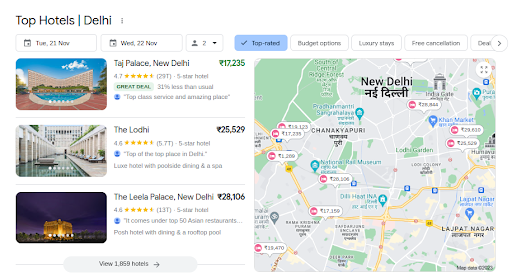
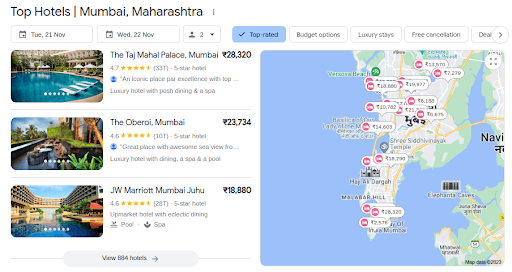
Goibibo, a leading travel company, is a prime example of how programmatic SEO can be effectively utilized. When you search for “top hotels in Delhi,” you’re likely to encounter a Goibibo landing page among the top results. This is because they have leveraged programmatic SEO to create a vast network of landing pages, each tailored to a specific location and keyword combination.
For instance, the landing page for “top hotels in Delhi” differs from the one for “top hotels in Mumbai” in terms of the location and content, while maintaining the same overall layout and design. This allows Goibibo to effectively target and capture a wide range of travel-related search queries without manually creating each page from scratch.
Advantages of Programmatic SEO
Programmatic SEO offers several advantages, including:
Scalability: The ability to generate a large number of landing pages quickly and efficiently.
Targeting: The precision to target specific keywords and search queries.
Efficiency: Automation streamlines the process, saving time and resources.
Adaptability: The ability to adapt to changing search engine algorithms and user behavior.
Disadvantages of Programmatic SEO
While programmatic SEO offers significant benefits, it’s essential to consider potential drawbacks:
Overreliance on Algorithms: Algorithms may lead to over-optimization or a lack of personalization.
Potential Errors: Algorithms may introduce inaccuracies or technical issues.
A balanced approach that combines automated strategies with human expertise is crucial to optimize websites for search engines while maintaining a positive user experience. Programmatic SEO will undoubtedly play an increasingly important role in shaping the success of businesses online as the digital landscape continues to evolve.
Imagine you have a virtual storefront and want to attract more customers. Programmatic SEO is like having a team of salespeople who can create custom storefronts for each product you sell.
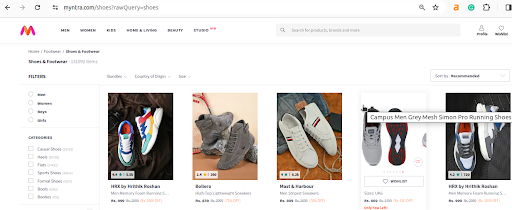
1. The first pillar of programmatic SEO is to focus on keywords that are easy to rank for. Think of these as the keywords that people use when they are just starting to research a product or service. For example, if you sell shoes, you might target keywords like “best running shoes” or “comfortable shoes for work.”
2. The second pillar of programmatic SEO is to make sure your landing pages are aligned with the search intent of the keywords you are targeting. If someone is searching for “best running shoes,” they are probably looking for information about different brands and models. Your landing page should provide this information, as well as a clear call to action, such as “Shop now.”
3. The third pillar of programmatic SEO is to provide a great user experience. This means making sure your pages load quickly, are easy to navigate, and provide valuable content. You should also avoid using AI-generated content that is low quality or thin.
Step by Step Guide to Implement a Programmatic SEO Strategy
Step 1: Keyword Research and Content Planning
The foundation of programmatic SEO lies in identifying relevant keywords that align with your target audience’s search intent. This involves understanding the specific terms and phrases users employ when seeking information or products related to your industry or niche.
To effectively conduct keyword research, consider utilizing keyword research tools that provide insights into search volume, competition levels, and related keywords. Additionally, analyze your competitors’ websites and content to uncover keywords they are effectively targeting.
Another technique to find good keywords is to identify modifiers and related terms. For instance, instead of using the broad term “laptop,” opt for a more specific phrase like “best lightweight laptops for students.”
Incorporating related terms can broaden your content’s reach and attract a wider audience. For example, along with targeting “best lightweight laptops for students,” also consider incorporating related keywords like “student laptop deals,” “back-to-school essentials,” and “college tech recommendations.”
By strategically employing modifiers and related terms, you can enhance the relevance of your content and draw more visitors to your website.
Step 2: Design Your Page Template
Before diving into content creation, it is crucial to establish a clear and consistent template for your programmatic SEO pages. This template will serve as the blueprint for all the pages you generate, ensuring uniformity and a positive user experience across the board.
Start by outlining the essential elements of your page, such as the header, body content, sidebar, and footer. Define the layout and structure of each element, ensuring it aligns with your overall website design and branding guidelines.
Consider incorporating user experience (UX) best practices into your page template. Ensure the layout is easy to navigate, the text is readable, and the overall design is visually appealing. Prioritize mobile responsiveness, as a significant portion of searches occur on mobile devices.
Step 3: Identify and Collect Your Data
The unique and valuable data you gather will serve as the backbone of your programmatic SEO pages. This data should be relevant to the keywords you have identified and provide a compelling reason for users to visit your pages.
The specific data you collect will vary depending on your industry or niche. For instance, an e-commerce website might collect product descriptions, pricing information, and customer reviews. A travel website could gather destination information, hotel listings, and travel tips.
Explore various methods for data collection, such as scraping websites, conducting surveys, or utilizing existing data sources. Ensure the data is accurate, up-to-date, and relevant to your target audience.
Step 4: Build the Database with Content and Labels
Once you have collected the necessary data, organize it into a structured database. Airtable is a user-friendly tool that can effectively handle large amounts of data and categorize it into fields tailored to your specific needs.
Create fields for each piece of content you intend to display on your programmatic SEO pages. Additionally, include fields for metadata, such as page titles, URLs, and descriptions.
Populate the database with the collected data, ensuring accuracy and completeness. Utilize Airtable’s filtering and sorting capabilities to easily manage and analyze your data.
Step 5: Optimize your page titles and meta descriptions
Your page titles and meta descriptions are two of the most important factors that search engines consider when ranking your pages. They are also the first things that people will see when your pages appear in search results, so they need to be informative and enticing.
Here are some tips for optimizing your page titles and meta descriptions:
Include your target keywords in your page titles and meta descriptions, but don’t overdo it. Your titles and descriptions should still be natural and easy to read.
Your page titles should be no more than 60 characters long, and your meta descriptions should be no more than 160 characters long.
Your titles and descriptions should accurately reflect the content of your page. They should also be interesting and attention-grabbing.
Your meta descriptions should include a call to action, such as “Click here to learn more” or “Shop now.”
Schema markup is a type of structured data that helps search engines understand the content of your pages. It is a way of telling search engines what your pages are about so that they can display them in more relevant search results.
Internal linking is the practice of linking to other pages on your website. This helps search engines understand the structure of your website and can improve your search rankings.
The anchor text of your internal links should be relevant to the page you are linking to.
Don’t use the same anchor text for all of your internal links. Use a variety of anchor text to keep your links natural and avoid keyword stuffing.
Only link to pages that are relevant and high-quality. Avoid linking to pages that are thin or low-quality.
It is important to monitor and analyze the results of your programmatic SEO efforts to see what is working and what is not. You can use a variety of analytics tools to track the performance of your pages, such as Google Analytics and Search Console.
A few things to keep in mind while monitoring and analyzing your results;
Organic traffic: How much organic traffic are your programmatic SEO pages generating?
Click-through rate (CTR): What is the CTR of your programmatic SEO pages and are they really compelling?
Ranking: How are your programmatic SEO pages ranking in search results?
By monitoring and analyzing your results, you can identify which pages are performing well and which pages need to be improved. You can then make adjustments to your programmatic SEO strategy to improve the performance of your pages.
What is The Difference Between Programmatic SEO and Regular SEO
Programmatic SEO automates large-scale content creation using data and templates, while regular SEO focuses on manual, high-quality content optimization. Let’s explore their key differences.
Feature
Programmatic SEO
Regular SEO
Approach
Automated, data-driven
Manual, content-focused
Content Creation
Bulk generation using templates & databases
Handwritten, high-quality content
Keyword Targeting
Focuses on long-tail & localized keywords at scale
Targets broader, high-competition keywords
Time & Effort
Fast, minimal manual effort
Time-consuming, requires continuous updates
Best For
Large-scale websites, directories, marketplaces
Blogs, brand websites, service-based businesses
Scalability
Highly scalable
Limited scalability
Customization
Limited personalization
Highly customized content
Importance of Programmatic SEO in 2025
Programmatic SEO is crucial in 2025 for automating large-scale content creation, improving search rankings, and driving organic traffic. It saves time, enhances efficiency, and helps businesses target niche and local keywords. By leveraging AI and automation, it ensures a competitive edge in an evolving digital landscape.
Scales SEO Efforts – Automates content creation for thousands of pages, saving time and effort.
Increases Traffic – Helps rank for long-tail keywords, driving more organic visitors.
Personalized Content – Creates unique, data-driven pages tailored to user intent.
Improves Efficiency – Reduces manual work by using automation and AI.
Boosts Competitive Edge – Helps smaller businesses compete with big brands.
Enhances Local & Niche SEO – Builds pages for specific locations or topics at scale.
Future-Proof Strategy – Adapts to AI-driven search trends in 2025 and beyond.
To make Programmatic SEO work well, it takes planning and continuous improvements. If you need help with this tricky but effective strategy, consider talking to the experts at Techmagnate. They know how to make your SEO work its best.
Ready to shine online? Reach out to Techmagnate and unlock the full potential of Programmatic SEO!
Sarvesh Bagla is an enterprise SEO expert and industry leader who has driven transformational digital growth for India’s top brands across the BFSI, Healthcare, Automotive, and ECommerce industries. As the Founder and CEO of Techmagnate, he leads large-scale organic search strategies and performance marketing campaigns for businesses looking to succeed in today’s AI-driven search landscape.
A strong advocate for thought leadership, Sarvesh is deeply involved in SEO evangelism and regularly contributes to industry discussions through LinkedIn, webinars, and CMO roundtables. His focus today is on helping brands prepare for an AI-first SEO future (AEO, GEO) and strategies for Large Language Models (LLMs) at the core.
Get the most valuable search related insights about leading brands, trending keywords, search volumes, fastest growing categories, city-level insights and much more!
It has come to our notice that fraudulent job offers are being circulated on the internet through messaging apps like WhatsApp and Telegram, which falsely claim to be from Techmagnate. We take this matter seriously and would like to caution all candidates to be wary of such postings.
Please Note That –
We do not charge any fees/security deposit/payment from candidates, irrespective of the professional experience they hold, for job applications or interviews
Official communication channels include our website and verified social media accounts, primarily LinkedIn.
Kindly double-check the domain name – @techmagnate.com – in the email address
We follow a transparent and ethical approach for hiring/onboarding supported by proper documentation.
Ensure that you only apply through verified channels to avoid being scammed. We also recommend that you exercise caution when sharing personal information or financial details with any job posting or recruitment agencies claiming to represent us.
We want to ensure that potential candidates interested in joining Techmagnate have a safe and positive experience.
If you find that someone that fits the description above has reached out to you, please notify us immediately at jobs@techmagnate.com.
 Important Alert:
 Important Alert: