Beware of fake job offers and payment requests. We only use official email IDs and never conduct interviews on messaging apps.Beware of fake job offers and payment requests. We only use official email IDs and never conduct interviews on messaging apps.
Summary: This comprehensive guide explores On-Page SEO its importance, techniques, and actionable strategies to enhance your website’s visibility and performance. It includes a detailed on-page SEO checklist, best practices for optimizing content, keywords, internal links, and images, and a curated list of free SEO tools for implementation. In the era of AI-driven search and Google SGE, on-page optimization plays a pivotal role in ensuring your content is both search-engine-friendly and AI-readable.
For improved rankings, engagement, and ROI, partner with Techmagnate, a leading on-page SEO service provider trusted by global brands.
Key Takeaways:-
On-Page SEO improves site rankings by optimizing content, keyword usage, and page structure for search engines.
Keyword placement in titles, headings, and meta descriptions is essential for better SEO performance.
Image optimization enhances user experience and page speed, contributing to SEO success.
Content optimization with relevant keywords and unique angles boosts engagement and traffic.
Mobile optimization is crucial as a majority of users search and shop on mobile devices.
Table of Contents
What is On-Page SEO?
On-Page SEO is the process of optimizing your website’s pages to help them rank higher on Google and other search engines. It includes making sure your content is valuable, using the right keywords, and structuring your page properly so that both search engines and people can understand it easily.
Think of On-Page SEO as tidying up your website so that visitors can easily find what they need, and search engines can see that your page is relevant to a user’s search.
For example, when you search for “best smartphones under 20,000”, Google shows pages that are well-optimized with clear titles, good content, images, and fast loading speed. That’s On-Page SEO at work!
How Does On-Page SEO Work?
On-page SEO works by helping search engines and users understand what your web page is about, how relevant it is to specific queries, and how trustworthy it appears compared to other pages.
Here’s a simplified breakdown of how it works:
Crawling & Indexing:
Search engines like Google first crawl your page, analyzing your content, headings, images, links, and metadata to determine what the page covers.
Relevance Scoring:
Google then compares your page’s content and keyword usage against search queries. Proper keyword placement, semantic optimization, and structured headings (H1 to H3) signal relevance.
User Experience Signals:
Factors like page speed, mobile-friendliness, and time on page influence how search engines evaluate your content quality.
Content Authority:
Internal linking, EEAT signals, and external backlinks boost your page’s authority showing that your content is credible and worth ranking higher.
Continuous Optimization:
On-page SEO isn’t a one-time setup. Regularly refreshing content, improving readability, and adding AI-driven optimization insights (like using NLP or entity SEO tools) keeps your pages aligned with the latest Google algorithm updates.
In 2025, with AI search (SGE and ChatGPT integration), on-page SEO now includes optimizing for LLMs (Large Language Models) meaning your content should be structured, factual, and citation-worthy to get picked up by AI answer engines.
Why is On-Page SEO Important?
Helps search engines understand your content
Improves user experience and engagement
Enhances chances of ranking higher on SERPs
Increases organic traffic and conversions
Imagine searching for the ‘best seo services’ in town. A query is entered into a search engine, and it gives countless relevant business options. On-page SEO is what helps those search engines recognize out of all those listed agencies , which ones are the real deal.
Here’s why On-Page SEO matters:
Discover What Your Customers Search ForDiscover What Your Customers Search For
Get insights on evolving customer behaviour, high volume keywords, search trends, and more.
Visibility: A well-optimized page is more likely to rank high on search engines. That means more eyes on your business. Many businesses achieve this with the help of on-page SEO services, which ensure that optimization efforts meet search engine standards effectively.
Relevance: If your content is spot on with specific keywords or topic, search engines consider it most relevant for the user’s search query.
User experience: Good on-page optimization makes pages easier to navigate and more enjoyable to read, increasing time on site and engagement.
Competitive edge: Every little extra effort in this competitive world should be utilized.
On-Page SEO vs Off-Page SEO vs Technical SEO: Key Differences Explained
The below chart serves as a roadmap to understanding the on-page SEO elements, helping distinguish it from other aspects of search engine optimization.
On-Page SEO
Off-page SEO
Technical SEO
Content
Backlinks
Indexing
Keyword Placement
Guest posting
Crawling
HTML Tags
Quora
Page speed
Meta Description
Social Media Promotions
Data structure/td>
Image Optimization
PR
Site structure
Links (Internal & External)
–
Sitemaps
URL
–
–
Additional read: Technical SEO vs On-Page SEO: Key Differences
12 Actionable On-Page SEO Techniques to Enhance Your Site
Now that we have a clear understanding of what on-page SEO elements are, it’s time to explore each technique in detail. These actionable on-page SEO tips form the foundation of your overall on-page optimization strategy and directly impact how well your pages rank on search engines.
1. Content optimization
Content is king for any website. To improve rankings, you need to create high-quality, intent-driven content. SEO writing plays a key role in this process, as it involves strategically using keywords and structuring your content to meet both user intent and search engine requirements. When done correctly, it ensures that your content is not only readable and engaging but also optimized for search engines, helping you rank higher and attract more traffic.
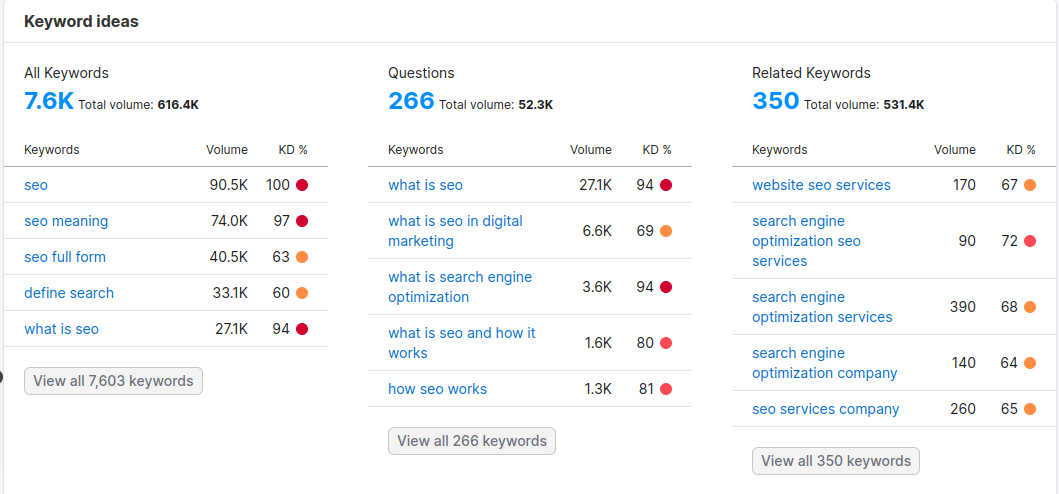
The best way to start with the content process is through effective keyword research. Using a tool will give better keyword and topic ideas related to what users are searching. When you compare target keywords, you can identify the ones with higher search volume and lower competition, giving you a competitive edge in your content strategy. However, it’s equally important to know which SEO techniques should be avoided, such as keyword stuffing, over-optimization, and duplicate content, as these practices can negatively impact your rankings.
Understand this with an example of ‘seo services’ using the Semrush tool. You can see a list of keywords with search volume. High search volumes are easier to target but they have high competition too.
Image source: semrush
Long tail keywords are easier to rank as sometimes they have low search volume. Once you finalize the keywords, the content optimization starts. We recommend following a few practices to optimize high quality content for your website:
Add your primary keyword and secondary keywords throughout your content naturally.
Make sure the content matches the search intent
Cover a topic end-to-end
Give your content a unique angle, that sets it apart from competitors. Conducting an SEO competitor analysis can help you identify gaps in their strategies and allow you to create content that stands out more effectively.
Make it visually appealing and easy to read
Ensure that you are understanding canonical URLs to avoid duplicate content issues and help search engines identify the preferred version of your content.
2. Keyword placement
Google and readers scan a page to see what it is about. Writing quality content will automatically have all primary keywords and LSI keywords. However, there are specific placements where you must put keywords strategically.
Here are the most important areas where on-page keyword optimization should be done:
Page Title: Add your main keyword close to the beginning of the title tag. This helps search engines quickly understand the topic and boosts click-through rates.
Headings (H1): The H1 tag should clearly define the page topic and include the target keyword an essential part of heading tag optimization in on-page SEO.
Subheadings (H2, H3): Use secondary and related keywords naturally in subheads. This improves readability and allows search engines to connect supporting ideas.
First Paragraph: Include your focus keyword within the first 100 words to signal relevance early on.
Meta Description: Incorporate the target keyword while maintaining a natural, compelling message that encourages clicks.
Image Alt Text: Use descriptive, keyword-rich alt text for images to improve accessibility and image SEO.
Image File Name: Rename image files with relevant keywords before uploading (e.g., on-page-seo-techniques.jpg instead of IMG1234.jpg).
Additionally, it’s important to maintain the right keyword density in SEO. This means using your keywords naturally and in moderation throughout the content, ensuring search engines can easily identify the page’s topic without the risk of keyword stuffing.
3. Image optimization
Image optimization for on-page SEO is the process of enhancing the images on a web page to improve both user experience and search engine visibility. Images significantly impact the loading speed of a webpage. Here are some key steps to optimize images for on-page SEO:
Choose the Right Image Format: Use formats like JPEG/PNG for images with transparency.
Resize Images: Images should be appropriately sized for their placement on the webpage.
Use Descriptive File Names: Rename image files with descriptive, keyword-rich filenames before uploading.
Add Alt Text: Provide descriptive and meaningful alt text for each image. Include relevant keywords if applicable.
Optimize Image Titles: Use descriptive and keyword-rich titles for your images.
4. Links (Internal and External)
On-page SEO involves various types of links that are crucial for optimizing a web page. Two important types of links in on-page SEO are internal links and external links. Following a guide to anchor text can help you craft clear, relevant link text, which is essential for both user experience and SEO.
Internal Links (On-Page SEO Internal Linking): Internal links are links that point to other pages within the same website. They are important for on-page SEO because they help with website navigation, distribute page authority, and establish a logical hierarchy for your content.
External Links (Outbound Links): External links are links that point from your webpage to other websites or external sources. While these don’t directly benefit your website’s SEO, they can be valuable for providing additional information and credibility to your content.
Why Linking Matters for On-Page SEO Success?
Both internal and external linking are crucial on-page SEO tasks that strengthen site architecture and content authority. A well-planned on-page SEO link strategy helps improve crawl depth, enhances content discoverability, and boosts engagement metrics like dwell time and click-through rate.
5. URL optimization
URL optimization for on-page SEO means making your web page’s website address (URL) clear, concise, and relevant to the content on the page. This helps both search engines and people understand what your page is about. For example:
The “Good URL” tells both users and search engines that the page is about SEO services, which is clear and helpful. The “Poor URL” is confusing and doesn’t give a clear idea what the page is about.
6. Meta description Optimization
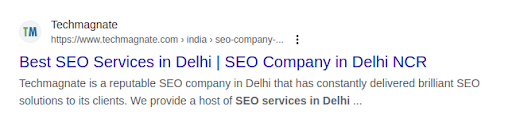
A meta description is like a short summary (155-160 characters) of what a web page is about. It’s a brief description you see below a website link in search results. Meta descriptions help people decide if they want to click on that link or not.
In the above image, when you search for the keyword ‘SEO service in Delhi,’ the meta description of Techmagnate’s website here is summarizing what Techmagnate is and the specific SEO services it provides.
Users can quickly understand that Techmagnate is a company that offers SEO service in Delhi. It’s like a quick preview that helps them decide whether to click on the link or not.
7. Title Tags – The First Impression Matters
A title tag is like the title of a book – it tells search engines and users what your page is about. It appears in search results as the clickable headline.
💡 Best Practices:
✔ Keep the title under 60 characters so it doesn’t get cut off in search results.
✔ Include the main keyword naturally to help search engines understand your topic.
✔ Make it engaging and clear. Adding power words like “Ultimate,” “Best,” or “Guide” can boost clicks.
✅ Example of good meta title:
Bad Title: SEO Services – Get More Traffic
Good Title: SEO Services to Skyrocket Your Website Traffic (Proven Strategies)
8. Header Tags (H1-H6) – Structure Your Content for Easy Reading
Think of header tags as the chapters of a book that organize your content into sections.
💡 Best Practices for Heading tags optimization:
✔ H1 Tag – The main heading of the page. It should clearly describe the page topic.
✔ H2 & H3 Tags – Use them for subheadings to break the content into sections, making it easy to scan.
✅ Example:
If you’re writing about On-Page SEO, your structure might look like this:
H1: On-Page SEO: The Complete Guide
H2: What is On-Page SEO?
H2: Why is On-Page SEO Important?
H2: Best On-Page SEO Practices
H3: Title Tags
H3: Header Tags
This helps both users and search engines navigate your content better.
9. Page Speed Optimization – Faster Websites Win
Imagine clicking on a slow website – frustrating, right? Page Speed Optimization ensures faster loading times, reducing bounce rates and keeping visitors engaged.
💡 Best Practices:
✔ Reduce large image sizes – Use formats like WebP instead of PNG.
✔ Minimize CSS & JavaScript – Remove unnecessary code that slows down your site.
✔ Use a Content Delivery Network (CDN) – This helps load your site faster worldwide.
✅ Example:
A website taking 3+ seconds to load can lose 50% of visitors! Tools like Google PageSpeed Insights can help check your site speed and suggest improvements.
10. Mobile-Friendliness – Optimize for Small Screens
More than 60% of searches happen on mobile phones. If your website isn’t mobile-friendly, you’re losing potential visitors.
💡 Best Practices:
✔ Use a responsive design so your website adjusts to all screen sizes.
✔ Ensure text is readable without zooming and buttons are easy to click.
✔ Test your site with Google’s Mobile-Friendly Test to spot issues.
✅ Example:
Ever visited a website on your phone where you had to zoom in to read the text? That’s an example of a non-mobile-friendly site. A good website should automatically adjust to fit your screen.
11. Schema Markup – Stand Out in Search Results
Schema markup is like giving Google extra details about your page so it can show special results like stars, FAQs, or images in search results.
💡 Best Practices:
✔ Use FAQ schema to make your answers appear directly in search results.
✔ Apply Review schema for product ratings ⭐⭐⭐⭐⭐.
✔ Use Recipe schema for food-related content.
✅ Example:
If you search “best pizza recipe”, you might see a result with a star rating and cooking time – that’s schema in action!
12. Featured Snippet Optimization – Get Position Zero
A featured snippet is the highlighted answer Google shows at the top of search results.
💡 Best Practices:
✔ Answer questions directly in 40-60 words.
✔ Use bullet points or numbered lists to increase the chances of appearing in snippets.
✔ Optimize for question-based searches like “How to,” “What is,” and “Why does.”
✅ Example:
When you search “How to make tea?”, Google might show a step-by-step snippet at the top before other websites. That’s the power of optimized content!
Advanced On-Page SEO Techniques (Bonus Tips)
1. Incorporate a Semantic SEO Strategy
Instead of just targeting one keyword, Google now focuses on context and related topics. A strong Semantic SEO Strategy helps structure content around related terms, improving relevance and rankings.
How to apply Semantic SEO?
✅ Use LSI keywords (related phrases) naturally.
✅ Cover the entire topic instead of just one keyword.
✅ Structure your content to answer user intent.
📌 Example:
Instead of just using “SEO techniques”, include variations like:
On-Page SEO strategies
Advanced SEO methods
How to optimize a website for search engines
This helps Google understand your content better and rank you for multiple related terms!
Google favors credible, well-researched content from experts, emphasizing E-E-A-T in SEO (Experience, Expertise, Authoritativeness, and Trustworthiness) to rank high-quality pages.
How to boost E-A-T?
✅ Show author credentials (Who wrote the content? Why are they an expert?).
✅ Use trusted sources (official stats, research papers).
✅ Make sure your website is secure (HTTPS).
📌 Example:
If a blog about heart disease is written by a certified doctor, it ranks higher than a general blog with no expert insights.
For business sites, adding testimonials, case studies, and client logos also improves trust and credibility.
3. Voice Search Optimization
With the rise of Siri, Alexa, and Google Assistant, voice search is changing SEO.
How to optimize for voice search?
✅ Use natural, conversational language.
✅ Optimize for “near me” searches (local SEO).
✅ Create FAQ-style content with direct answers.
📌 Example:
Instead of:
❌ “Best smartphones 2025” Voice search users ask:
✅ “What are the best smartphones in 2025?”
Rewriting content to match how people actually speak can help you rank for voice searches!
4. Content Freshness Strategy
Google loves fresh, updated content. Keeping your site relevant boosts rankings and engagement.
How to maintain content freshness?
✅ Update old posts every 6-12 months with new trends & data.
✅ Repurpose content (turn blogs into videos, infographics, LinkedIn posts).
✅ Fix outdated or broken links regularly.
📌 Example:
If you wrote an article on “SEO trends 2023”, update it with the latest 2025 insights to keep it relevant!
Free SEO Tools for On-Page Optimization
While on-page is an ongoing process, there are multiple tools in the market to ease out the optimization for you. You don’t always need paid tools to improve SEO. Here are some free tools to help:
Google Search Console – Fix technical SEO issues and track rankings.
Yoast SEO (WordPress Plugin) – Optimize meta titles, descriptions & readability.
Ahrefs Free Tools / Semrush Free Plan – Keyword research & backlink analysis.
Google PageSpeed Insights – Improve website speed & performance.
1. Google Search Console – Fix Technical SEO Issues & Track Rankings
What is it?
Google Search Console (GSC) is a free tool by Google that helps website owners track performance, fix technical SEO issues, and submit sitemaps. By using Google Search Console, you can monitor keyword rankings, identify indexing problems, and improve your site’s visibility.
✅ Track website performance in search results.
✅ Find and fix technical SEO issues.
✅ Submit sitemaps for indexing.
How to Use It?
Check search performance: See which keywords bring traffic to your site.
Fix indexing issues: If some pages aren’t appearing on Google, GSC tells you why.
Find mobile usability errors: Google flags any issues affecting mobile-friendliness.
Monitor backlinks: Check which websites link to yours.
2. Yoast SEO (WordPress Plugin) – Optimize Meta Titles, Descriptions & Readability
What is it?
Yoast SEO is a popular WordPress plugin that helps optimize content for search engines and users by improving:
✅ Meta titles and descriptions.
✅ Readability and content structure.
✅ Internal linking suggestions for better navigation.
How to Use It?
🔹 Optimize meta titles and descriptions: Ensure they are keyword-rich and engaging.
🔹 Improve readability: Follow Yoast’s recommendations for sentence length, passive voice, and subheading usage.
🔹 Get SEO suggestions: Use the tool’s traffic light system to optimize content before publishing.
What is it?
Screaming Frog is an SEO auditing tool that scans websites to detect technical issues, such as:
✅ Broken links and redirects.
✅ Duplicate content and missing meta tags.
✅ Page response codes and indexing errors.
How to Use It?
🔹 Run a full website crawl: Identify errors affecting site performance.
🔹 Fix broken links: Locate and update non-working internal and external links.
🔹 Check for duplicate content: Find and resolve duplicate pages or missing meta descriptions.
4. Ahrefs Free Tools / Semrush Free Plan – Keyword Research & Backlink Analysis
What is it?
Ahrefs and Semrush offer free tools to help with essential SEO tasks like:
✅ Finding high-ranking keywords.
✅ Analyzing competitor strategies.
✅ Tracking backlinks and domain authority.
How to Use It?
🔹 Conduct keyword research: Identify relevant search terms with high potential.
🔹 Analyze competitor backlinks: Discover link-building opportunities.
🔹 Monitor site performance: Track keyword rankings and SEO trends over time.
5. Google PageSpeed Insights – Improve Website Speed & Performance
What is it?
Google PageSpeed Insights is a tool that evaluates a website’s speed and performance, helping improve:
✅ Page load time for better user experience.
✅ Core Web Vitals like interactivity and visual stability.
✅ Mobile and desktop performance scores.
How to Use It?
🔹 Test your website: Enter the URL and analyze performance metrics.
🔹 Optimize images and scripts: Reduce file sizes and remove unnecessary code.
🔹 Improve server response time: Use caching and a CDN for faster loading speeds.
Closing Thoughts
On-page SEO is a vital aspect of optimizing your website for search engines. By focusing on factors such as high-quality content, keyword optimization, user-friendly design, and mobile responsiveness, brands can improve their website’s visibility and rankings in search results. Regularly monitoring and updating your on-page SEO efforts is crucial to staying competitive in the online landscape and attracting organic traffic to your site.
A well-optimized website not only benefits search engines but also provides a better user experience, ultimately leading to increased engagement and conversions.
When it comes to On-Page SEO, Techmagnate – a leading SEO service provider has you covered. We offer top-notch services to optimize web pages, ensuring they shine in the digital landscape. With our expertise, you can be confident that your online presence will not only meet but exceed industry standards, ensuring that your website gains the attention and results it deserves.
On-Page SEO involves optimizing individual web pages to improve their ranking on search engines by focusing on content, structure, and keyword placement.
Why is On-Page SEO important?
It helps search engines understand your content, improves user experience, enhances rankings, and drives more organic traffic to your website.
How do I optimize images for On-Page SEO?
Resize images, use descriptive filenames and alt text, and choose the appropriate image formats like JPEG or PNG to improve page load speed and SEO.
What are the best practices for keyword placement in On-Page SEO?
Place primary keywords in titles, meta descriptions, headings (H1, H2), and throughout the content while maintaining natural readability.
How does mobile optimization impact On-Page SEO?
Mobile optimization ensures your site is responsive and user-friendly on mobile devices, improving engagement and helping with rankings, especially after Google’s mobile-first indexing.
How does AI impact On-Page SEO in 2025?
AI-driven algorithms like Google’s RankBrain, BERT, and SGE (Search Generative Experience) focus on user intent and content relevance. Optimizing for natural language, structured data, and topical depth ensures your page ranks better in AI-powered search results.
How can I use AI tools for On-Page SEO optimization?
AI tools such as Surfer SEO, Frase, and ChatGPT can analyze top-ranking pages, suggest missing topics, optimize keyword placement, and generate SEO-friendly meta tags streamlining your on-page optimization process.
How does On-Page SEO help brands appear in AI-generated answers (like ChatGPT or Google SGE)?
By structuring content clearly with schema markup, FAQs, and concise definitions, brands can improve their chances of being featured or cited in AI-driven search responses and LLM-generated summaries.
What are the key On-Page SEO elements every website must optimize?
The main on-page SEO elements include title tags, meta descriptions, header tags (H1–H6), keyword placement, internal links, image alt text, and schema markup all of which help improve relevance and rankings.
How do I measure the success of my On-Page SEO efforts?
Track metrics like organic traffic, keyword rankings, CTR, bounce rate, and average session duration using tools like Google Search Console, GA4, and Ahrefs. Regular on-page SEO analysis helps identify what’s working and what needs refinement.
Sarvesh Bagla is an enterprise SEO expert and industry leader who has driven transformational digital growth for India’s top brands across the BFSI, Healthcare, Automotive, and ECommerce industries. As the Founder and CEO of Techmagnate, he leads large-scale organic search strategies and performance marketing campaigns for businesses looking to succeed in today’s AI-driven search landscape.
A strong advocate for thought leadership, Sarvesh is deeply involved in SEO evangelism and regularly contributes to industry discussions through LinkedIn, webinars, and CMO roundtables. His focus today is on helping brands prepare for an AI-first SEO future (AEO, GEO) and strategies for Large Language Models (LLMs) at the core.
Get the most valuable search related insights about leading brands, trending keywords, search volumes, fastest growing categories, city-level insights and much more!
It has come to our notice that fraudulent job offers are being circulated on the internet through messaging apps like WhatsApp and Telegram, which falsely claim to be from Techmagnate. We take this matter seriously and would like to caution all candidates to be wary of such postings.
Please Note That –
We do not charge any fees/security deposit/payment from candidates, irrespective of the professional experience they hold, for job applications or interviews
Official communication channels include our website and verified social media accounts, primarily LinkedIn.
Kindly double-check the domain name – @techmagnate.com – in the email address
We follow a transparent and ethical approach for hiring/onboarding supported by proper documentation.
Ensure that you only apply through verified channels to avoid being scammed. We also recommend that you exercise caution when sharing personal information or financial details with any job posting or recruitment agencies claiming to represent us.
We want to ensure that potential candidates interested in joining Techmagnate have a safe and positive experience.
If you find that someone that fits the description above has reached out to you, please notify us immediately at jobs@techmagnate.com.
 Important Alert:
 Important Alert: