Beware of fake job offers and payment requests. We only use official email IDs and never conduct interviews on messaging apps.Beware of fake job offers and payment requests. We only use official email IDs and never conduct interviews on messaging apps.
Summary: The blog post highlights the impact of Google’s Knowledge Graph in improving search experiences. It explains the Knowledge Graph’s role in enhancing search accuracy, visibility, and user experience, and its benefits for SEO, including support for semantic and voice search.
Key Takeaways:-
Google’s Knowledge Graph shows quick, factual answers using entity-based data.
It boosts SEO by improving visibility, trust, and engagement.
Use structured data to help Google connect your content with the Graph.
It powers the Knowledge Panel but isn’t the same thing.
Future updates will enhance AI, personalization, and voice search accuracy.
Search engines continually evolve to provide as accurate search results as possible. One of the key features of the search landscape is the Knowledge Graph.
The Knowledge Graph is a knowledge base that collects factual information about people, places, and things and displays it as an instant answer to quickly address the user’s query. It is a sophisticated technology used to enhance the search experience by organizing and presenting information in an interconnected, easily accessible manner.
In this article, we’ll discuss in detail the Knowledge Graph (in the context of Google), its vital role in delivering relevant search results, and what the future holds for the Knowledge Graph.
Table of Contents
What is Google’s Knowledge Graph?
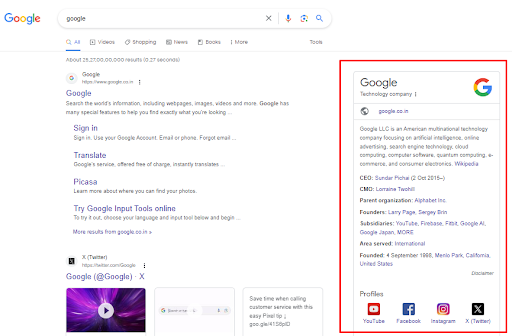
Have you ever seen an information box on the right side of search results in Google that shows a snippet of the answer to your query? If your answer is yes, then you’ve witnessed the power of Google’s Knowledge Graph.
Essentially, the Knowledge Graph is a system integrated into the Google search engine to enhance the user experience by providing facts, figures, and data related to the user’s most likely search intent.
Google categorizes the information in the Knowledge Graph as ‘entities’. These are the primary objects in a Knowledge Graph, representing real-world objects like people, places, and things.
Google’s Knowledge Graph was introduced in 2012 with a database of 3.5 billion facts, spanning a staggering 500 million entities. As Google continued to accumulate information for knowledge, in May 2022, Google confirmed that the system comprised 500 billion facts on 5 billion entities.
Discover What Your Customers Search ForDiscover What Your Customers Search For
Get insights on evolving customer behaviour, high volume keywords, search trends, and more.
The information and data for the Knowledge Graph are mined from a variety of open-source platforms, such as Wikipedia, CIA World Factbook, and Freebase among others. Google also uses collected data from Google Maps reviews, information from Google Business Profile, and other user-generated content sources to constantly update the Knowledge Graph.
Google uses Schema.org markup and other such services to integrate structured data into the Knowledge Graph from websites featuring structured information. When a search query is entered, Google first identifies the entities within the query and then uses natural language processing (NLP) to identify the context and relevance of the entities to the search query.
Just like Google, the Knowledge Graph is also continuously evolving and updating its database with updated information from user interactions, new data, and changing world events.
Google uses machine learning algorithms to update the Knowledge Graph and improve its understanding of how different entities are related.
Why Optimize for Knowledge Graph on Google?
Optimizing Google’s Knowledge Graph is an effective SEO strategy that can significantly impact a brand’s online visibility and user engagement. Many businesses partner with a digital marketing company to implement structured data, enhance content relevance, and improve search engine recognition for better Knowledge Graph integration. Here’s why it matters:
1. Increase in Brand Visibility on Search Results
When your business information appears in the Knowledge Panel, it stands out prominently on the SERP. This visibility increases the chances of users clicking on your brand, as the Knowledge Panel’s strategic positioning draws immediate attention.
2. Establish Authority and Trust
Having your brand information verified in Google’s Knowledge Graph enhances credibility. Google recognizes your business as a trusted source of information, which can improve your brand’s perceived authority and help it stand out from competitors.
3. Enhance User Engagement
A Knowledge Panel displaying your brand’s information offers users a concise summary, which fosters trust and boosts engagement. Users are more likely to trust businesses with Knowledge Panels, as they signify Google’s endorsement and verified information.
4. Improve SEO with Entity-Based Optimization
Entity-based optimization helps Google understand the relationships and context of your content, resulting in improved search relevance. Structuring content to align with the Knowledge Graph aids in Knowledge Graph SEO and boosts the chances of appearing in Knowledge Panels.
5. Increase Voice Search and Semantic Search Relevance
Optimizing for the Knowledge Graph improves your chances of appearing in voice and semantic search results. Voice search assistants like Google Assistant rely on the Knowledge Graph for quick, accurate answers, so optimizing for it aligns your content with voice search trends.
How the Knowledge Graph Can Benefit SEO
Search engine optimization (SEO) is all about optimizing websites according to search engine standards for enhanced visibility and higher rankings. This is where the Knowledge Graph can be leveraged by brands to refine their SEO strategies. The Knowledge Graph presents the following key benefits:
Increased Visibility
The Knowledge Graph can help increase the visibility of a website as the search results are often accompanied by the brand’s information in the Knowledge Graph. The Knowledge Graph is strategically placed, either on the right side or at the top of the search results. This significantly increases the brand’s visibility, leading to click-through rates and traffic to the website.
Enhanced search Relevance
The Knowledge Graph helps Google understand the relationships and context of various entities, like people, places, and things. This understanding allows Google to deliver more relevant search results.
Improved user Experience
The Knowledge Graph provides users with quick, concise, and accurate information. When a website’s content is featured in the Knowledge Graph, it’s presented as a reliable source of information.
This can enhance a site’s reputation and credibility among users and lead to increased trust and higher engagement rates.
Rich Snippets and Featured Answers
The Knowledge Graph powers rich snippets and featured answers in Google search. These elements search results more attractive and can include additional information like ratings, reviews, and other details that make a website stand out. To create rich snippets, use structured data markup like Schema.org and follow Google’s guidelines.
With the rise of voice search, the Knowledge Graph has become increasingly important. Voice assistants like Google Assistant rely on the Knowledge Graph to provide quick and accurate answers to users’ queries.
Optimizing for the Knowledge Graph can therefore enhance a website’s chances of being featured in voice search results.
Local SEO Enhancement
For local businesses, the Knowledge Graph can integrate with Google Maps and Local Search features, providing detailed information about the business, such as location, hours of operation, and customer reviews. This integration is vital for improving local search visibility and attracting local customers.
International SEO
The Knowledge Graph supports various languages and regional nuances, which can be beneficial for websites targeting an international audience.
Knowledge Graph vs. Knowledge Panel: Key Differences
The below table will help differentiate between the Knowledge Graph and the Knowledge Panel.
Aspect
Knowledge Graph
Knowledge Panel
Definition
A vast, interconnected database of entities (people, places, things) that helps Google understand relationships between them.
A visual display on the SERP that presents information drawn from the Knowledge Graph.
Purpose
To enhance search accuracy and context by connecting related entities and providing factual data.
To provide users with quick, easily accessible information about specific entities on the SERP.
Displayed In
Google’s backend database is used to inform various SERP features.
The right side of the Google search results page or in prominent, highlighted sections.
Content
Contains comprehensive data about entities and their relationships across various domains.
Summarizes key information about a single entity, including name, description, and related images.
Use in SEO
Supports entity-based SEO strategies and improves search relevance through structured data.
Enhances brand visibility and authority by prominently displaying brand information on the SERP.
Controlled By
Google, based on data sources such as Wikipedia, CIA World Factbook, and Google’s algorithms.
Can be influenced by brands via Google Business Profile and verified Knowledge Panel suggestions.
User Experience
Contributes to more relevant, accurate search results across various queries.
Provides users with factual summaries at a glance, improving user experience and engagement.
SEO Impact
Indirectly impacts SEO by associating brands with verified, factual information and relationships.
Directly boosts visibility on the SERP, increasing click-through rates and brand recognition.
Future of Google’s Knowledge Graph
The continuous evolution and introduction of AI, machine learning, and other disruptive technologies are expected to take the Knowledge Graph to the next level, offering enhanced user experience and further improving search results.
Some of these technologies are:
Increased semantic understanding
Google’s Knowledge Graph is likely to evolve with a more sophisticated semantic understanding. Leveraging a semantic SEO strategy supports this evolution, helping Google better interpret the context and nuances of user queries, which leads to more accurate and relevant search results.
Enhanced personalization
The Knowledge Graph may become more personalized, using data from users’ search history, preferences, and behavior to tailor search results more effectively to individual needs and interests.
Database expansion
The Knowledge Graph could expand its database significantly, incorporating more sources and types of information. This includes integrating more real-time data, specialized databases, and perhaps user-generated content under strict quality controls.
AI & Machine Learning
Enhanced AI algorithms and machine learning techniques could be employed to continuously improve the Knowledge Graph’s accuracy, update its database in real time, and predict user needs.
Voice and visual search enhancement
With the increasing use of voice assistants and visual search technologies, the Knowledge Graph will likely evolve to support these interfaces more effectively, understanding and interpreting voice queries and visual inputs more accurately.
Enhanced language support
As Google continues to focus on global markets, the Knowledge Graph will likely support a wider range of languages, dialects, and regional content, making its service more accessible worldwide.
Final Thoughts
Google’s Knowledge Graph represents a transformative step in the evolution of search technology. By integrating sophisticated algorithms, machine learning, and a vast database of facts, it has significantly enhanced the accuracy, relevance, and speed of search results.
Businesses, content creators, and everyday users benefit from its ability to provide quick, contextually relevant information in an easily digestible format.
As technology continues to advance, the Knowledge Graph is poised for further evolution, with increased personalization, expanded multilingual support, and deeper integration with AI and voice search technologies.
Unlock the Power of Knowledge Graphs. Connect with Us for Insights and Solutions!
Frequently Asked Questions (FAQs)
How does Google collect data for the Knowledge Graph?
Google gathers data from trusted sources like Wikipedia, Google Maps, user reviews, and structured data on websites. It uses machine learning to keep this information updated.
What role does structured data play in Knowledge Graph optimization?
Structured data, such as Schema.org markup, helps Google understand the context and relationships of content, improving the chances of inclusion in the Knowledge Graph.
How does the Knowledge Graph support voice and semantic search?
The Knowledge Graph enhances voice and semantic search by providing quick, accurate answers based on the understanding of entities and their relationships.
Can the Knowledge Graph improve local business visibility?
Yes, by integrating with Google Maps and local search features, it helps businesses appear in Knowledge Panels with key info like location and reviews.
What benefits does the Knowledge Graph offer for user experience?
It offers users fast, relevant, and trustworthy information directly on search results, improving search accuracy and engagement.
Sarvesh Bagla is an enterprise SEO expert and industry leader who has driven transformational digital growth for India’s top brands across the BFSI, Healthcare, Automotive, and ECommerce industries. As the Founder and CEO of Techmagnate, he leads large-scale organic search strategies and performance marketing campaigns for businesses looking to succeed in today’s AI-driven search landscape.
A strong advocate for thought leadership, Sarvesh is deeply involved in SEO evangelism and regularly contributes to industry discussions through LinkedIn, webinars, and CMO roundtables. His focus today is on helping brands prepare for an AI-first SEO future (AEO, GEO) and strategies for Large Language Models (LLMs) at the core.
Get the most valuable search related insights about leading brands, trending keywords, search volumes, fastest growing categories, city-level insights and much more!
It has come to our notice that fraudulent job offers are being circulated on the internet through messaging apps like WhatsApp and Telegram, which falsely claim to be from Techmagnate. We take this matter seriously and would like to caution all candidates to be wary of such postings.
Please Note That –
We do not charge any fees/security deposit/payment from candidates, irrespective of the professional experience they hold, for job applications or interviews
Official communication channels include our website and verified social media accounts, primarily LinkedIn.
Kindly double-check the domain name – @techmagnate.com – in the email address
We follow a transparent and ethical approach for hiring/onboarding supported by proper documentation.
Ensure that you only apply through verified channels to avoid being scammed. We also recommend that you exercise caution when sharing personal information or financial details with any job posting or recruitment agencies claiming to represent us.
We want to ensure that potential candidates interested in joining Techmagnate have a safe and positive experience.
If you find that someone that fits the description above has reached out to you, please notify us immediately at jobs@techmagnate.com.
 Important Alert:
 Important Alert: