Beware of fake job offers and payment requests. We only use official email IDs and never conduct interviews on messaging apps.Beware of fake job offers and payment requests. We only use official email IDs and never conduct interviews on messaging apps.
For SEO to work, you need to find the right balance – web optimization for search engines and users, keyword targeting, content creation, and off-page optimization.
It’s a little tricky, but that’s exactly what this blog will help you with.
Table of Contents
Balance Keyword Targeting
When you plan on balancing keywords, there are a number of factors that play a role – user intent, search volume, and competition.
Intent refers to the reason why someone is searching for a particular keyword or phrase. The user intent is of four types – navigational, informational, commercial, and transactional.
Search volume is the average number of people searching for a query per month/year (typically per month).
Competition refers to the number of other websites that are also targeting the same keyword.
If you have done your research and picked the set of keywords you plan to target and prioritize, organize them based on the three things we’ve mentioned above by implementing the following tips –
Ensure the webpage/content complements the user intent.
Analyze the keyword difficulty through Semrush or Google Keyword Planner.
Target long-tail keywords with lower difficulty or competition.
Analyze the search volume to ensure users are at least searching for that keyword.
Discover What Your Customers Search ForDiscover What Your Customers Search For
Get insights on evolving customer behaviour, high volume keywords, search trends, and more.
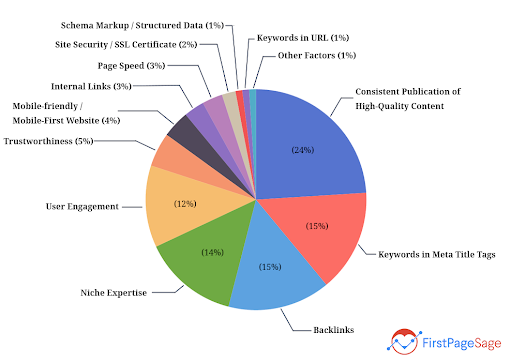
Balancing keyword targeting is just the beginning. It’s pertinent to identify the tasks you need to execute. You can identify these tasks by learning about important SEO ranking factors. Take a look at the important Google algorithm ranking factors below (source– firstpagesage.com):
Creating high-quality content, optimizing on-page elements, building natural backlinks, and boosting the user experience are some important tasks that affect rankings on search results.
However, it’s not enough to simply execute these tasks. It’s also important to prioritize them based on their impact and level of importance.
For example, creating high-quality content should be a top priority for any SEO strategy. Equal importance should be given to optimizing on-page elements such as meta descriptions, titles, and headings.
Improving user experience is also crucial for SEO, as search engines prioritize websites that provide a good user experience. This may involve optimizing website speed, navigation, and mobile responsiveness.
When you’re at it, building natural links is another important aspect of SEO, but you need quality content for it. Therefore, you need to set your priorities accordingly.
The right balance lies in understanding the impact of each activity, how it is associated with other tasks, and what’s their importance. If you’ve found the right balance there, your SEO strategy will be successful.
Website Optimization for Search Engine vs Users
Website optimization for search engines and users requires achieving the right balance – you need to ensure your website aligns with SEO practices while delivering the brand’s message to the target audience.
Here’s a breakdown of the desired balance between various elements:
Text Content vs Rich Media Content (images, videos, infographics)
Simply put, text content and rich media are equally important. While text content is crucial for conveying information to search engines as well as readers, rich media boosts user engagement.
If you have an infographic, image, or video in your content, it’s easier for users to digest the information at a quick glance. But text content is just as important.
The key is to understand the type of content you are creating and achieve the right balance. Text content is going to be pivotal for blog posts, but it’s not as important for product pages for an ecommerce site. Even though text is pivotal, users are more likely to look at product images or videos.
So quite appropriately, you’ll have to find the right balance between the two. Think of rich media as something that visually enhances your text content and not as a replacement. If you have cracked it, the strategy is going to be successful.
Content creation should always be done with the target audience or readers in mind; essentially, it should be People-First. This form of content takes into account the audience’s needs, interests, and preferences to give out information that is helpful, engaging, and informative.
Remember, when it comes to content creation, the right balance aims to resolve a query for users and follow the guidelines of search engines. If you have done this right, your rankings on search results are automatically going to see a boost, granted you optimize the on-page elements.
Keyword Placement vs Keyword Intent
While keyword placement is important for search engine optimization, it’s equally important to consider the intent behind the keyword. Keyword placement should not contradict the intent of the query.
It’s important to understand why someone is searching for a particular keyword and focus on creating helpful content. And when you do so, you’ll not only be able to place the keyword in the content, but do it organically.
Internal links help to establish a website’s hierarchy and guide search engines to important pages, while ensuring there are no orphan pages on the websites. External links, on the other hand, signal to search engines that your content is authoritative.
So both have a different purpose. The key is to balance the two by linking to high-quality and relevant external sources and using internal linking to guide users and search engines to important pages.
Speed Optimization for Search Engines vs Users
While search engines prioritize websites with fast loading times, user experience should always be the top priority. Slow load times can negatively impact user engagement and lead to high bounce rates.
To strike the right balance, focus on optimizing images, reducing page load times, and improving your website’s Core Web Vitals, while ensuring it doesn’t deteriorate the user experience.
New vs Old Content Optimization
The overall content quality of your website should be top-notch. So even though adding new content to the website is important, you must ensure old content is optimized and updated frequently.
Also, you need to think about what kind of older content is there on the website. Let’s say you have a blog post on World War 2. It’s a historical topic, and so it’s highly unlikely that there’s going to be frequent updates on the topic.
In contrast, a blog post on important SEO ranking factors needs to be updated as search engines algorithms continue to evolve and pivot their ranking factors.
Balancing OFF-Page SEO
Anchor Optimization vs Natural Backlink Profile
Anchor cloud is the distribution of anchor text used in backlinks to a website. You must balance the use of branded, exact, and phrase anchors in the anchor cloud to ensure that it looks natural and not overly-optimized.
Here’s the distribution of the anchors –
Branded anchors include the name of the website or company being linked to.
Exact anchors match the target keyword exactly.
Phrase anchors include the target keyword as part of a longer phrase
Your backlink profile should have a diverse distribution of branded and generic anchors as well as exact and phrase anchors.
This indicates to search engines that the links are being built naturally and not being manipulated for the purpose of ranking higher in search results.
To balance this, focus on building high-quality, relevant backlinks from authoritative websites in your niche. You can start with guest posting on relevant blogs or websites, participating in online communities, or even do Quora Marketing.
Backlinks Quality vs Backlinks Quantity vs Backlink Relevancy
You build backlinks to send signals to search engines for one basic thing – you have a trustworthy and authoritative website. Having a lot of backlinks acquired through unscrupulous activities negates that.
But you also need a great number of quality backlinks. To build such links, you must strike a balance between earning backlinks from both niche and high-authority websites.
Niche websites can provide relevant backlinks while high authority websites can provide a boost in search engine rankings.
SEO Goal vs Success Metrics
When it comes to SEO, tracking the success of the campaign is crucial. However, an effective report’s foundation is choosing the right success metrics. Thus, define your goals clearly by identifying the set objectives – whether that is organic traffic, search results rankings, or increasing leads.
Accordingly, you can track campaign success to assess if you have achieved or are working towards achieving your objectives.
That’s it, folks!
We’ve covered everything you need to know to balance your SEO strategy and tasks. If you’re struggling with SEO, book a consultation for customized SEO services today.
Sarvesh Bagla is an enterprise SEO expert and industry leader who has driven transformational digital growth for India’s top brands across the BFSI, Healthcare, Automotive, and ECommerce industries. As the Founder and CEO of Techmagnate, he leads large-scale organic search strategies and performance marketing campaigns for businesses looking to succeed in today’s AI-driven search landscape.
A strong advocate for thought leadership, Sarvesh is deeply involved in SEO evangelism and regularly contributes to industry discussions through LinkedIn, webinars, and CMO roundtables. His focus today is on helping brands prepare for an AI-first SEO future (AEO, GEO) and strategies for Large Language Models (LLMs) at the core.
Get the most valuable search related insights about leading brands, trending keywords, search volumes, fastest growing categories, city-level insights and much more!
It has come to our notice that fraudulent job offers are being circulated on the internet through messaging apps like WhatsApp and Telegram, which falsely claim to be from Techmagnate. We take this matter seriously and would like to caution all candidates to be wary of such postings.
Please Note That –
We do not charge any fees/security deposit/payment from candidates, irrespective of the professional experience they hold, for job applications or interviews
Official communication channels include our website and verified social media accounts, primarily LinkedIn.
Kindly double-check the domain name – @techmagnate.com – in the email address
We follow a transparent and ethical approach for hiring/onboarding supported by proper documentation.
Ensure that you only apply through verified channels to avoid being scammed. We also recommend that you exercise caution when sharing personal information or financial details with any job posting or recruitment agencies claiming to represent us.
We want to ensure that potential candidates interested in joining Techmagnate have a safe and positive experience.
If you find that someone that fits the description above has reached out to you, please notify us immediately at jobs@techmagnate.com.
 Important Alert:
 Important Alert: