Beware of fake job offers and payment requests. We only use official email IDs and never conduct interviews on messaging apps.Beware of fake job offers and payment requests. We only use official email IDs and never conduct interviews on messaging apps.
A top-level domain (TLD) – or domain extension – is the part of a web address that comes after the final dot, like the “.com” in techmagnate.com. It’s a small choice with a big effect on how memorable, trustworthy and on-brand your website feels, even though, as we’ll show, it has almost no direct effect on your Google rankings.
Before you launch a site, picking the right extension is one of the first decisions you’ll make. The most common contenders are .com, .net, .org, .co and .io – each with a different reputation, typical cost and ideal use case.
In this guide we’ll define what a domain extension is, compare .com vs .net vs .org vs .co vs .io side by side, explain what .io, .co and .org actually mean, and help you decide which TLD is right for your business. Let’s begin.
Let’s begin.
Table of Contents
What is a Domain Name?
A domain name is a unique name given to your website. It is the address for your website.
Moreover, a website’s name is one of the most important factors in search. The domain name impacts search and has a huge impact on search rankings and how people find you. Alongside selecting a strong domain name, applying effective web design tips can further enhance visibility and user experience.
A domain name has two parts:
Discover What Your Customers Search ForDiscover What Your Customers Search For
Get insights on evolving customer behaviour, high volume keywords, search trends, and more.
Here, ‘techmagnate’ is the domain name of the website address, and ‘.com’ is the domain extension.
Taken together, they form the address of your website on the internet.
What is a Top Level Domain (TLD) or Domain Name Extension?
The name of a website is known as the second-level domain. It is the unique identifier of the website.
The domain name extension follows the second-level domain. It is referred to as a top-level domain or TLD, and both terms are often used interchangeably.
Types of Domain Extensions:
Now that we know what a domain extension is, here are the three types of domain extensions you should be aware of:
Generic Domain Extensions
Sponsored Domain Extensions
Country Code Domain Extensions
TLD Extension Type 1: Generic Domain Extensions
Generic Domain Extensions are the most commonly-used extension category. Most online businesses in India and across the world use a generic domain extension. Popular extensions are .com, .org, and .net.
You can easily buy a generic domain extension by signing up for a domain name on domain hosting websites like Bluehost, Hostgator, and GoDaddy.
Examples:
Commercial Websites: www.xyz.com
Network: www.xyz.net
Non-Profit Organizations: www.xyz.org
Business Website: www.xyz.biz
TLD Extension Type 2: Sponsored Domain Extensions
Sponsored Domain Extensions are domain extensions that only a select few organizations can use. You need to fulfill the qualification criteria to use these extensions as part of your website name.
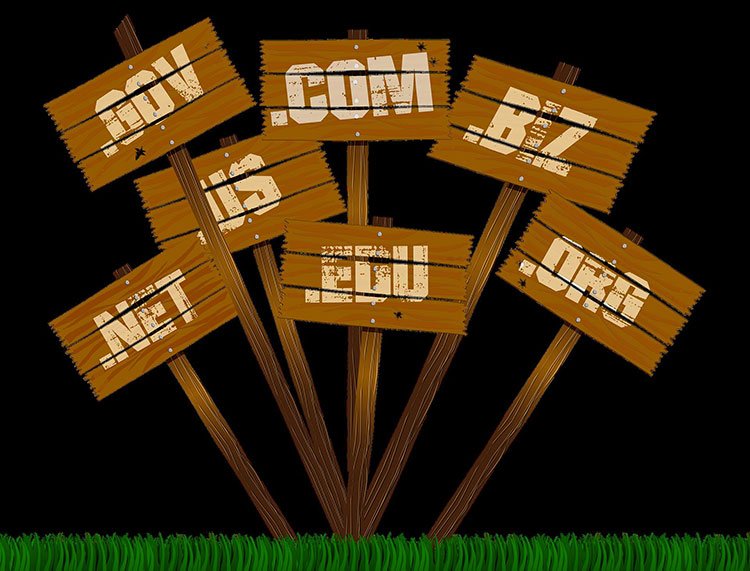
Some common examples of sponsored domain extensions include .gov and .edu. Only certified educational institutions like universities and colleges are allowed to use the .edu domain extension. On the other hand, the .gov domain extension is explicitly used by government agencies.
TLD Extension Type 3: Country Code Domain Extensions
Country Code Domain Extensions are country-specific. Most countries have unique two-letter domain extensions to showcase the location of the website.
For example, many Indian-based organizations, startups, and enterprise-level organizations use the .in extension to showcase that they’re based in India.
Examples:
India: www.xyz.in
United Kingdom: www.xyz.uk
Russia: www.xyz.ru
What does .com mean?
Initially designed for eCommerce extensions, the .com domain extension is increasingly used for commercial websites today. If you come across any website with a .com extension, it most likely means that it is a commercial website.
However, the growing popularity of this extension has made it the preferred choice for independent players, too. In addition to eCommerce and business websites, you will come across blogs and personal websites using a .com extension.
This shows that a .com website owner may not necessarily be someone who runs a business or an eCommerce platform.
What does .net mean?
The .net LTD extension stands for network. It was originally envisioned for websites specializing in network-based technology such as ISPs, email services, and database services. It is second in popularity after the .com extension and is widely used across countries and organizations.
In recent years, the .net has begun to inhabit equal importance as the .com extension, and many websites have started using this extension if their preferred .com domain is already claimed.
What does .org mean?
.org is short for “organisation”. It was originally intended for non-profit organisations, and although registration is now open to anyone, it still carries a strong non-commercial association in users’ minds.
That’s why .org remains the natural choice for charities, NGOs, foundations, open-source projects and community or educational resources. If you run a commercial business, a .com usually sends a clearer signal than a .org.
What does .co mean?
.co is the country-code top-level domain (ccTLD) for Colombia, but it has been marketed worldwide as a short, memorable stand-in for “company” or “corporation”. That dual meaning has made it a popular alternative for businesses and startups whose preferred .com is already taken.
Google treats .co as a generic domain rather than a Colombia-only one, so it works for a global audience. Two things to keep in mind: it usually costs more than a .com, and because it looks so similar to .com, some visitors may type the .com version by mistake. (Note: .co is separate from country pairings like .co.uk or .co.in, where “co” simply denotes a commercial sub-domain.)
What does .biz mean?
The .biz LTD extension is designed for business owners. It has the least popular and most affordable spot on the domain extension list. Though it falls under the generic domain extension, the .biz LTD is primarily used by business and eCommerce websites.
What does .io mean?
.io is technically the country-code top-level domain (ccTLD) for the British Indian Ocean Territory, but it’s best known today as a favourite of tech startups, SaaS products and developer tools. The appeal is the branding: “IO” reads as “input/output” in computing, giving the extension an instantly technical feel.
Although it began as a ccTLD, Google treats .io as a generic domain, so it isn’t tied to one country for search targeting. The trade-off is cost – .io domains usually renew at a higher price than a .com.
What does .ai mean?
The .ai TLD extension was originally the country-code domain for Anguilla, a small island in the Caribbean. However, over time, it has become globally recognized as a go-to domain for Artificial Intelligence (AI) companies, startups, and technology-driven businesses.
Today, the .ai domain extension is widely used by organizations in machine learning, data science, robotics, automation, and SaaS, symbolizing innovation and modern technology. Although it began as a ccTLD, Google treats .ai as a generic top-level domain (gTLD), meaning it ranks equally well worldwide just like .com or .org.
This extension is ideal for AI startups, tech innovators, and digital-first companies that want to highlight their connection to artificial intelligence and stand out in a competitive online space.
.Com vs Other TLD Extensions: A Comparative Analysis
Extension
Best use case
Trust / perception
Typical cost
SEO impact
.com
Almost any business, brand, blog or shop — the default first choice
Highest trust and recall; what users assume by default
Low–moderate; widely available at all registrars
Neutral — Google treats it as a generic TLD; no ranking advantage
.org
Non-profits, NGOs, charities, open-source and community projects
Signals “non-commercial / mission-driven”
Low, similar to .com
Neutral — no ranking advantage or penalty
.net
Tech, networking, infrastructure or as a .com fallback
Credible but feels dated; less memorable than .com
Low, similar to .com
Neutral — generic TLD, treated like .com
.co
Startups and businesses when the .com is taken
Modern, business-y; can be mistaken for .com
Higher than .com (premium ccTLD)
Neutral — a Colombia ccTLD that Google treats as generic (gTLD-like)
.io
Tech, SaaS, developer tools and startups
Trendy, technical, “input/output” branding
Higher than .com (premium ccTLD)
Neutral for global targeting — Google treats .io as generic, not geo-locked
Note: costs vary by registrar and are indicative; .co and .io are premium ccTLDs that typically renew at higher prices than .com.
Does .com enjoy an uncontested advantage over other domain extensions? Or should you consider other factors while considering an LTD? Find the answers to all this and more.
We will now make a one-on-one comparison between .com and other domain extensions.
Reference: wpbeginner.com
.Com vs .Net: What is better?
The .com and .net domain extensions are both business-targeted extensions. These are two of the most common domain extensions for online businesses.
Here are some things that you must consider before deciding to with either:
The .net extension is used by less than 4% of websites.
Most people will assume that your website extension is a .com. So, the likelihood of the target audience searching for the .net extension is minimal. Visitors are most likely to remember your domain if it ends with a .com extension.
Since the .com is more memorable and more widely used, it instills a sense of reliability among the visitors.
The .com extension also comes with unique usability. Most smartphone keyboards come with a “.com” key to enable users to plug a domain into their browser quickly. This option is not available for other domain extensions, including the .net extension.
The verdict: The .com is more popular and well-acclaimed than the .net TLD extension. Use the .com extension if you have the option to choose between the two. If you can’t claim your preferred domain name with the .com extension, you might consider the .net extension.
.Com vs .Org: What is better?
Are you confused between the .org and the .com extension, and which one is right for you?
If yes, consider the following points:
The .com is the preferred TLD extension for commercial business websites.
The .org is developed for non-profit organizations, making it the ideal fit for charities, NGOs, free online educators, and open-source technology platforms.
You will lose credibility if you are a profitable business and use a .org extension because websites with this extension are generally associated with free resources.
If your company has a non-profit division, you can consider using the .org extension for your non-profit vertical and the .com extension for the business vertical.
The verdict: Both .com and .org are equally popular and trusted domain name extensions. They also convey different meanings about your website. Use the .org extension if you run a not-for-profit organization. Use the .com extension if you run a business, blog, or personal website.
.Com vs .Co: What is better?
The .com and the .co are rival extensions for business websites.
Here are some top things you might want to consider before you decide between the two:
Due to the similarity in terminology between the .com and the .co, it becomes incredibly challenging for .co website owners to brand themselves effectively as users automatically assume that their domain name ends with a .com, thus requiring clarification.
The .co domain is more expensive than .com, which means that you should go for this domain extension only if your target domain name is unavailable in the .com version.
The verdict: Both .com and .co are equally viable. But if you were to come down to choose between the two, we would recommend the .com domain extension anytime, any day.
.Com vs .Biz: What is better?
Does running a business website automatically mean that you should go for the .biz extension? Let’s find out.
Using the .biz extension has some implications that are hard to evade. If you use the .biz domain extension, you are communicating to your visitors that sales are your website’s primary objective.
You might appear too sales-y to your customers if you use the .biz website. While turning a profit might be your ultimate objective, it is not something that you want to advocate actively.
On the contrary, using the .com extension will not only give your website a sense of authenticity but help you promote activities on your website that are not just transactional. For example, you can run a blog, a news publication, an open forum for discussion, and explore a plethora of other activities with a .com website.
The verdict: Owing a .biz website means that you are running a business. Moreover, the extension is relatively cheaper to purchase. But despite this unique value proposition, the .com remains uncontested as the premium website domain extension due to the trust factor associated with .com websites and the versatility it brings in terms of what you can do with the websites.
.Com vs .io: What is Better?
When confronted with the.com and .io extensions, the correct decision is multifaceted.
The .io extension is getting popularized among tech and SaaS companies. When people encounter a website with the .io extension, they immediately associate it with some AI-enabled solution.
Compared to the .com extension, the .io extension is an excellent branding practice for SaaS and tech companies.
The verdict: Depending on the kind of universe you operate in, the extension should complement that. For instance, choosing the .io extension is of little significance when you don’t have a tech business. In such a case, the .com extension is a much better option.
.Com vs .Ai – The New-Age Domain Battle
The .com and .ai domain extensions have become two of the most powerful choices for modern businesses each serving a unique purpose. While .com remains the classic and most trusted TLD for global credibility, .ai has quickly become the favorite among tech startups, AI companies, and digital innovators.
Here are some things to consider before choosing between the two:
Popularity & Trust: The .com extension remains the most recognized and trusted TLD across the web, making it ideal for any business targeting a broad or global audience.
Innovation Appeal: The .ai domain instantly signals that your brand is connected to Artificial Intelligence, Machine Learning, or advanced technology, helping you stand out in the tech industry.
SEO Value: Google treats both .com and .ai as generic top-level domains (gTLDs), so there’s no ranking disadvantage when using a .ai extension. However, .com domains often have stronger backlink profiles due to their age and familiarity.
Availability: Since many .com domains are already taken, businesses in the tech space often find .ai domains more available and brandable.
Brand Perception: The .ai TLD can give your website a modern, cutting-edge image, while .com conveys trust, credibility, and universality.
The verdict:
If your business caters to a general or commercial audience, go with .com for its universal trust and recall. But if you’re an AI startup, tech company, or innovation-driven brand, the .ai extension can be a smart and futuristic choice that aligns with your niche identity.
Is .com more trustworthy and memorable than .co, .net, .org, and other domain extensions?
According to independent research conducted by Growth Badger, .com websites are more trustworthy and memorable than websites with other TLD extensions.
This research found that:
Websites with a .com extension are 33% more memorable than websites with a .biz, .co, .net, .org, or other TLD extensions.
People are 3.8 times more likely to assume that a website ends in .com than anything else.
Websites with a .com extension are the most trusted, and .co websites are the second most trusted.
Does the Domain Extension affect SEO?
Everyone in the online space wants to optimize their websites for SEO, which begs us to contemplate the role that a TLD extension plays in it. So the question we should be asking is:
Will a particular domain extension affect a website’s SEO ranking chances?
Do .com websites enjoy a better chance at quickly ranking on search engines?
The answer to both questions is no.
Your domain extension does not affect your website’s SEO ranking chances. Neither does owning a .com website give you an SEO advantage over websites with other TLD extensions.
Google has announced that it does not consider domain extensions as a ranking metric.
In other words, whether you own a .biz website, a .org website, a .net website, or a .co website – your domain extension will not affect how quickly you rank on search engines. If you want to rank your website in search engines, you have to optimize it for on-page, off-page, and technical SEO.
So, what TLD extension is right for your business?
In this blog, we have introduced all types of TLD extensions and compared them all. We have also highlighted that your TLD extension will not affect your SEO rankings.
Now that we have all this information, let’s discuss the best TLD extension based on various parameters that will help you choose the right one. These parameters will also help you avoid certain domain extensions.
Trustworthiness & Memorability: Growth Badger’s research on TLD extensions suggests that websites with a .com and .co extension are most trusted by users. The same research has found that .com, .co, .org, and .biz extensions are more memorable than websites with a .blog, .net, .io, or .us TLD extension.
Versatility: Most website extensions, such as .biz and .org, are limited in terms of what they represent. On the other hand, .com websites emerge as the obvious winner in terms of versatility as it gives you more freedom w.r.t what you want to represent. You can be a news publication or an online journal, a blog or a magazine, a product or service business, or an independent website owner – the .com extension is for everyone!
Industry Niche: For most niches, the .com is the preferred TLD extension as it is most trusted by users across the world. However, if you are a non-profit organization, a charity, or an online resource website, then going for a .com extension might make more sense for you.
Pricing: In terms of pricing, .biz websites tend to be more affordable than other websites. On the other hand, the .com websites tend to be the most expensive. So if you’re a website owner with pricing limitations, you can consider a .biz TLD extension for your business.
Conclusion
We have done a comprehensive overview of all TLD / domain extensions in this blog. We hope you have a better understanding of what these are and which one is right for you. If you’re looking to build a website, from domain and extension selection to designing, content development, and SEO, feel free to check out our dedicated website design and development services.
For custom quotes on our web development services, please write to us at enquiry@techmagnate.com or give us a call at +91-9910308266.
We hope that you enjoyed this blog. Like, comment, and share this post with friends and people who might benefit from this resource. Watch this space for the latest blogs on trending topics in the digital niche.
Which domain extension is best - .com, .net, .org, .co or .io?
For most websites, .com is best — it’s the most trusted and memorable. Choose .org for non-profits, .co or .io for startups and tech products when the .com is taken, and .net mainly as a fallback. None of them gives you an SEO advantage.
Is .io or .co better than .com for a startup?
Only for branding. .io suits tech and SaaS products and .co works when your .com is unavailable, but both usually cost more than a .com and can be mistaken for it. If you can get the matching .com, it’s worth securing too.
Is .ai a good domain extension for startups and tech companies?
Yes. The .ai domain extension has become popular among AI startups, SaaS companies, and tech innovators. It signals a connection to artificial intelligence and can help build a modern, tech-forward brand identity.
What is the difference between .com and .io domain extensions?
The .com domain is universal, best for commercial or general-purpose websites, while .io (originally for British Indian Ocean Territory) is now widely used by tech, SaaS, and startup companies for its short and modern look.
Which domain extension is best for business websites?
The .com domain extension remains the best choice for most businesses because it’s widely recognized, credible, and easy to remember. However, .co, .biz, or .ai can work well if your desired .com is unavailable.
Can I switch domain extensions later without losing SEO rankings?
Yes, but it requires careful planning. Use 301 redirects, update internal links, and inform Google Search Console to maintain your SEO equity. Improper migration may result in temporary traffic drops.
Does my domain extension affect SEO?
No. Google treats .com, .net, .org, .co and .io as neutral for ranking – your extension doesn’t help or hurt your position. Rankings come from on-page, off-page and technical SEO, not the TLD.
What does .io mean and is it a country domain?
Yes, .io is the country-code domain for the British Indian Ocean Territory, but it’s widely used by tech and SaaS companies because “IO” reads as “input/output”. Google treats it as a generic domain, so it isn’t geo-locked to one country.
Sarvesh Bagla is an enterprise SEO expert and industry leader who has driven transformational digital growth for India’s top brands across the BFSI, Healthcare, Automotive, and ECommerce industries. As the Founder and CEO of Techmagnate, he leads large-scale organic search strategies and performance marketing campaigns for businesses looking to succeed in today’s AI-driven search landscape.
A strong advocate for thought leadership, Sarvesh is deeply involved in SEO evangelism and regularly contributes to industry discussions through LinkedIn, webinars, and CMO roundtables. His focus today is on helping brands prepare for an AI-first SEO future (AEO, GEO) and strategies for Large Language Models (LLMs) at the core.
Get the most valuable search related insights about leading brands, trending keywords, search volumes, fastest growing categories, city-level insights and much more!
It has come to our notice that fraudulent job offers are being circulated on the internet through messaging apps like WhatsApp and Telegram, which falsely claim to be from Techmagnate. We take this matter seriously and would like to caution all candidates to be wary of such postings.
Please Note That –
We do not charge any fees/security deposit/payment from candidates, irrespective of the professional experience they hold, for job applications or interviews
Official communication channels include our website and verified social media accounts, primarily LinkedIn.
Kindly double-check the domain name – @techmagnate.com – in the email address
We follow a transparent and ethical approach for hiring/onboarding supported by proper documentation.
Ensure that you only apply through verified channels to avoid being scammed. We also recommend that you exercise caution when sharing personal information or financial details with any job posting or recruitment agencies claiming to represent us.
We want to ensure that potential candidates interested in joining Techmagnate have a safe and positive experience.
If you find that someone that fits the description above has reached out to you, please notify us immediately at jobs@techmagnate.com.
Team @Techmangate
Build a Better Digital Marketing Strategy with Techmagnate’s Search Trends Reports
 Important Alert: