Beware of fake job offers and payment requests. We only use official email IDs and never conduct interviews on messaging apps.Beware of fake job offers and payment requests. We only use official email IDs and never conduct interviews on messaging apps.
Summary:From leveraging persuasive content to optimizing ad targeting, this blog delves into the nuances of conversion-driven social media marketing. Uncover the secrets to transforming social media platforms into powerful conversion engines and learn how to measure success beyond surface-level metrics.
What has been updated from the old blog post:
1. Removed statistics paragraph from the intro, as it’s outdated
2. Added ‘Social Media Statistics & Trends (2022 – 2023)’ section
3. The Key Components of Social Media Marketing
4. Addition content to the ‘Benefits of Social Media Marketing’ section
5. Additional content to the ‘What is social media marketing’ section
6. Added ‘Social Media Marketing Platforms for Success’ section
7. Additional content to ‘How to Create a Stellar Social Media Marketing Strategy’ section
Almost all of us use social media at least once a day. If you’re an avid social media user, you might have an account on Snapchat, Instagram, Facebook, YouTube, Pinterest, etc. But how much social media do you utilize in marketing for your business?
If you’re thinking that simply building a page and a plain social media calendar is enough, you need to revisit your strategy by incorporating effective social media marketing tools to make social media pay for your bills.
In this blog, we will discuss the hacks and tips you need to start your social media marketing. But first, let’s go over some social media marketing meanings.
Table of Contents
What is social media marketing?
Social media marketing (SMM) is a form of digital marketing where content is created and shared across various social media platforms to achieve marketing and branding goals.
The main objective of social media marketing is to increase brand awareness, generate leads, drive website traffic, and engage with your target audience. By leveraging the massive user base and interactive features of social media, it helps connect with consumers and strengthen your brand’s presence online.
The Key Components of Social Media Marketing
Before jumping into the world of social media marketing and its nitty-gritty, it’s vital to know about the components of social media marketing to better understand this domain. Here we go.
Social media platforms
Social media marketing leverages platforms like Facebook, Instagram, X, LinkedIn, Pinterest, and others to reach and engage with your target audience. Each platform attracts distinct groups of people and types of content, allowing businesses to craft tailored strategies to connect with the right audience in the most effective way.
Content creation and sharing
Creating interesting and shareable content is really important for doing well in social media. This content can be in different forms like text, pictures, videos, infographics, and more. The goal is to make content that really connects with people, so they want to get involved by liking, commenting, and sharing.
Audience engagement
Social media is all about being social. To do well in social media marketing, it’s important to actively connect with your audience. This means replying to comments and messages and joining in on conversations that matter in the community.
Brand consistency
It’s crucial to maintain brand consistency, i.e. to keep your brand looking the same on all social media sites. Use the same logos, colors, messages, and way of talking to help people recognize your brand easily.
Paid advertising
Lots of social media sites let businesses advertise to more people. When you pay for ads on social media, you can be really specific about who you want to see them—like their age, interests, and what they do online.
Analytics and Monitoring
Keep an eye on how well your social media marketing is performing by using tools that show you important stuff like how many people are interacting, how far your posts reach, how many clicks you get, and if people are responding to your’ Call to Action’. This info helps you figure out what’s effective so you can make smarter choices for your next campaigns.
Influencer marketing
Teaming up with popular social media figures, known as influencers, can really boost a brand’s exposure. These influencers can make content endorsing a product or service to their followers, using their trust and influence to spread the word.
Community building
Creating a community for a brand means making people feel like they belong and keeping them interested. You can do this by regularly talking with them, organizing events, and making content that encourages them to share their own stuff and join in.
Trends and virality
Social media is always changing, and it’s important to keep up with what’s popular or trending. Making content that fits with the current trends can help more people see it and interact with it, possibly making it go viral.
Adaptability
Social media is constantly evolving. New platforms come up, and the ones we already have keep updating how they work. Good social media marketers can adapt. They change their plans to match what’s popular and the latest updates on the platforms.
Benefits of Social Media Marketing
Using social media for marketing has many advantages and disadvantages of social media for both businesses and individuals who want to promote their products, services, or personal brand. Let’s look at some of the key benefits, including the advantages of social media marketing that can help businesses thrive:
Increase brand awareness
You’ve set up your business, launched a powerful website, and built a solid sales funnel—but now you need to invite people in. How do you do that?
Social media is the perfect tool to announce your arrival to the world. With billions of active users across platforms, social media offers a massive audience for your business to reach.
By using likes, comments, shares, tweets, and more, you can significantly boost engagement, driving traffic to your site. Adding links to your pages, website, and products makes it easy for people to discover and connect with your brand.
If people have already followed your account, your target audience is set. It’s time to advertise to these people which will lead to a high rate of conversions. You can give them offers, discounts, bonuses, and free goods through social media to get them to buy your product.
Targeted advertising
On social media, ads can be targeted directly at certain groups based on factors like age, hobbies, and online habits. This way, businesses can make sure their ads are seen by the people most interested in what they have to say.
Engagement and interaction
Social media lets businesses connect directly with their audience. They can answer questions, get feedback, and build long-lasting relationships with their customers.
Cost-effective
Using social media for marketing is often cheaper than traditional advertising. Many social media platforms have budget-friendly advertising choices, making it possible for businesses of any size to use them.
SEO benefits
Using social media can help your website show up better on search engines. When people like, share, and comment on your posts, it can make your site rank higher in search results.
Real-time marketing
Social media helps businesses stay up-to-date with trends and events as they happen. Being quick to adapt is important for taking advantage of opportunities and staying relevant in the fast-paced digital world.
Data analytics and insights
Social media platforms give businesses tools to check how well their campaigns are doing. These tools show data that helps businesses understand what their audience likes, how they behave, and if their marketing strategies are working.
Content distribution
Social media is a great way to share and spread your content. Whether it’s blogs, videos, pictures, or anything else, using social media can help more people see it and visit your website.
Building brand loyalty
Talking to customers on social media is a great way to make them really like your brand. If you often chat with them, share special offers, and give them exclusive stuff, it can make them feel like they’re part of a cool group that really loves your brand.
Global reach
Social media goes beyond borders, helping businesses connect with people all around the world. This is super helpful for online businesses or those aiming to reach an international audience.
Competitive advantage
Being active on social media is increasingly becoming a standard expectation for businesses. A well-executed social media strategy can give you a competitive edge in your industry.
Influencer collaborations
Social media influencers can really help you sell your stuff. If you team up with influencers who know about what you’re selling, it can make more people notice and trust your brand.
The reach of social media is so vast, that it’s practically impossible to define it. This is where numbers come to the rescue because numbers don’t lie. Let’s take a quick look at what impact social media had during 2023 with social media marketing statistics.
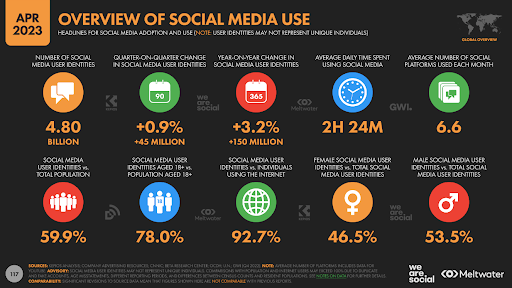
There are 4.8 billion social media users in the globe, accounting for 59.9% of the global population and 92.7% of all Internet users.
Between April 2022 and April 2023, the number of new social media users reached 150 million, reflecting a 3.2% year-over-year increase. This translates to an average of 410,000 new social users daily, equivalent to 4.7 users every second.
26.8% of internet users aged 16 to 64 learn about businesses, products, and services through social media advertisements.
When researching brands, 44% of internet users aged 16 to 64 use social media as their major source of information.
In 2023, the social media advertising industry is expected to reach $207.10 billion in ad spending.
India statistics
Instagram was used by 74.70% of internet users in India in 2023, thus becoming the most popular social media network in the country with 516.92 million active users.
With over 492.70 million users, Facebook has become the second-most favorite platform in India, accounting for 71.20% of user profiles on Facebook.
Beyond merely establishing brand recognition (44%), a substantial portion, amounting to 41%, relies on social media platforms as a key source of revenue generation
A total of 76% of individuals on social media have made a purchase based on something they encountered on the platform.
Best Social Media Marketing Strategies To Deploy
Using social media is a great way for businesses to reach people, make their brand known, and get people interested. Now that we’ve gone over the basics, let’s get on to building a social media strategy tailored to your brand.
Set S.M.A.R.T. Goals
Develop a comprehensive social media marketing plan via S.M.A.R.T. goals that align with overall business goals. Plan and schedule content in advance to maintain a consistent posting frequency. Stay updated on industry trends and adjust strategies accordingly.
Specific: You need to have a specific goal in mind before building your strategy. It can be a set number of likes, followers, or conversions.
Measurable: Your goals should be measurable through data, analytics, numbers, or figures. For example, it can be double the number of your Instagram followers.
Attainable: Your goal needs to be realistic and attainable in the allotted time.
Relevant: Your goal should have relevance to your business. For example, it should generate leads.
Time: Your strategy needs to have a beginning and an end.
Mobile first. Always!
As a large number of social media users access platforms via mobile devices, make sure your content is mobile-friendly and make it a key element of your social media marketing plan.
Know your audience
Get to know your audience – their age, interests, and how they behave on the internet. Make your content suit them and address their problems.
Choose the right platform
Pay attention to the social media platforms where your audience spends the most time. Different social media platforms have their own unique features and user groups, so pick the ones that make the most sense for your audience, like Facebook, Instagram, X, LinkedIn, etc.
Creative engaging content
Create a content plan that is consistent with your brand’s voice, beliefs, and goals. Create a variety of interesting content types, such as photographs, videos, infographics, and blog articles. Tailor content to suit the preferences of your target audience on different platforms. Ask your audience to share their own content to get more people interested.
Platform optimization
Tailor content to each specific social media platform’s features and audience expectations. Optimize profiles for searchability and use platform-specific tools (e.g., hashtags, stories) effectively.
Brand consistency
Keep your brand’s tone and look the same on all social media platforms. Use consistent visuals, tone, and messaging to enhance brand recognition. Ensure that profile information, logos, and cover images are uniform across channels. This makes people recognize and trust your brand. Remember, consistency is key to building brand credibility.
Leverage paid advertising
To broaden your reach and target certain groups, it’s best to invest in paid advertising, which helps enhance the effectiveness of your campaigns. Monitor ad performance and adjust your social media marketing plan based on analytics.
Implement a content calendar
Make a plan for your content ahead of time by drafting a content calendar. This way, you can stick to a regular posting schedule and make sure your content matches important events or promotions.
Focus on audience engagement
Respond quickly to comments, messages, emails, and mentions to build a robust and active community. Encourage user-generated content and help your followers develop a feeling of community. Use tactics to boost the number of likes, comments, shares, and total involvement.
Community management
Actively manage and nurture your social media community. Encourage discussions, polls, and Q&A sessions to foster engagement. Address negative feedback or issues promptly and professionally.
Influencer marketing is a blessing
Collaborate with influencers who share your brand’s values and target demographic. Use these influencers’ reach to increase your brand’s visibility and trust. When developing an influencer marketing strategy, remember to establish clear goals and expectations.
Keep an eye on analytics
Use analytics tools to track the effectiveness of your social media activities. Keep track of crucial data like reach, engagement, conversion rates, and follower growth to make data-driven decisions and refine your social media marketing plan.
Use chatbots
Artificial intelligence has significantly improved digital marketing. Implement chatbots in your social media strategy as they can easily discuss and address consumer issues.
Run contests and giveaways
Encourage user engagement by holding contests and giveaway events. This can enhance engagement, and reach, and assist in the development of a community around your business.
Innovation and Adaptability:
Stay abreast of emerging trends and technologies in social media. Be ready to adapt strategies based on platform algorithm changes or shifts in user behavior. Experiment with new features and formats to keep content fresh and engaging.
Promote yourself as a thought leader
Share educational content, industry insights, and valuable information. Position your brand as an authority in your niche.
Give your brand a human touch
Humanize your brand by sharing behind-the-scenes videos, employee engagement events, and customer testimonials. People are more likely to connect with a brand that feels personal and honest.
Social media for business offers a great deal of analytics for you to measure your performance. Audit your metrics to know if your strategy is working.
Social media platforms are ever-evolving, so your strategy and marketing tactics for social media marketing need to be dynamic too. Step onto the social media bandwagon for your business and witness the conversions roll in.
Social Media Marketing Platforms for Success
Social media can be incredibly valuable for your business, but your social media marketing best practices needs to be tailored to each platform. To do this effectively, it’s essential to understand the unique features and audience of each social network. Let’s dive in:
Facebook
Image source: Facebook
Facebook is by far the king of all social media platforms (partly because it owns half of them). It is the most used platform by both marketers and consumers. Facebook his is the platform with which you begin your social media journey.
89% of marketers use Facebook for business for marketing their brand
83% of users visit the platform daily
66% are followers of at least a single brand on the platform
Facebook had attracted 3 million monthly active users by the first quarter of 2023
Instagram
Image source: Instagram
Instagram is a social networking service whose primary model is sharing photos and using hashtags for social media marketing. But Instagram is the most dynamic of all social media platforms with new features rolling in every few months.
Instagram was the first to introduce the ‘Story’ feature that now can be found on WhatsApp and Facebook. In 2019, it launched IGTV for longer videos, whose duration earlier was limited to a minute, and then introduced ‘Reels’ within days of TikTok being banned by the Government of India.
Instagram has more of a young user base with half of its users being 34 years and younger. Here are some statistical insights for Instagram
According to Instagram, more than 90% of its user base follows a business
89% of marketers say that Instagram is the best platform for Influencer Marketing
500 million and more users visit Instagram Stories every day
Now, that is a whole lot of marketing space. But the standard marketing techniques don’t work here. It is a great space to engage and communicate with your audience and other brands while offering them more than just your product.
X (formerly Twitter)
Image source: Twitter
Content marketing and blogging took an unprecedented 180-degree turn with the microblogging site, X. It has been running as one of the top social media platforms. It is the best place if you’re a new business and want to be discovered.
X usage becomes increasingly predominant in times of major events. Registered users can read and post tweets as well as follow other users via update feed, and re-tweet the posts that resonate with them.
Live-tweeting takes over during sporting events or television airings and it has become a popular way for consumers to engage online with others with similar interests and also communicate with the brand. Here is some data for X:
People are 26% more likely to view ads on X than any other platform
X has become the top platform for discovery because 79% of users like to discover what’s new
X as a social media marketing platform is a great way to engage and communicate about your brand’s offerings, its principles, and thoughts with the audience and other brands. X battles between brands are a real thing and a great marketing gimmick.
LinkedIn
Image source: LinkedIn
While LinkedIn is a professional networking site where you can’t really sell your product, it is a great place for employee marketing, brand awareness, and increasing your B2B lead generation.
It is one of the highest social media platforms ranked in terms of active users and even tops Facebook in generating leads. Here are some interesting LinkedIn insights:
LinkedIn is 277% more effective than Facebook in generating leads
95% of content marketers use LinkedIn to market their B2B services
90 million users of LinkedIn are involved in Influencer marketing and are at senior management positions which help in LinkedIn lead generation.
LinkedIn is a platform used best to market your B2B services, engage with similar brands, acquire talent through presenting the culture of your company, and much more.
Pinterest
Image source: Pinterest
Pinterest is the ideal place to find cool pictures and ideas. It works well for businesses that have things that look good in pictures, like nice products or services.
Snapchat
Image source: Snapchat
Lots of young people like using Snapchat. People share things that only last for a short time, usually 24 hours. Businesses also use it to make interesting ads and connect with customers.
YouTube
Image source: YouTube
The popular online video-sharing and social media platform, YouTube, offers brands a unique social media platform where brands can make and share videos. It’s great for teaching, showing off products, and telling the story of your brand.
WhatsApp
Image source: WhatsApp
This widely used messaging app allows businesses to connect with customers through chat. WhatsApp Business provides additional features for small and medium-sized businesses.
Reddit
Image source: Reddit
Reddit is like a big online community where people share stuff and talk about things. If a company wants to, they can join specific groups (called subreddits) to chat with the audience they want to reach.
Tumblr
Image source: Tumblr
Tumblr is a microblogging platform that allows users to share multimedia content. It can be suitable for brands with a creative and visually appealing identity.
Remember, how well a platform works for you relies on your business type, who you’re trying to reach, and your marketing aims. Social media is always changing, with new platforms popping up and others fading away. Keep up with the latest trends and adjust your strategy accordingly.
Social media marketing is a powerful tool for businesses to engage with their audience, boost brand awareness, and drive conversions. By understanding each platform’s features, creating engaging content, and utilizing paid ads and influencer collaborations, businesses can effectively connect with their target audience. If you want to implement these strategies effectively, partner with us, a leading social media optimization company, to build a strong presence, improve engagement, and achieve measurable growth. With a focused approach, social media marketing remains essential for businesses looking to thrive in the digital age.
Neha Bawa is the Director of Brand Marketing at Techmagnate. She has worked in Digital Marketing since 2012 and has specialised in content creation. She has earned a Master’s degree in Interactive Communications from Quinnipiac University in Connecticut, U.S.A. Her interests lie in creating great content, docs, and working towards sustainability through biodiversity.
Get the most valuable search related insights about leading brands, trending keywords, search volumes, fastest growing categories, city-level insights and much more!
It has come to our notice that fraudulent job offers are being circulated on the internet through messaging apps like WhatsApp and Telegram, which falsely claim to be from Techmagnate. We take this matter seriously and would like to caution all candidates to be wary of such postings.
Please Note That –
We do not charge any fees/security deposit/payment from candidates, irrespective of the professional experience they hold, for job applications or interviews
Official communication channels include our website and verified social media accounts, primarily LinkedIn.
Kindly double-check the domain name – @techmagnate.com – in the email address
We follow a transparent and ethical approach for hiring/onboarding supported by proper documentation.
Ensure that you only apply through verified channels to avoid being scammed. We also recommend that you exercise caution when sharing personal information or financial details with any job posting or recruitment agencies claiming to represent us.
We want to ensure that potential candidates interested in joining Techmagnate have a safe and positive experience.
If you find that someone that fits the description above has reached out to you, please notify us immediately at jobs@techmagnate.com.
 Important Alert:
 Important Alert:

















 6th Feb | Invite-only


