Beware of fake job offers and payment requests. We only use official email IDs and never conduct interviews on messaging apps.Beware of fake job offers and payment requests. We only use official email IDs and never conduct interviews on messaging apps.
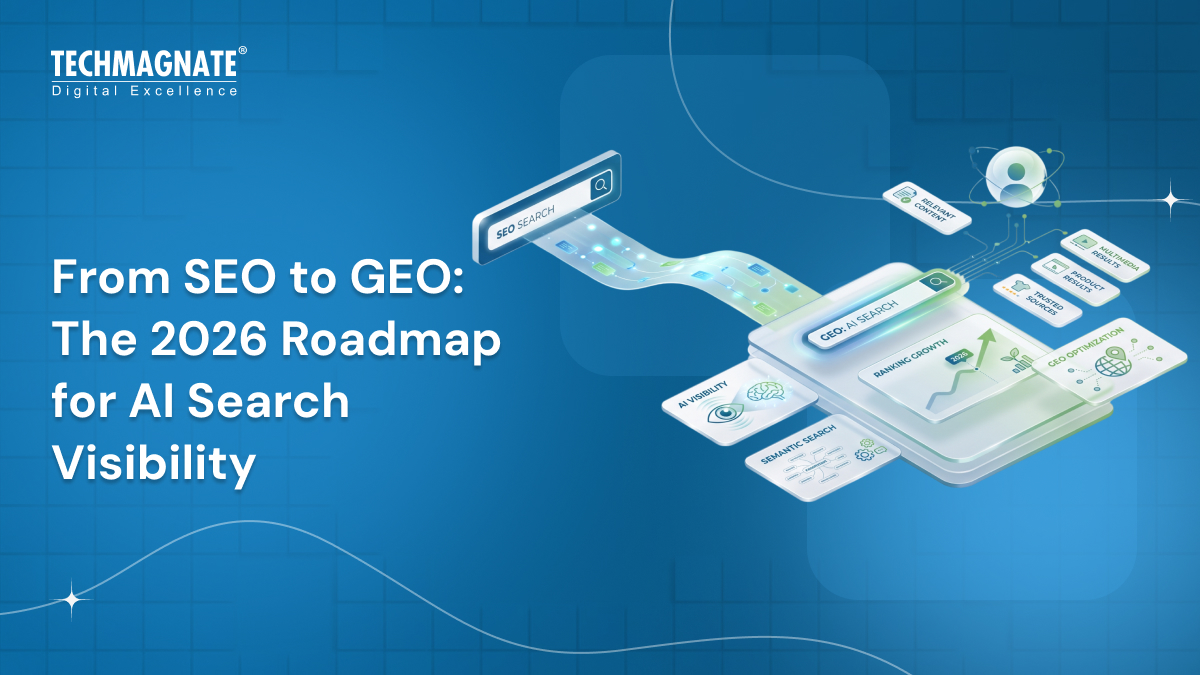
When a potential customer asks an AI assistant which enterprise solution to choose, does your brand appear in the answer? For most companies, the answer is no and closing that gap is exactly what moving from SEO to GEO is about. Generative engine optimization (GEO) is the practice of structuring your content so AI systems cite, summarise and recommend it, not just so Google ranks it. While traditional SEO still earns rankings, it does not guarantee visibility in AI-generated answers from ChatGPT, Perplexity, Gemini or Google AI Overviews.
This matters now. According to a Gartner forecast published in February 2024, traditional search volume is expected to decline by 25% by 2026 as users move to AI-powered answer engines, and Google AI Overviews have already cut click-through rates by up to 61% for informational queries. The result is a widening gap in AI search visibility: brands can rank #1 on Google and still be absent from the answers buyers actually read.
This roadmap explains the shift from SEO to GEO in practical terms – what GEO is, how it differs from traditional SEO (and from AEO), the six pillars to action, and the GEO metrics every business should track – as covered in our how GEO differs from SEO. GEO works alongside AEO and LLM SEO, where success depends on how AI systems evaluate relevance, trust and context. Used together, they keep your brand visible and recommended across AI-driven search.
Table of Contents
What Is Generative Engine Optimization (GEO)? The New Rules of Discovery
Generative engine optimization (GEO) is the practice of structuring the content to be cited, summarised and recommended by AI-powered search platforms. It focuses on structuring information so AI models can easily interpret and reference it in responses. Unlike traditional SEO, GEO prioritizes visibility within AI-generated answers rather than just rankings on search engine results pages.
Achieving success with GEO begins with understanding how AI-generated answers are formed. Modern generative engines rely on a process called Retrieval-Augmented Generation (RAG). The RAG pipeline first retrieves relevant information from the web and then synthesizes it to form a cohesive, conversational answer. For your content to be included, it must be both easily retrievable by the system and authoritative enough to be considered cite-worthy.
To understand this process more clearly, consider what happens when a user asks a complex question on an AI platform. The engine will often break that single question into multiple sub-queries to gather comprehensive information. This makes it essential that your content is structured to address these underlying sub-queries completely and accurately. If traditional SEO was about getting your book into the library’s catalog, GEO is about making sure your content is relevant, well-structured and reliable enough to be the book the librarian selects and hands directly to the reader.
Traditional SEO vs Generative Engine Optimization (GEO)
Understanding how GEO differs from traditional SEO helps clarify the shift from ranking-focused strategies to content designed for AI-driven discovery and responses.
This shift is not a minor SEO update. It is a structural change in how online discovery works. Brands that understand generative engine optimization early are better positioned for stronger AI search visibility. Those that do not adapt may struggle to appear in AI-generated responses.
AEO vs GEO vs SEO: How They Fit Together
These three acronyms are often used interchangeably, but they optimise for different stages of AI-driven discovery:
SEO (Search Engine Optimization) earns rankings on Google and Bing — the foundation everything else is built on.
AEO (Answer Engine Optimization) makes your content easy to extract — clear definitions, quick-answer blocks and structured data so a machine can lift the answer cleanly.
GEO (Generative Engine Optimization) goes one step further: it makes AI choose your brand over competitors when it synthesises the final answer, through entity consistency, third-party validation and citation-worthy depth.
In practice you don’t run three separate strategies. They converge on the same core principles — authoritative content, structured data and entity clarity — with AEO and GEO adding citation-friendliness on top of a strong SEO base. A brand that ranks well and is easy to extract and is trusted across the web is the brand AI recommends.
Your Website Ranks #1 on Google — But You Still Lack AI Search Visibility
Brands that lead in traditional search are now facing declining visibility in AI-driven search. Even with a top position on Google, they are not appearing in AI-generated answers. This highlights a growing gap between rankings and actual AI brand visibility. Large language models do not rely only on rankings. They assess multiple signals, so strong SEO performance does not guarantee inclusion across platforms such as ChatGPT, Perplexity, Gemini or AI Overview Optimization (AIO). As a result, a brand can rank first and still remain excluded from the answers users search.
A key reason for this disconnect lies in how AI systems gather information. Around 85% of brand mentions in AI-generated responses come from third-party sources rather than owned websites. This means AI models learn about your brand through reviews, media coverage and forums, allowing external narratives to shape perception. For example, a major wellness brand with strong rankings had almost no presence in AI answers because models relied on third-party sources.
This gap can also evolve over time due to LLM perception drift, where AI systems may gradually shift their interpretation of a brand, moving it from “reliable” to “irrelevant” month-over-month as data signals change.
This change is already having a measurable impact. According to Seer Interactive (2025), Google AI Overviews have reduced click-through rates by up to 61% for informational queries. Companies like Chegg reported a 49% drop in their non-subscriber traffic and a 24% revenue decline in Q4 2024 due to AI-driven search. Brands that focus on a single platform risk missing 60–80% of their total visibility, making AIO essential.
The 2026 GEO Roadmap: 6 Pillars for AI Recommendations
To consistently appear in AI-generated recommendations, brands need to align with how LLMs retrieve, interpret and synthesize information. Traditional SEO alone is no longer enough to compete for brand visibility. The following six pillars form a practical Generative Engine Optimization framework designed to improve AI search visibility and strengthen performance across evolving AI search ranking factors.
Step
What to do
Outcome it drives
1. Structured data for LLMs
Apply FAQPage, Article, Organization & HowTo schema across top pages
Machine-readable meaning; better retrieval
2. Content architecture
Definition-led openings + quick-answer blocks in the first 200 words
Up to 2.8x higher extraction; AI Overview inclusion
3. Entity & brand consistency
Align name & facts across Knowledge Graph, Wikipedia, Wikidata, LinkedIn
Clear brand identity; more citations
4. Off-site authority
Earn mentions on Reddit, YouTube, Quora, PR & directories
Third-party validation (≈85% of AI mentions)
5. Multi-platform optimisation
Optimise for ChatGPT, Perplexity, Gemini & AI Overviews, not one
Avoid missing 60–80% of AI visibility
6. Topical authority
Pillar + 8–12 cluster pages; original research; 90-day refresh
Depth signals; sustained inclusion
Pillar 1: Structured Data & Schema Markup for LLMs
Structured data using Schema.org markup enables AI systems to interpret websites in a machine-readable format. Instead of relying only on visible text, LLMs use these signals to understand meaning, relationships and intent, making it a key element of GEO.
Each schema type defines how specific information is organised and interpreted, whether it is FAQs, articles, business details or products. This structured format helps AI systems understand and classify content more accurately during retrieval, improving how it is selected and evaluated for answers. Without it, even high-quality content is harder for AI to process, trust and cite.
Structured data helps AI systems interpret information more clearly, even though LLMs can process unstructured text. Research shows it can reduce hallucinations and improve retrieval accuracy. While its direct impact on AI citations is still evolving, search engines continue to recommend schema to help understand entities and relationships and strengthen knowledge graphs in an AI-first environment.
Pillar 2: Content Architecture for AI Extraction
AI systems do not process content the way humans do. Instead of reading linearly, they break information into fragments, evaluate clarity and reconstruct responses based on structure and readability. This makes content architecture a critical factor in improving AI search visibility and aligning with evolving AI search ranking factors. Content that is easy to extract is more likely to appear in AI-generated answers.
Certain content structures make it easier for AI systems to extract information. Starting sections with clear, definition-led sentences can increase the likelihood of extraction by up to 2.8x. Similarly, placing quick-answer blocks within the first 200 words improves inclusion in AI Overviews. Pages that use structured lists, quotes and statistics perform better, driving 30% to 40% higher AI search visibility compared to unstructured formats. This shows that clarity and organization now influence outcomes more than backlinks.
To understand this shift, consider an example of how content changes when optimized for extraction.
Before:
Our firm provides enterprise-level financial auditing services designed to ensure compliance, improve reporting accuracy and support governance frameworks.
After:
What financial auditing services do you provide?
We provide enterprise financial auditing services focused on three areas:
Ensuring regulatory compliance
Improving reporting accuracy
Strengthening governance controls
This structure improves the AI content citation strategy, making it easier for AI systems to extract and reuse information in answers.
Pillar 3: Entity & Brand Signal Consistency
AI systems build brand understanding through entity associations across the web. When a brand appears inconsistently, models struggle to form a clear identity, weakening AI searchvisibility and reducing citations. Even strong brands can appear fragmented if their signals are not aligned.
This is where entity SEO becomes essential. It ensures consistency across platforms such as Google Knowledge Graph, Wikipedia, Wikidata, Crunchbase, LinkedIn and industry directories. These sources help AI systems validate and connect brand information, strengthening generative engine optimization efforts.
For example, General Motors (GM) restructured its content pages specifically for AI-native extraction to resolve entity fragmentation. By creating LLM-friendly ‘answer blocks’ and standardizing brand data, GM recorded a 23% increase in AI visibility and a 35% increase in citations within weeks. This proves that AI search visibility relies on Entity Consolidation rather than just keyword volume.
Your website alone is not enough to build AI search visibility. As we saw earlier, the vast majority of AI mentions originate off-site, which means generative engine optimization depends heavily on third-party validation. Large language models pull insights from Reddit, YouTube, Wikipedia, Quora, forums and review platforms, where real conversations shape credibility.
To strengthen AI brand visibility, brands must actively contribute beyond owned channels. This includes expert participation in forums, PR coverage in authoritative publications, accurate directory listings and engagement in user-generated content ecosystems. Where relevant, a verified presence on platforms like Wikipedia can further reinforce trust.
This shift makes answer engine optimization an off-site strategy, where authority is built through consistent, credible mentions across independent sources.
Pillar 5: Multi-Platform AI Optimization
AI search platforms operate differently, with each using its own signals to determine which brands appear. No single model dominates, so AI search visibility depends on a multi-platform approach. Gemini leads in citation volume at 21.4%, while Perplexity delivers the highest citation quality with an average position of 1.3.
Platform
What It Favors
ChatGPT
Authoritative long-form content
Perplexity
Recent, well-cited sources
Gemini
Google ecosystem signals
Google AI Overviews
Structured, direct answers
Optimizing for just one platform can result in missing 60–80% of total AI search visibility. A strong multi-platform AI optimization strategy ensures consistent presence across all major AI discovery channels.
AI systems prioritize brands that demonstrate strong topical authority rather than those with scattered content. This makes a focused generative engine optimization strategy essential. Instead of isolated pages, brands need structured depth across key topics.
Content clusters play a key role. A pillar page supported by 8 to 12 interconnected subtopic pages helps build entity SEO and signals expertise. This structure improves how AI systems interpret relationships between topics and aligns with core AI search ranking factors.
The type of content also matters. AI models prefer original insights over repeated or generic information. Proprietary research, surveys and case studies strengthen your content’s credibility and improve the likelihood of being cited across AI-generated responses.
Keeping content up to date is equally important. AI models favour recent information, so updating high-value pages every 90 days helps maintain relevance and consistent inclusion across evolving AI search ranking factors.
Tracking What Matters: The New Metrics of AI Visibility
To evaluate performance in AI-driven discovery, brands must shift focus from traditional metrics to those that define AI brand visibility. GEO success is measurable, but only if you track the right indicators that reflect how AI systems interpret and present your brand.
Citation Frequency measures how often AI models mention your brand, products or key entities in their responses. Consistent mentions signal stronger visibility.
Context Accuracy evaluates whether AI describes your brand correctly and in the right context. Inaccurate positioning can dilute credibility.
Sentiment Weight tracks whether your brand is framed positively, negatively or neutrally. Even strong visibility can be undermined by negative sentiment.
Platform Priority identifies which AI platforms, such as ChatGPT or Gemini, reference your brand most, helping prioritize optimization efforts.
These metrics reveal how AI search ranking factors influence discoverability beyond rankings. A key concept here is LLM perception drift, which reflects how AI descriptions of your brand change over time. For instance, a healthcare brand shifted from “reliable” to “controversial,” leading to a 20% drop in AI recommendations.
Traditional SEO tools like Ahrefs or SEMrush cannot track these signals. They do not capture sentiment, context or citation patterns within AI responses. As a result, brands lack clarity on how they are actually represented.
Dedicated GEO monitoring is essential as new solutions emerge to track these dimensions. Without it, visibility remains reactive. You cannot improve what you cannot measure and most brands still cannot measure their AI brand visibility today.
How to Measure AI Search Visibility: Two Core Formulas
Two metrics turn “AI visibility” from a feeling into a number, and you should track them separately because a brand can be mentioned without being linked:
Share of Voice (SoV) = (answers mentioning your brand ÷ all answers in your prompt set) × 100. It tells you how often you show up when buyers ask AI about your category.
Citation Share = (citations of your domain ÷ all citations across the prompt set) × 100. It tells you how often your pages are the cited source, not just named.
Measure both per platform – ChatGPT, Perplexity, Gemini and AI Overviews each assemble answers differently and report weekly or monthly across a stable prompt set. Avoid presenting a day-over-day change from a small prompt set as a trend. Pair these with the Citation Frequency, Context Accuracy, Sentiment Weight and Platform Priority signals above for a complete AI brand visibility picture.
Why Forward-Thinking Brands Are Shifting Budget from SEO to GEO
In 2020, brands that ignored mobile optimization faced long-term losses. In 2026, AI search visibility marks a similar turning point. Just as mobile-first indexing changed how websites were built and ranked, generative engine optimization is now reshaping how brands are discovered and recommended. Today, AI systems influence what users see, trust and choose, making LLM SEO a critical investment rather than an experimental channel. For enterprises, this shift is no longer optional. It is directly tied to growth, competitive positioning and long-term market relevance.
This shift is clearly reflected in how enterprises are reallocating budgets to optimize for AI search. Traditional SEO alone cannot capture visibility within AI-generated answers, which are increasingly shaping buyer decisions. Market data highlights the scale and urgency of this transition:
5x investment growth: Spending on LLM optimization is projected to be five times higher than traditional SEO by 2029.
Enterprise adoption: 63% of enterprise marketers are planning dedicated budgets for AI search visibility in 2026.
Revenue influence: AI search is expected to impact $750 billion in US revenue by 2028.
Early ROI: Enterprises investing in LLM SEO report an average 11% revenue increase within six months.
These trends show that AI visibility is becoming closely tied to revenue outcomes. Early adopters are building a clear competitive advantage, gaining early visibility, and strengthening their market position. Brands that invest now will lead in AI-driven discovery, while others risk falling behind and spending years trying to recover lost visibility.
Your 10-Point GEO Quick-Start Checklist
Implementing generative engine optimization begins with a set of structured actions that improve AI brand visibility across platforms. While these steps may appear straightforward, each requires depth and coordination to execute effectively at scale.
Brand name audit: Ensure consistent naming across your website, directories, social profiles and Wikipedia to prevent entity confusion in AI systems.
Schema markup implementation: Apply FAQPage, Article, Organization and HowTo schema markup across your top 50 pages to improve machine readability and indexing.
Content priming: Rewrite your top 20 pages with definition-led openings and quick-answer blocks within the first 200 words for better AI extraction.
Ecosystem presence: Build active visibility on Reddit, YouTube and at least three industry directories where AI models frequently source information.
Original research creation: Publish at least one data study each quarter to increase your chances of being cited in AI-generated responses.
Brand mention monitoring: Track mentions weekly across ChatGPT, Perplexity, Gemini and Google AI Overviews to measure AI brand visibility.
AI search testing: Test your top brand queries across major AI platforms to identify gaps, inconsistencies or missing citations.
Content recency updates: Refresh high-value pages every 90 days to maintain strong retrieval signals in AI systems.
Topical authority building: Create structured content clusters using pillar pages supported by 8–12 related articles per topic.
Perception drift analysis: Conduct a quarterly LLM perception drift check to compare how AI describes your brand over time.
These actions form the operational foundation of GEO optimization. Each step signals authority, consistency and relevance, which are critical for sustained visibility in AI-driven discovery.
The Future Belongs to Brands AI Trusts
The era of the “10 blue links” is steadily fading. AI systems now curate direct answers and only the brands included in those responses remain visible in the buyer journey. If your brand is not mentioned, it effectively does not exist at the moment of decision-making. This shift is redefining how AI search visibility shapes discovery, comparison and final selection.
By late 2026, the difference between brands that invest in generative engine optimisation and LLM SEO and those that do not will become clearly visible. The first group will consistently appear in AI-generated recommendations, while the second will gradually lose presence across key discovery platforms. This gap will influence not just traffic, but also trust and authority.
The starting point is understanding how AI currently sees your brand. Without this clarity, improving GEO optimization becomes guesswork.
Want to see how AI currently recommends your brand or your competitors? Get a Free AI Visibility Audit or explore our GEO and LLM optimization services to take the next step.
Frequently Asked Questions
What is the difference between SEO and GEO?
Search Engine Optimization (SEO) focuses on improving rankings on search engine results pages, driving clicks and traffic. Generative engine optimization (GEO) focuses on getting your brand cited within AI-generated answers across platforms like ChatGPT, Perplexity and Google AI Overviews optimization environments. SEO drives visibility through links, while GEO drives inclusion within direct answers.
How do I optimize my website for ChatGPT and AI search?
To improve AI search visibility, brands need a structured approach. This includes implementing schema for LLMs, improving content architecture for extraction, maintaining strong entity consistency and building third-party authority signals. A well-rounded GEO optimization strategy ensures your content is discoverable, interpretable and credible for AI systems.
What is LLM perception drift and why does it matter?
LLM perception drift refers to how AI models change the way they interpret and describe your brand over time. These shifts can happen without any change in your business. If left unmonitored, this drift can weaken AI brand visibility by introducing inaccurate positioning or reducing your presence in AI-generated answers.
Does traditional SEO still matter in 2026?
Traditional SEO still matters in 2026, but its role has clearly evolved. Technical SEO still determines how well your site is crawled and indexed, while backlinks continue to influence domain authority and trust signals. However, these alone are no longer enough to secure visibility in AI-generated answers. To stay competitive, brands need a hybrid approach that combines a strong SEO foundation with GEO, ensuring presence across both search engine results and AI-driven platforms.
How long does it take to see results from GEO optimization?
Initial improvements, such as schema updates and content restructuring, can show results within weeks. A complete GEO optimization strategy typically delivers measurable gains in 3–6 months.
What is the difference between AEO and GEO?
Answer Engine Optimization (AEO) makes your content easy for AI to extract — clear definitions, quick-answer blocks and structured data. Generative Engine Optimization (GEO) goes further, making AI choose your brand over competitors when it synthesises an answer, through entity consistency and third-party authority. AEO gets you into the answer; GEO gets you recommended. Both sit on a strong SEO foundation.
How do I optimise my content for AI Overviews and ChatGPT?
Lead each page with a definition-led answer and a quick-answer block in the first 200 words, add FAQPage and Article schema, structure content with question-based headings, keep entity and brand details consistent across the web, and earn third-party mentions. Then test your priority queries across ChatGPT, Perplexity, Gemini and AI Overviews and refresh high-value pages roughly every 90 days.
Sarvesh Bagla is an enterprise SEO expert and industry leader who has driven transformational digital growth for India’s top brands across the BFSI, Healthcare, Automotive, and ECommerce industries. As the Founder and CEO of Techmagnate, he leads large-scale organic search strategies and performance marketing campaigns for businesses looking to succeed in today’s AI-driven search landscape.
A strong advocate for thought leadership, Sarvesh is deeply involved in SEO evangelism and regularly contributes to industry discussions through LinkedIn, webinars, and CMO roundtables. His focus today is on helping brands prepare for an AI-first SEO future (AEO, GEO) and strategies for Large Language Models (LLMs) at the core.
Get the most valuable search related insights about leading brands, trending keywords, search volumes, fastest growing categories, city-level insights and much more!
It has come to our notice that fraudulent job offers are being circulated on the internet through messaging apps like WhatsApp and Telegram, which falsely claim to be from Techmagnate. We take this matter seriously and would like to caution all candidates to be wary of such postings.
Please Note That –
We do not charge any fees/security deposit/payment from candidates, irrespective of the professional experience they hold, for job applications or interviews
Official communication channels include our website and verified social media accounts, primarily LinkedIn.
Kindly double-check the domain name – @techmagnate.com – in the email address
We follow a transparent and ethical approach for hiring/onboarding supported by proper documentation.
Ensure that you only apply through verified channels to avoid being scammed. We also recommend that you exercise caution when sharing personal information or financial details with any job posting or recruitment agencies claiming to represent us.
We want to ensure that potential candidates interested in joining Techmagnate have a safe and positive experience.
If you find that someone that fits the description above has reached out to you, please notify us immediately at jobs@techmagnate.com.
Team @Techmangate
Build a Better Digital Marketing Strategy with Techmagnate’s Search Trends Reports
 Important Alert: