Beware of fake job offers and payment requests. We only use official email IDs and never conduct interviews on messaging apps.Beware of fake job offers and payment requests. We only use official email IDs and never conduct interviews on messaging apps.
Summary: The blog post is part of a two-episode series on a comprehensive guide on the latest SEO strategies for the year 2025. Part one of the series emphasizes that SEO remains a crucial and effective technique in the search landscape.
The article outlines various aspects of SEO, including, understanding SEO strategy, the importance of continuous learning and adaptation, creating an effective SEO strategy for 2025, and much more.
As we enter 2025, in the search landscape, search engine optimization or SEO is still considered to be one of the smartest and most effective techniques to stay on top of the search results. To evaluate the success of your SEO strategies, try our SEO ROI Calculator. No set SEO template can be used across the board. Every website, depending on its niche requires its own set of SEO strategies which need to be continuously monitored and tweaked as required.
There’s a lot of talk about a sound SEO strategy, and just about every SEO professional will suggest the same. But what exactly is an ‘SEO strategy’? In this article, we’ll go in-depth into understanding an SEO strategy, its importance, its components, and which strategies to employ for SEO in 2025.
Table of Contents
What is an SEO Strategy?
An SEO (Search Engine Optimization) strategy is a comprehensive plan designed to improve a website’s visibility in search engine results. The goal is to increase organic (non-paid) traffic by making the website more relevant and attractive to search engines like Google. It includes:
Keyword Research
This is the foundation of SEO. It involves identifying the terms and phrases (keywords) potential customers use in search engines. Understanding these keywords helps in tailoring website content to match what users are searching for.
On-Page SEO
This aspect optimizes individual web pages to rank higher and earn more relevant traffic. It includes optimizing content, HTML source code, meta tags, titles, and images. Ensuring that content is high-quality, relevant, and provides value to the reader is crucial.
Regularly creating and updating content is vital for SEO success. This content must be aligned with the identified keywords and be valuable and engaging for the target audience. Good SEO Writing ensures that your content is not only informative but also optimised for both search engines and users, improving visibility and engagement.
Off-Page SEO
This involves activities outside of the website to improve its position in search rankings. The most common off-page SEO tactic is building backlinks, which are links from other websites to your site. These are important because they act as a ‘vote of confidence’ from one site to another, indicating to search engines that others vouch for your content.
Technical SEO
This refers to optimizing the website’s technical aspects to improve search engine rankings, such as improving site speed, mobile-friendliness, indexing, crawlability, site architecture, and security. For WordPress users, a WordPress SEO Checklist can be an invaluable tool to cover all necessary technical optimizations.
Additional read: Key Elements and Practices Involved in Technical SEO
Local SEO
For businesses that operate in specific geographic areas, local SEO is crucial. It involves optimizing the website for local search results, including managing local listings and local keywords.
Analytics and Measurement
An SEO strategy must include tools for tracking performance, such as Google Analytics. Regularly analyzing this data helps in understanding how well the strategy is working and where improvements can be made.
User Experience (UX)
Google increasingly considers the user experience in its rankings. A good SEO strategy involves ensuring the website is user-friendly, with a clear structure, fast loading times, and engaging design.
Voice & AI Search Optimization
With voice search and AI-driven answers growing rapidly, optimizing for conversational queries is critical.
Use natural language in content and structured FAQs to make your site more discoverable across AI search engines and assistants.
Continual Learning and Adaptation
SEO is not a set-and-forget task. Search engines continuously update their algorithms, so strategies need to evolve. Staying informed about the latest trends and changes in SEO best practices is crucial.
However, SEO is not a one-time task—it’s a continuous process. Search engines, particularly Google, frequently update their algorithms to enhance search performance. To stay ahead of the competition, businesses must regularly refine their SEO strategies and keep up with industry trends.
Since Google frequently updates its algorithms, businesses must adapt their SEO efforts to maintain online visibility and ranking.A strong, evolving SEO strategy, combined with effective CRO and SEO strategies, helps websites drive more organic traffic, improve user engagement, and achieve long-term digital success.
Why Is Creating an SEO Strategy Important?
An effective SEO strategy is essential for businesses aiming to enhance their online visibility and attract organic traffic. Google prioritizes websites that offer high-quality, engaging, and useful content, making it a crucial factor for ranking higher in search results. Additionally, search engines focus on providing users with the best possible experience, rewarding well-optimized websites with better rankings.
Here’s why having a solid SEO strategy is crucial:
Improves Search Engine Rankings Google’s algorithm considers various factors like content quality, relevance, and website structure. A well-planned SEO strategy ensures your site meets these criteria, increasing its chances of appearing on the first page of search results.
Increases Organic Traffic and Credibility Unlike paid advertising, organic traffic is cost-effective and sustainable. A strong SEO strategy helps your website rank higher, making it more visible to potential customers and establishing your brand’s credibility.
Keeps You Competitive in the Digital Space Competitors are constantly improving their SEO efforts, and without a proper strategy, your business may lose visibility. Regularly updating your SEO approach ensures you stay ahead in search rankings and attract more potential customers.
Supports Long-Term Business Growth
SEO is a sustainable digital marketing strategy that delivers consistent organic traffic, leads, and brand visibility over time. By regularly updating your site with fresh, high-quality content and following the latest SEO best practices, you can strengthen your online authority, maintain top rankings, and drive long-term business growth.
9 Step Guide for Building an SEO Strategy
In today’s AI-driven search landscape, there’s no “one-size-fits-all” SEO approach. Continuous SEO monitoring, analysis, and refinement are critical for maintaining visibility in Google’s evolving algorithms. As SEO experts, we’ve outlined a step-by-step strategy framework to help you create an effective, future-ready SEO plan for 2025.
Keyword Research and Intent Mapping
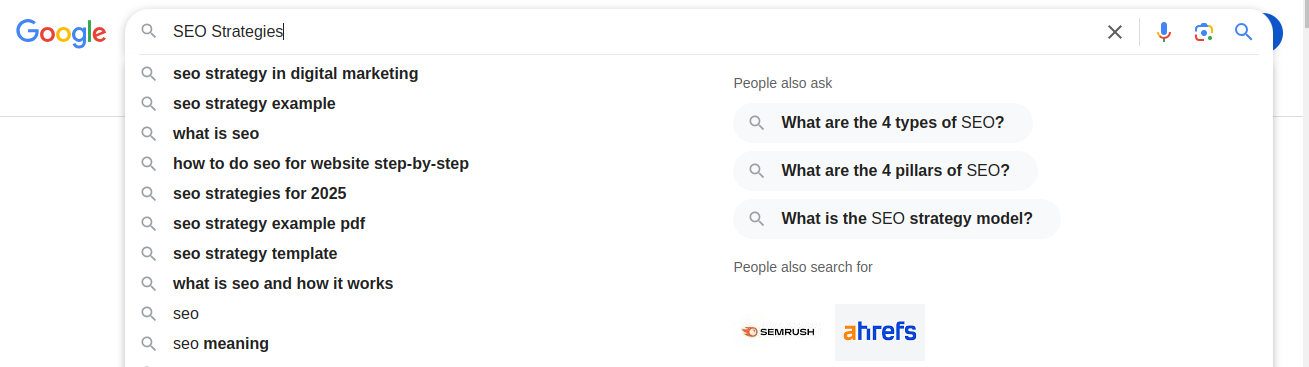
Keywords are terms and phrases that are used for search in Google. Targeting these phrases can help you rank higher in search results and attract more organic traffic. One of the best ways to identify trending keywords is to use ‘Google Suggest’.
Type a keyword in the search bar and check the auto-populated suggestions displayed by Google. These terms are the most searched for, thus giving you ideas on which keywords to target, based on your niche.
Ensure that you create a mix of short-tail and long-tail keywords, wherein the latter has less competition and can be easily ranked.
Analyze Google’s First Page
Monitoring Google’s first page is a great way of identifying which keywords are ranking and what users are searching for. The top 10 results on the first page give unique insights into search patterns and the keywords that are most relevant. This helps you create content around the most searched topics in your niche, and attract more organic traffic.
Content makes the ‘Difference’
Once you’ve identified the relevant keywords and what’s trending, it’s time to create high-quality and engaging content that users will be attracted to. When aiming to build SEO brand marketing, it’s essential to develop a consistent voice and message that resonates with your target audience and reflects your business’s unique identity. Following the crowd won’t help you rank. The best way is to scan the current content and figure out what more to add or to create something different but contextually relevant.
Remember, the more unique your content is, the more users it will attract, leading to enhanced website traffic, and potential conversions. Not only will your page rank in SERPs but awesome content also begets social sharing, thereby taking organic promotion to a whole new level.
On-page optimization
A key aspect of SEO, on-page optimization ensures that your website adheres to Google’s guidelines, thus enhancing its online visibility and search rankings. While there are numerous components to on-page SEO, let’s take a look at three of the key factors that make up a successful on-page optimization strategy.
1. Internal linking
An indispensable tool for on-page optimization, internal lining entails linking high-authority pages to the ones that need to be boosted. The more authoritative pages are linked to a less authoritative page, the more link juice is passed on to the latter, giving it more value in search engines.
2. URLs with relevant keywords
Gone are the days of long URLs. Search engines, especially Google prefer short URLs with relevant keywords, which makes the webpage easier to index, rank, and display in SERPs.
3. Semantic SEO
Semantic SEO is a technique that focuses more on meaning and context rather than solely on specific keywords. This strategy aims to satisfy the user’s intent by providing comprehensive and contextually relevant content rather than just targeting exact keyword matches.
Focus on search intent
With AI and machine learning advancements, search intent now holds more weight than mere keyword usage. It refers to the purpose behind a user’s search query, whether they seek information, navigate to a site, or make a purchase.
Why it matters in SEO:
Higher Rankings – Google prioritizes content that matches user intent.
Increased Conversions – Intent-based optimization attracts the right audience.
Types of search intent:
Informational – Research-based queries.
Navigational – Searching for specific websites.
Transactional – Ready to purchase.
Commercial – Comparing options.
Optimizing content for search intent improves visibility and user experience, strengthening your SEO strategy.
Content Design
Great content alone isn’t enough—it must be visually appealing and well-structured to maximize impact. Content design enhances readability and engagement, making it easier for users to consume and share information.
Why it matters in SEO:
Improves User Experience – Visually engaging content keeps visitors on your site longer.
Boosts Shareability – Infographics and images encourage social media shares.
Reduces Bounce Rate – Well-structured content increases dwell time, signalling quality to search engines.
Effective content design includes:
Graphs & Charts – Simplifies complex data.
Infographics – Presents key points visually.
Images & Videos – Enhances engagement.
Clear Formatting – Improves readability.
Well-designed content enhances SEO, increasing traffic and audience retention.
Content optimization
Creating high-quality content is not a one-time effort; it requires continuous updates to stay relevant and effective. Regularly optimizing content, especially guides, listicles, and industry reports, ensures accuracy, improves search rankings, and enhances user engagement.
Key Content Optimization Practices:
1 Update Outdated Information – Regularly refresh facts, statistics, and insights to maintain relevance.
2 Refine Keywords – Adjust content to align with evolving search trends and user intent.
3 Enhance Readability – Improve structure, formatting, and visuals for better user experience.
4 Improve Internal Linking – Connect updated pages to boost SEO and navigation.
Ongoing content optimization strengthens SEO, drives traffic, and keeps users engaged.
AI & Voice Search Optimization
AI-powered search and voice search continue to reshape how users interact with search engines. With Google’s SGE (Search Generative Experience) and the rise of voice-activated assistants like Alexa and Google Assistant, optimizing for conversational queries is critical.
Optimize for Conversational Keywords – Instead of short-tail keywords, focus on natural language processing (NLP)-driven queries like “What’s the best SEO strategy for 2025?”
Structured Content Format – Use FAQ schema, bullet points, and concise answers to rank in voice search and featured snippets.
Long-Form Content with Scannable Answers – Create deep-dive articles that provide in-depth insights while breaking up sections with short, scannable responses for quick voice search queries.
AI-Generated Summaries – Implement AI-enhanced meta descriptions that summarize your content clearly for AI-based search engines like Google’s SGE.
Local SEO & Google Business Profile Optimization
Local search is more competitive than ever, with Google prioritizing location-based results. Businesses must focus on optimizing their Google Business Profile (GBP) and local SEO elements.
Claim & Optimize Your Google Business Profile – Ensure your GBP is fully completed with accurate NAP (Name, Address, Phone), business hours, and categories.
Encourage Customer Reviews – High-quality reviews boost your local SEO rankings and click-through rates (CTR). Respond to reviews promptly to build trust.
Use Local Schema Markup – Implement geo-specific schema markup to help search engines better understand your business.
Create Hyperlocal Content – Publish blogs, landing pages, and articles relevant to your target geographic area (e.g., “Best SEO Agency in London: A 2025 Guide”).
Optimize for ‘Near Me’ Searches – Use localized keywords like “best SEO services near me” to improve your Google Maps ranking.
SEO Strategy for Keyword Research
Keyword research is one of the most essential elements of a sound SEO strategy. Not only does it help in relevant content creation, but it also lays the foundation for a robust SEO campaign. Keywords are terms and phrases that search engines analyze to deliver relevant search results.
This makes keyword research vital for any digital marketing strategy. This incredibly important process entails identifying and analyzing the terms and phrases that people enter into search engines. Keyword research is all about understanding what users are searching for, their trends and patterns, and the relevance of keywords in terms of competition.
Now that we’ve briefly touched upon the importance of keyword research, let’s now delve into the key components.
Understanding user intent
Understanding user intent lies at the core of keyword research. This process involves the identification of what users are searching for, and whether is it informational, transactional, or simply browsing.
Search volume analysis
A key component of keyword research, search volume analysis gives an overview of how often a particular keyword is searched for. High search volumes indicate the popularity of a keyword, however, it is deemed competitive, thus difficult to capitalize on.
Competitor analysis
This process involves the identification of keywords that a brand’s competitors are ranking on, thus, thus tweaking SEO strategies accordingly.
Find more valuable insights for your SEO strategy with our guide to SEO competitor analysis!
Long tail keywords
Although with lesser search volumes, long-tail keywords have been instrumental in attracting more targeted traffic with less competition, making them highly valuable for brands.
Best Tools for Keyword Research
Though being one of the most crucial elements of a successful SEO strategy, keyword research isn’t that hard to conduct, especially with a plethora of online tools that make the process a breeze. Here are some of the popular keyword research tools you should consider.
Google Ads
This tool not only serves as a great advertising platform for paid advertisements, but it’s also highly effective when it comes to keyword research., The Google Keyword Planner Provides search volume, competition level, and cost-per-click (CPC) estimates for keywords.
Price: Free to Use
SEMrush
One of the most comprehensive keyword research tools on the web, SEMrush provides a host of features for digital marketing. This tool comes with keyword difficulty analysis, search volume, CPC, keyword variations, related keywords, and competitive research.
Price: $499/month
Ahrefs
Yet another popular keyword research tool, Ahref is most known for its backlink analysis but is also quite famous for its keyword research tool. Known as the ‘keyword explorer’, this feature provides search volume, keyword difficulty, click-through rates, and more. Also shows top-ranking pages for each keyword.
Price: $999/month
Moz Keyword Explorer
Moz offers a state-of-the-art keyword research tool that provides important functions, such as keyword suggestions, SERP analysis, and organic CTR estimates. Also. Moz Keyword Explores features a ‘Priority’ score that collates multiple metrics and suggests the best keywords to target.
Price: Free to Use
Ubersuggest
A widely used keyword research tool, Ubersuggest offers keyword ideas and insights. This wonderful tool provides search volume, SEO difficulty, paid difficulty, and more, along with content ideas and backlink data.
Price: $400/one-time
KWFinder
This fantastic keyword research tool is particularly useful for finding long-tail keywords with lower competition, ideal for niche-specific keywords. With this tool, you get valuable insights, such as search volumes, trend data, CPC, and level of difficulty in ranking for keywords.
Price: $90/month
AnswerThePublic
A keyword research tool with a twist. AnswerThePublic provides keyword ideas based on questions, prepositions, and comparisons. This unique tool features Visual keyword research and content ideas tools, showing questions, propositions, alphabetic, and related searches.
Price: $99/month
Serpstat
Is yet another comprehensive SEO tool that provides a host of features, including an expansive keyword research tool. The keyword research tool provides keyword difficulty, search volume, competition level, and a unique feature for clustering keywords.
Price: $410/month
SpyFu
Best known for its competitor keyword research, SpyFu takes competitor research to a whole new level. It offers competitors’ most profitable keywords, paid and organic search ranking, and ad variations.
Price: $79/month
Keywords Everywhere
A highly effective keyword research tool in the form of a browser extension that displays keyword data directly in search results on various websites. The extension shows multiple data points, such as search volume, CPC, and competition data, and works seamlessly with Google, YouTube, Amazon, and various other platforms.
Price: $80/month
Why SEO is Changing Rapidly in 2025
Search engines are prioritizing user experience, AI-driven results, and authoritative content. Here’s what’s new:
AI-Powered Search (SGE & LLMs): Google’s Search Generative Experience (SGE) and other AI search tools like ChatGPT or Perplexity are redefining how users find information, prioritizing context-rich, conversational content.
Voice & Conversational Search Growth: With more people using voice assistants, optimizing for natural language queries and long-tail keywords is essential.
E-E-A-T (Experience, Expertise, Authority, Trustworthiness): Google rewards content from verified experts with real-world credibility As the landscape continues to evolve, effective SEO Marketing strategies are key to staying ahead. By adapting to these changes, businesses can continue to improve their visibility, attract organic traffic, and remain competitive in an ever-shifting digital space.
Final Thoughts
The key takeaway for SEO professionals, webmasters, and digital marketers is the need for continual learning and adaptation.
The strategies that worked yesterday may not be as effective tomorrow, and staying informed about the latest google trends, algorithm updates, and best practices is crucial. This means not only adopting new tactics but also refining existing ones to better align with the evolving search landscape.
In conclusion, the future of SEO in 2025 and beyond lies in a balanced blend of technical expertise, creative content strategy, and a keen eye on the shifting preferences and behaviors of search engine users.
By embracing these strategies, staying agile in approach, and continuously optimizing for both search engines and users, businesses, and websites can achieve sustained visibility and success in the digital realm.
If you are looking to enhance your brand’s online presence and higher search rankings, look no further. Our customized SEO services are designed to cater to the needs of all businesses, regardless of the niche or size. Contact us today to elevate your brand’s success.
Frequently Asked Questions (FAQs)
What is an SEO strategy?
An SEO strategy is a structured plan to improve website visibility, rankings, and organic traffic using optimization techniques.
How often should an SEO strategy be updated?
Regular updates are essential, especially when Google algorithm changes, industry trends shift, or content becomes outdated.
What are the key components of an SEO strategy?
Keyword research, content optimization, technical SEO, link building, and user experience improvements are crucial elements.
How does search intent impact SEO strategy?
Aligning content with user intent improves rankings, engagement, and conversions by delivering relevant and valuable information.
What is the role of content in an SEO strategy?
High-quality, optimized content improves rankings, engages users, and enhances credibility, driving more organic traffic to the website.
How long does it take to see results from an SEO strategy?
SEO is a long-term process noticeable improvements usually take 3 to 6 months, depending on competition and optimization efforts.
Sarvesh Bagla is an enterprise SEO expert and industry leader who has driven transformational digital growth for India’s top brands across the BFSI, Healthcare, Automotive, and ECommerce industries. As the Founder and CEO of Techmagnate, he leads large-scale organic search strategies and performance marketing campaigns for businesses looking to succeed in today’s AI-driven search landscape.
A strong advocate for thought leadership, Sarvesh is deeply involved in SEO evangelism and regularly contributes to industry discussions through LinkedIn, webinars, and CMO roundtables. His focus today is on helping brands prepare for an AI-first SEO future (AEO, GEO) and strategies for Large Language Models (LLMs) at the core.
Get the most valuable search related insights about leading brands, trending keywords, search volumes, fastest growing categories, city-level insights and much more!
It has come to our notice that fraudulent job offers are being circulated on the internet through messaging apps like WhatsApp and Telegram, which falsely claim to be from Techmagnate. We take this matter seriously and would like to caution all candidates to be wary of such postings.
Please Note That –
We do not charge any fees/security deposit/payment from candidates, irrespective of the professional experience they hold, for job applications or interviews
Official communication channels include our website and verified social media accounts, primarily LinkedIn.
Kindly double-check the domain name – @techmagnate.com – in the email address
We follow a transparent and ethical approach for hiring/onboarding supported by proper documentation.
Ensure that you only apply through verified channels to avoid being scammed. We also recommend that you exercise caution when sharing personal information or financial details with any job posting or recruitment agencies claiming to represent us.
We want to ensure that potential candidates interested in joining Techmagnate have a safe and positive experience.
If you find that someone that fits the description above has reached out to you, please notify us immediately at jobs@techmagnate.com.
 Important Alert:
 Important Alert:



















 6th Feb | Invite-only


