Beware of fake job offers and payment requests. We only use official email IDs and never conduct interviews on messaging apps.Beware of fake job offers and payment requests. We only use official email IDs and never conduct interviews on messaging apps.
Summary: SaaS companies often overlook some practices while planning their SEO strategies. And that’s the biggest mistake they make. These mistakes are in a way opportunities to grow the SaaS business. Read more to know about these common errors.
In the quest to improve their business online, SaaS companies make simple SEO mistakes.
While most common mistakes are already covered on Google search results, a few are not disclosed.
In this blog post, we will cover the most common mistakes and often overlooked areas that are not discussed so often but surely make a great impact on the overall SEO strategies.
Key Takeaways:-
SaaS companies often make simple SEO mistakes while trying to improve their online presence.
While common mistakes are well-known, there are other crucial ones not discussed much.
This blog post covers both common and not-so-discussed mistakes.
Avoiding these common mistakes and staying updated can greatly enhance your SaaS SEO performance.
Table of Contents
Understanding SaaS SEO in 2025
Regarding SaaS (Software as a service) business, it’s all about making a product appear on the search results page.
The strategy for SaaS SEO involves targeting specific words and phrases used by the target audience – for which a genuine understanding of the market is required.
Not just website visitors, the goal here is always for customer acquisition. A user coming to the webpage should be able to get answers to the queries he/she typed along with a strong call-to-action to sign up and purchase a solution.
If the website is hard to navigate, it disinterests a user and increases the chances of going to another competitor’s site.
Getting other reputable websites or news sites to talk about yours is also important for SaaS SEO. When other trustworthy websites give backlinks to your site, it attracts Google to have a look at you. So, it’s a good idea to link building with authority websites and get quality backlinks.
If your SaaS company serves in a particular city or region, you’ll also want to make sure Google prioritizes your site in local search. This involves putting your business on Google Maps and using words on your website that tell Google where you operate.
This is SaaS SEO in a nutshell. In the next sections, we’ll discuss some mistakes that happen while strategizing for it.
Discover What Your Customers Search ForDiscover What Your Customers Search For
Get insights on evolving customer behaviour, high volume keywords, search trends, and more.
10 Common SaaS SEO Mistakes People Make in the Business
Running a successful SaaS business requires a strong SEO strategy to drive organic traffic and boost visibility. However, many businesses make crucial mistakes that hinder their SEO efforts and online growth. Below, we highlight 10 common SaaS SEO mistakes and provide practical tips on how to avoid them, helping your SaaS business stay at the top of search engine rankings.
Mistake #1: Underestimating the Importance of User Experience
Neglecting user experience (UX) in SaaS SEO can be detrimental to your website’s performance. Imagine a visitor coming to your site and your webpage takes too long to load. Would the visitor wait for the webpage to open? Absolutely no.
Users will leave your site leading to an increased bounce rate – indicating a negative signal to search engines.
How to avoid this?
In 2025, prioritize your UX efforts to succeed in the SaaS business.
Create a website that is easy to navigate, with clear menus, an intuitive layout, and strong call-to-actions. When users land on your product page, they should be able to determine all the features and information related to the software you provide. Along with the content, the information should be easily accessible and understandable, and page loading times must be quick (favorably between 0-3 seconds).
Mistake #2: Making content product-driven, not user-driven
SaaS content that is overly focused on promoting the product rather than addressing the needs and interests of the users is not helpful in the eyes of search engines.
A user looks for solutions to problems, not over-the-top promises of a product or service. When content is too product-centric, it often lacks the depth and relevance users seek.
How to avoid this mistake
Shift your focus towards creating content that satisfies users’ queries, giving them valuable solutions to their problems. It can be only done through a deep understanding of the target audience’s pain points, challenges, goals, and budgets.
Creating comprehensive guides, helpful articles, case studies, or client testimonials in easy-to-understand and a tone that users can understand easily. You can not only attract more visitors but also improve user engagement. Save your SEO efforts and start creating helpful content from now on.
Mistake #3: Overstuffing content with Keywords
Many SaaS companies just focus on creating content around their product keywords, without realizing it hampers language.
When content is overstuffed with repetitive keywords, it doesn’t come out naturally and provides a poor reader experience. Users may find the content difficult to understand, as the messaging gets unclear. Moreover, search engines like Google also penalize websites for keyword stuffing, potentially resulting in lower rankings or even being removed from search results.
How to avoid this mistake
SaaS SEO content should be of high quality and user-friendly and naturally incorporate relevant keywords. Let’s understand this with an example.
“Our cutting-edge SaaS product offers the best CRM software on the market. Our CRM software is perfect for CRM management, CRM automation, and CRM reporting. Try our CRM software today!”
Do you see the stuffing of words here?
Now, look at this example.
“Our cutting-edge SaaS product offers a comprehensive CRM solution designed to streamline customer relationship management tasks. Our CRM software incorporates advanced automation and reporting features, empowering businesses to enhance customer interactions and drive growth. Experience the benefits of ourCRM solution by trying it today. ”
See the major difference the right keyword research and natural language processing make to the content.
Mistake #4: Not Optimizing your videos
Video content has become increasingly important in digital marketing strategies, and neglecting to optimize videos can hinder the effectiveness of your SEO campaigns.
Here’s why excluding video SEO in your SaaS content strategy is a mistake;
1. Missed Organic Search Visibility: Without optimization, your videos may not rank well in search engine results pages (SERPs) – causing you to miss out on potential traffic and leads.
2. Reduced Engagement on the website: Adding unoptimized videos on the website may fail to engage your target audience – leading to lower viewer retention.
3. Limited Reach to your target audience: SaaS platform videos need to reach a broader audience by making them more discoverable through search engines and video platforms like YouTube.
How to avoid this mistake
Make sure that product videos or platform videos are optimized with relevant keywords, descriptive title tags and meta descriptions, engaging thumbnails, and clear calls to action.
The title and thumbnail should be enticing enough for users to click on that video. Additionally, consider transcribing your videos to make them accessible and give a seamless user experience.
Mistake #5: Not tailoring content according to local audience
Having a multinational business is good. But in the quest to touch skies, we can’t ignore our first audience. Neglecting the search intent and user experience of a local audience can hinder your ability to connect with users in specific geographical areas.
How to avoid this mistake
Tailor your content to suit the preferences and interests of your target audience in different regions. This includes using local keywords, addressing specific pain points, and highlighting relevant local events or trends. By tailoring your content to the local audience, you can better achieve customer acquisition.
For example, if you’re selling a specific software and you only mention the selling price in USD, even when it’s searched for in the Indian demographic, it won’t be relevant. For the local audience, you should consider displaying the price in the local currency, such as Indian Rupees (INR). This simple adjustment can simply increase the likelihood of conversions from your audience.
Mistake #6: Ignoring reviews and feedback on the website
A website visitor complains about your page load speed and you choose to ignore it. Overlooking this valuable source of user input can affect your overall online reputation management.
Potential customers can hesitate to engage with your SaaS if they perceive that their concerns are not being addressed.
How to avoid this mistake
Actively monitor reviews and feedback on your website. Engage with users, address their concerns, and use their input to make meaningful improvements to your SaaS offering.
Mistake #7: Forget implementing structured data markup
If your product is unknown, chances are low for anyone to search for it. But, they can search for long-tail keywords stating exclusive features and functionalities. Not adding schema for your feature section can miss your chances of getting noticed in the search engine and lose organic traffic.
Websites with structured data markup are more likely to be featured in rich results, such as knowledge panels, event listings, and product reviews.
How to avoid this mistake
Implement structured data markup on your website according to best practices. You have to mark up relevant elements in the on-page content such as product details, reviews, events, and FAQ sections, using schema.org vocabulary.
Mistake #8: Not doing the research work, ignoring competition
Not doing the groundwork and disregarding competition is the biggest mistake anyone can make in SEO. It is a negative act as you are ignoring potential opportunities in the market, that only you can cater to.
How to avoid this mistake
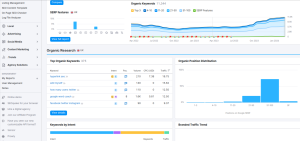
You can conduct thorough research on keywords, market trends, and competitors as part of your content marketing strategy. Use SEMRush to check your competitor’s website. Put the domain name of the competitor in the search bar of SEMRush and press. You’ll get a domain review as seen in the screenshot.
Scroll down and check sections like top organic keywords, organic keywords, and SERP features. Identify their strengths and weaknesses, and use this information to fill the market gap by creating your own SEO strategy.
Mistake #9: Not monitoring analytics
Analytics provide real-time insights into how users interact with your website. You can track metrics such as website traffic, user engagement, conversion rates, and customer journey paths. Understanding user journey and user behavior to optimize your website.
For example, you can discover untapped keyword opportunities, trends in user search behavior, or technical issues hindering your site’s performance.
How to avoid this mistake
Dedicate some time every week to monitor the performance of your SaaS SEO. Tools like Google Analytics, Google Search Console, and other tools or platforms you can check. Check the insights to get an overview of your business and gain to optimize your SaaS business.
Mistake #10: Failing to stay updated with the latest trends in SEO
Search engine algorithms, especially Google are evolving continually to deliver more relevant and valuable results to users. Many businesses confuse search engine optimization to be a basic level strategy. They fail to understand how algorithm plays a crucial role in keeping your business up and running in this digital landscape.
How to avoid this mistake
Stay abreast with the latest SEO trends, which can be useful for your SaaS industry. Subscribe or follow leading SEO experts like Neil Patel, Danny Sullivan, and Sarvesh Bagla on LinkedIn. They cover all the dynamics of changing digital marketing, along with their expert opinion.
Furthermore, monitor industry publications, attend SEO conferences and webinars, and participate in online forums and communities. You can adapt your SaaS SEO activities to capitalize on emerging trends and maintain a competitive edge in the market.
SaaS SEO Mistakes to Avoid in 2025
Each mistake mentioned above presents an opportunity for growth and improvement.
By addressing these common SEO mistakes head-on and implementing proactive campaigns, such as improving user experience, creating user-centric content, adopting natural search terms in the content, optimizing videos, and more. You won’t believe what competitive advantage you will get in your SaaS business.
Remember, every missed opportunity is a potential mistake waiting to be rectified. If you need expert help in fixing these mistakes, contact us. We’d give personalized consultation on what to do with your SEO strategy to show transformational results.
Neha Bawa is the Director of Brand Marketing at Techmagnate. She has worked in Digital Marketing since 2012 and has specialised in content creation. She has earned a Master’s degree in Interactive Communications from Quinnipiac University in Connecticut, U.S.A. Her interests lie in creating great content, docs, and working towards sustainability through biodiversity.
Get the most valuable search related insights about leading brands, trending keywords, search volumes, fastest growing categories, city-level insights and much more!
It has come to our notice that fraudulent job offers are being circulated on the internet through messaging apps like WhatsApp and Telegram, which falsely claim to be from Techmagnate. We take this matter seriously and would like to caution all candidates to be wary of such postings.
Please Note That –
We do not charge any fees/security deposit/payment from candidates, irrespective of the professional experience they hold, for job applications or interviews
Official communication channels include our website and verified social media accounts, primarily LinkedIn.
Kindly double-check the domain name – @techmagnate.com – in the email address
We follow a transparent and ethical approach for hiring/onboarding supported by proper documentation.
Ensure that you only apply through verified channels to avoid being scammed. We also recommend that you exercise caution when sharing personal information or financial details with any job posting or recruitment agencies claiming to represent us.
We want to ensure that potential candidates interested in joining Techmagnate have a safe and positive experience.
If you find that someone that fits the description above has reached out to you, please notify us immediately at jobs@techmagnate.com.
 Important Alert:
 Important Alert: