Beware of fake job offers and payment requests. We only use official email IDs and never conduct interviews on messaging apps.Beware of fake job offers and payment requests. We only use official email IDs and never conduct interviews on messaging apps.
Summary: This guide covers how LSI keywords work, their benefits in SEO, including improved rankings and user experience, and methods for identifying and implementing them.
It highlights the use of LSI keywords as a strategy for future-proofing SEO efforts, making content more discoverable, and providing value to the target audience.
Welcome to the ever-evolving world of Search Engine Optimization (SEO), where staying ahead of the curve is not just an advantage but a necessity.
In this space, the introduction of Latent Semantic Indexing (LSI) keywords marks a significant shift, offering a powerful tool for those looking to enhance their digital presence. But what exactly are LSI keywords, and how can they revolutionize your SEO strategy?
LSI keywords are terms that are semantically related to your primary keyword. Unlike traditional keywords, which focus on exact matches, LSI keywords provide context and depth, helping search engines grasp the full meaning of your content.
This approach not only improves the quality of search results for users but also offers website owners a more nuanced and sophisticated way to optimize their content.
In this blog post, we will dive deep into the world of LSI keywords. From unraveling the concept to demonstrating how they can be seamlessly integrated into your SEO strategy, we aim to provide a comprehensive guide.
Whether you’re a seasoned SEO professional or a curious newcomer, understanding the role of LSI keywords is crucial in today’s digital landscape. Let’s embark on this journey to discover how LSI keywords can be the game-changer in your SEO playbook, propelling your website to new heights in search engine rankings.
They offer language variety, avoiding penalties for keyword stuffing.
Relevant LSI usage can improve search engine rankings by making content appear more valuable.
Comprehensive content with LSI keywords better satisfies search intent, enriching user engagement.
Adapting LSI keywords aligns with the semantic and context-aware direction of modern SEO.
Identify LSI keywords through research tools and integrate them naturally across content elements.
Table of Contents
What Are LSI Keywords?
LSI keywords are words or phrases frequently occurring in a context similar to the primary keywords. They help search engines understand the topic covered on a given page.
For example, if your primary keyword is “SEO best practices,” some LSI keywords could include “on-page seo,” “backlinks,” ” informative content,” and “link-building.” These words indicate that the content is related to the overall theme of SEO and help search engines categorize it accurately.
Using these LSI keywords naturally in the content allows you to avoid repetitive phrases and create a more engaging user experience. Google’s algorithm has evolved to prioritize contextual relevance, making LSI keywords more important.
Why Are LSI Keywords Important for SEO?
Source image: twistarticle
Understanding how search engines interpret content is key to better rankings—and that’s where LSI keywords come in.
Latent Semantic Indexing (LSI) keywords are terms and phrases closely tied to your main keyword, offering deeper context to your content. They help search engines better grasp what your page is really about, ensuring your content reaches the right audience. Here’s why they’re crucial:
They Add Context to Your Content – LSI keywords go beyond simple synonyms. They support the theme of your content, helping search engines connect related ideas more accurately.
They Come from Natural Language Processing – The idea behind LSI keywords comes from Latent Semantic Analysis—a method that helps search engines interpret word meaning and relationships in context.
They Improve Search Engine Understanding – By including semantically related terms, you make it easier for search engines to figure out what your page is truly about and how relevant it is to a user’s search.
They Boost SEO by Enhancing Relevance – The richer your content, the more value it provides. LSI keywords contribute to well-rounded, informative pages that are favored by search engines.
Align with User Inten – LSI keywords help ensure your content matches what users are genuinely searching for, even if their search query doesn’t exactly match your primary keyword. This helps improve your content’s relevance.
They Make Your Content More Comprehensive – By including related terms (e.g., “espresso” or “barista” for the keyword “coffee”), your content covers more angles of a topic—improving topical depth.
They Prevent Keyword Stuffing – Using LSI keywords naturally reduces overuse of your primary keyword while still reinforcing the topic.
They Align with Modern SEO Practices – Search engine algorithms now favor intent and context. LSI keywords meet these criteria, helping your content stay competitive in search rankings.
They Increase Your Chances of Ranking for Related Queries – Because your content touches on a wider range of related terms, it has the potential to show up for more search queries.
10. They’re Easy to Find and Use – With free LSI keyword tools available online, it’s simple to identify the right terms and naturally include them in your content strategy.
Discover What Your Customers Search ForDiscover What Your Customers Search For
Get insights on evolving customer behaviour, high volume keywords, search trends, and more.
LSI keywords are terms and phrases semantically related to a primary keyword. They are not just synonyms but can include synonyms, related terms, and other words that frequently occur in the same context as the primary keyword.
For example, for the primary keyword “apple,” LSI keywords could include “fruit,” “orchard,” “pie,” and “iPhone,” depending on the context.
Improving search engine interpretation
Search engines use semantically related keywords to better understand the content of a page. By incorporating LSI keywords, you help Google interpret your page’s topic more accurately, improving its relevance for search queries.
By analyzing these semantically related words, search engines can discern the topic and context of the page more accurately. This helps in delivering content with keywords that are more relevant to users.
Enhancing content quality
Including LSI keywords in content can improve its quality and relevance. It helps search engines see that the content is comprehensive and covers various aspects of the primary topic. This can lead to better rankings in search results.
Avoiding keyword stuffing as a key SEO strategy
Traditionally, SEO heavily relied on using exact-match keywords repeatedly. However, this often led to poor-quality content and keyword stuffing. Monitoring keyword density in SEO is essential, as it helps create a balanced use of keywords, improving readability and ensuring content quality without excessive repetition.
LSI keywords provide a way to optimize content without overusing the exact primary keywords, leading to more natural and user-friendly content.
Content relevance and ranking
Search engines use LSI keywords as one of the factors to determine the relevance of a webpage to a search query.
Pages that naturally include words and phrases related to the primary keyword are often considered more relevant, potentially leading to higher rankings.
Adapting to search algorithms
Search engine algorithms, like Google’s, are continually evolving, and understanding the way to find and use semantically related keywords and search terms is crucial for a better user experience.
They are increasingly becoming better at understanding user intent and the contextual meaning of terms.
LSI keywords align with this evolution by focusing on the overall topic and context rather than just the exact-match keywords. Understanding that LSI important keywords don’t rely solely on exact matches but also include semantically related phrases.
User experience
Ultimately, LSI keywords contribute to a better user experience. When content is rich in relevant and related terms, it’s more likely to satisfy the user’s search intent and provide comprehensive information on the topic they are interested in.
Why Use LSI Keywords For SEO
Using Latent Semantic Indexing (LSI) keywords in SEO offers several benefits. LSI keywords are terms and phrases semantically related to a primary keyword.
These are not just synonyms but words that often occur together within a particular context, helping search engines to understand the content better. Just like long-tail keywords in SEO, LSI keywords add depth and specificity, allowing you to capture varied user intents and increase relevance. Here are some key benefits of leveraging LSI keywords in SEO for more relevant results:
Enhanced content relevance and context
LSI keywords provide search engines with more context about your content. This helps in accurately matching your content with user queries.
Improved search engine rankings by focusing on the target keyword and its LSI counterparts through semantically related keywords.
Search engines like Google use LSI to understand the meaning of the content. By using relevant LSI keywords, your content may be deemed more valuable and relevant, potentially improving its ranking in search results.
Reduced risk of over-optimization
Overusing the same keywords (keyword stuffing) can lead to penalties from search engines. LSI keywords provide a way to create rich, varied content that avoids excessive repetition of the same terms.
Incorporate LSI keywords for better UX
LSI keywords contribute to more natural, engaging content. This enhances the reader’s experience, potentially increasing time spent on the site and decreasing bounce rates.
Use latent semantic indexing for increased content visibility
LSI keywords can capture a broader range of search queries, serving as a critical tool to help Google understand varied search intents.
Your content becomes accessible to users who might use different but related terms in their search, thanks to the use of relevant keywords in your content.
Identify the best LSI keywords for a competitive edge
By identifying and using unique LSI keywords that competitors might not be using, you can tap into new areas and gain an edge in search rankings.
Find related keywords for long-tail keyword optimization
Keyword optimization in seo can be particularly effective for long-tail keyword strategies, where you target more specific, less competitive phrases.
Future-proofing SEO by integrating LSI keywords into your content
As search engines evolve to become more semantic and context-aware, using LSI keywords aligns well with the direction of modern SEO practices.
How LSI Keywords Improve SEO?
Using LSI (Latent Semantic Indexing) keywords can significantly improve your content’s SEO. These are words and phrases closely related to your main keyword. They help search engines better understand your content’s topic and intent, making it easier for the right audience to find you. Here’s how they help:
Add Context to Search Engines – LSI keywords provide valuable context for search engines, helping them understand the broader topic of your content and ensuring your page ranks for a wider range of related queries.
Support Related Search Terms – Instead of only targeting one keyword, LSI terms allow your content to show up for a broader range of related queries.
Improve Content Relevance – Including naturally related terms (e.g., “social media,” “SEO,” “online advertising” for “digital marketing”) adds depth to your content.
Boost Organic Rankings – Search engines reward well-rounded content that addresses a topic comprehensively—something LSI keywords help achieve.
Enhance User Experience – Content that uses related terms reads more naturally, making it more engaging and easier to understand for readers.
Avoid Keyword Stuffing – Using LSI keywords allows you to reinforce your topic without awkwardly repeating the same keyword over and over.
Increase Dwell Time – When users find helpful, complete content, they stay longer—boosting engagement signals that also help SEO.
Improve Semantic Search Compatibility – As Google and other engines focus more on meaning and context, LSI keywords help your content align with those evolving algorithms.
Best Practices for Incorporating LSI Keywords
Follow the below-mentioned practices to make the best use of LSI in content:
1. Maintain a Balance
Using LSI keywords is essential for expanding content relevance, but they should be integrated naturally. Avoid overstuffing keywords, as it can disrupt readability and weaken user engagement. Instead, focus on enhancing the content’s flow, ensuring that keywords fit seamlessly within sentences. Balanced usage of LSI keywords contributes to a better user experience and aligns with search engine preferences for high-quality, relevant content.
2. Focus on User Intent
LSI keywords are best explained as the search intent behind user queries. Aligning your content with what the user is searching for improves relevance and ensures that it meets user expectations. This practice also increases the likelihood of higher engagement and better search rankings.
3. Periodic Updates
User search behavior and interests evolve, so it’s important to periodically update your LSI keywords. By monitoring shifts in search trends and adjusting keywords accordingly, you can ensure the content remains relevant and responsive to current topics. Regular updates help maintain content’s visibility and effectiveness in meeting user demands.
4. Use LSI Keywords in Highlighted Sections
To maximize the effectiveness, place LSI keywords in focused areas like headings, subheadings, introduction and conclusion.
5. Leverage Synonyms and Related Phrases
LSI keywords often include synonyms and related terms that can add depth and variety to your content. Instead of repeating the same keywords, incorporate different but related phrases to create a more comprehensive piece. This approach enhances readability, provides greater context, and aligns with search engines’ focus on natural language and context-driven SEO.
How to Identify LSI Keywords
Use keyword research tools
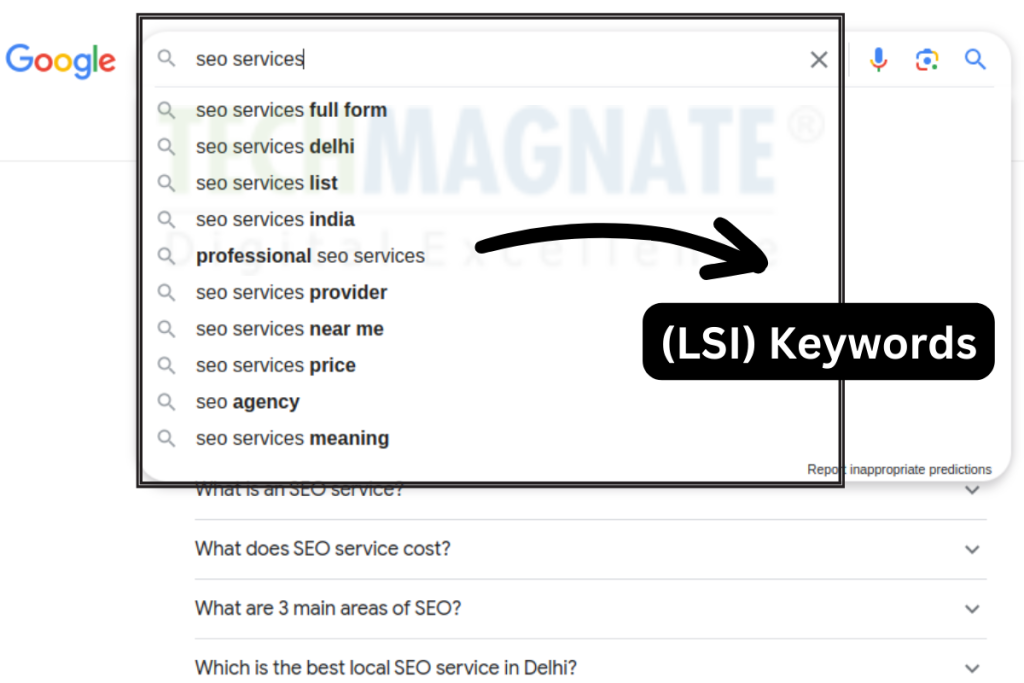
Google Keyword Planner and other best seo tools, such as Ahrefs and SEMrush, or even Google’s search suggestions can help you find LSI keywords.
These tools provide related search terms that people are using, effectively acting as a generator for relevant keywords.
Analyze top-ranking pages
Look at the content that ranks well for your primary keyword and analyze it with an LSI graph for stronger SEO performance. Identify common phrases and terms used in these pages, including LSI keywords throughout to enrich content comprehension.
Use LSI keyword tools
There are specific tools designed to find LSI keywords, such as LSIGraph. These tools give you a list of related keywords based on your main keyword.
Google’s “Related Searches”
At the bottom of Google’s search results, there’s a section called “Related Searches”. This section often contains valuable LSI keywords.
Contextual analysis
Sometimes, the best LSI keywords are found by thinking critically about your topic. Consider what other topics or terms are naturally associated with your primary keyword, using an LSI keyword generator to incorporate these relevant keywords into your content.
How to Use LSI Keywords
Natural integration
Don’t stuff your content with LSI keywords. They should be naturally integrated into your content, making it more informative and reader-friendly.
Diverse usage
Use LSI keywords in various parts of your content, including the body text, headings, subheadings, and meta tags (like the title and description).
Enhance UX
The primary goal of using LSI keywords should be to enhance the user experience by providing more comprehensive and relevant information.
Find LSI keywords to update existing content
Incorporate LSI keywords into your existing content. This can improve the relevance and freshness of your pages.
Balance with primary keywords
Maintain a balance between your primary keywords and LSI keywords. The primary keyword should remain the focus, but LSI keywords support and contextualize it.
Monitor performance
Use analytics tools to track your content’s performance with the implemented LSI keywords. These tools often function as an LSI keyword generator, providing valuable insights. Look for changes in rankings, traffic, and engagement.
Feedback and iteration
SEO is not a set-it-and-forget-it task. Continuously gather feedback, monitor changes in search engine algorithms, and iterate your use of LSI keywords accordingly.
How to Avoid the Overuse of LSI Keywords
While LSI keywords add valuable context and relevance to your content, overusing them can lead to keyword stuffing, which might harm readability and even your SEO performance. Here are some effective tips to help you use LSI keywords naturally:
Ensure Natural Flow: Integrate LSI keywords naturally into your content, making sure they fit within the context of your ideas without forcing them. This ensures readability and helps maintain content quality.
Use Synonyms and Variations: Instead of repeating the same LSI keyword, consider using synonyms and variations. This approach maintains context without redundancy and offers a richer language experience for readers.
Limit Keyword Frequency: Aim for an LSI keyword density that’s balanced. Use each LSI term only a couple of times throughout the content, based on its length. Generally, 1-2 occurrences per 500 words is sufficient.
Prioritize User Experience: LSI keywords should enhance content, not clutter it. Always read your content aloud to ensure it sounds natural. If any keyword seems repetitive or forced, replace it with a more seamless expression.
Diversify Content Structure: Use LSI keywords in different parts of the content, such as headings, subheadings, lists, and image alt text. This dispersal ensures your content remains varied while also making effective use of LSI keywords.
Monitor Content Readability: Use readability checkers (like Hemingway or Grammarly) to make sure keyword placement hasn’t made the content dense or difficult to follow. High readability keeps readers engaged and signals quality to search engines.
Conclusion
Using LSI keywords goes beyond improving rankings, it’s about enhancing content relevance and delivering value to your audience. By strategically incorporating LSI keywords, you can improve SEO and provide a better user experience.
By carefully selecting and integrating these keywords, you can strengthen your SEO strategy, making your content more discoverable and useful to your target audience.
If you’re looking to make the most of LSI keywords and improve your online visibility, contact us today. Our expert team of SEO professionals offers comprehensive SEO services and will handle all the heavy lifting to get you the results you need.
Frequently Asked Questions (FAQs)
Does Google Use LSI in Their Algorithm?
No, Google does not use traditional Latent Semantic Indexing (LSI). Instead, it uses advanced AI and natural language processing to understand content.
Are LSI keywords important for SEO?
While “LSI keywords” aren’t a real thing, using related terms helps Google understand your content and improve rankings.
How Do LSI Keywords Improve Your Rankings?
Using relevant words and phrases makes your content more clear and useful, helping it rank better.
Are LSI keywords the same as synonyms?
No, related words include synonyms but also terms connected to the main topic.
Do LSI keywords have any disadvantages?
Overusing related terms unnaturally can hurt readability and SEO. Focus on writing naturally.
How Do LSI Keywords Help with Semantic Search?
LSI keywords play a key role in semantic search, as they help search engines understand the meaning behind the content, not just the exact match of keywords. By using semantically related terms, you can enhance the contextual relevance of your content, aligning it with the user’s search intent.
Can LSI Keywords Improve Long-Tail Keyword Targeting?
Yes, LSI keywords are great for enhancing long-tail keyword targeting. They help provide additional context and specificity to the content, making it easier to rank for long-tail variations of your primary keyword, which are often less competitive and more focused.
Do LSI Keywords Help with Content Gap Analysis?
Absolutely! LSI keywords can highlight gaps in your content by revealing related terms that you may not have considered. By incorporating these related terms, you ensure that your content covers a broader range of topics, addressing more angles and improving overall SEO.
How Can I Track the Performance of LSI Keywords in My SEO Strategy?
You can track the performance of LSI keywords using tools like Google Analytics, Ahrefs, or SEMrush. These tools provide insights on keyword rankings, traffic patterns, and content performance, helping you understand how well your LSI keywords are contributing to SEO goals.
Are LSI Keywords Beneficial for E-commerce SEO?
Yes, LSI keywords can be highly beneficial for e-commerce SEO. They help optimize product descriptions, category pages, and FAQs with relevant, related terms that improve content visibility. By using LSI keywords, you can better align your product offerings with the variety of search queries customers use.
Sarvesh Bagla is an enterprise SEO expert and industry leader who has driven transformational digital growth for India’s top brands across the BFSI, Healthcare, Automotive, and ECommerce industries. As the Founder and CEO of Techmagnate, he leads large-scale organic search strategies and performance marketing campaigns for businesses looking to succeed in today’s AI-driven search landscape.
A strong advocate for thought leadership, Sarvesh is deeply involved in SEO evangelism and regularly contributes to industry discussions through LinkedIn, webinars, and CMO roundtables. His focus today is on helping brands prepare for an AI-first SEO future (AEO, GEO) and strategies for Large Language Models (LLMs) at the core.
Get the most valuable search related insights about leading brands, trending keywords, search volumes, fastest growing categories, city-level insights and much more!
It has come to our notice that fraudulent job offers are being circulated on the internet through messaging apps like WhatsApp and Telegram, which falsely claim to be from Techmagnate. We take this matter seriously and would like to caution all candidates to be wary of such postings.
Please Note That –
We do not charge any fees/security deposit/payment from candidates, irrespective of the professional experience they hold, for job applications or interviews
Official communication channels include our website and verified social media accounts, primarily LinkedIn.
Kindly double-check the domain name – @techmagnate.com – in the email address
We follow a transparent and ethical approach for hiring/onboarding supported by proper documentation.
Ensure that you only apply through verified channels to avoid being scammed. We also recommend that you exercise caution when sharing personal information or financial details with any job posting or recruitment agencies claiming to represent us.
We want to ensure that potential candidates interested in joining Techmagnate have a safe and positive experience.
If you find that someone that fits the description above has reached out to you, please notify us immediately at jobs@techmagnate.com.
 Important Alert:
 Important Alert: