Beware of fake job offers and payment requests. We only use official email IDs and never conduct interviews on messaging apps.Beware of fake job offers and payment requests. We only use official email IDs and never conduct interviews on messaging apps.
Summary: Beat the competition and boost conversions with the help of long-tail keywords. Seamlessly integrate long-tail keywords into your content and watch your visibility soar, driving sustainable growth in website traffic.
Long-tail keywords or phrases have become increasingly common in search queries. This surge is largely attributed to the growing popularity of voice search and AI assistant, where users casually speak natural, conversational language. Instead of using short, generic keywords in search engines, people now type their queries aloud like chatting with friends.
This shift in search behavior means that targeting long-tail keywords isn’t just optional—it’s essential for modern SEO success. Let’s dive deeper into why they matter and how you can use them to rank better and convert higher.
Key Takeaways:-
Long-tail keywords are essential for effective SEO as they target specific user queries, resulting in increased relevance and higher conversion rates.
Tools like Google Ads Planner, Google’s Autocomplete feature, and the “People Also Ask” section are valuable resources for finding long-tail keywords.
Incorporating long-tail keywords naturally into content and optimizing meta tags can enhance visibility and attract targeted traffic.
By focusing on long-tail keywords, businesses can overcome competition, improve search engine rankings, and drive sustainable growth in online businesses.
Modern SEO strategies combine long-tail keywords with user intent analysis, semantic search, and AI-driven keyword tools to achieve optimal results.
Table of Contents
What are long-tail keywords?
Long-tail keywords in SEO are specific, longer phrases that users enter when looking for particular information, products, or services. Unlike short-tail keywords, which are broader and more general, long-tail keywords target a larger audience and tend to be more descriptive. They often consist of three or more words and are characterized by their low search volume but high conversion rates.
For example, let’s consider the search term “digital marketing.” While this keyword is broad and competitive, a long-tail variation could be “best digital marketing strategies for large businesses.” This long-tail keyword is more specific and tailored to a particular audience—enterprises looking for effective digital marketing strategies.
Another example could be a “gluten-free chocolate cake recipe.” This long-tail keyword targets individuals with specific dietary restrictions who are searching for a particular type of dessert recipe.
Understanding what keyword optimization is and its importance in SEO is crucial for any online business or content creator. Below are some benefits of using long-tail keywords in your content strategy.
Discover What Your Customers Search ForDiscover What Your Customers Search For
Get insights on evolving customer behaviour, high volume keywords, search trends, and more.
One of the primary advantages of long-tail keywords is their ability to target specific search queries with precision. When users perform searches using long-tail keywords, they are often looking for particular solutions to their problems. By strategically using SEO keywords alongside long-tail keywords, you can ensure that your content is optimized to match user intent, improving the relevance and accuracy of search results.
For example, a user interested in baking may look for recipes online. But the user is looking for a vegan cake recipe. The natural flow of language goes like a ‘vegan cake recipe’. Now, the Google result page shows websites with chocolate cake recipes, since it is the keyword. But websites that have content with long tail keywords such as “eggless vegan chocolate cake recipe” or “best vegan bakeries near me” will show higher in search results.
By targeting these specific queries, the bakery can attract visitors who are actively seeking vegan options, thereby increasing the relevance of their content and increasing the possibility of conversion.
2. Lower Competition
Long-tail keywords in SEO often have lower search volumes compared to short-tail keywords – which means there is typically less competition for ranking on SERPs. While short-tail keywords may be highly competitive and dominated by established players in the industry, long-tail keywords present an opportunity for new businesses to establish their topic authority.
If users search for just ‘yoga mats’, there are various brands online providing workout equipments. But targeting a specific purchase range like
‘yoga mats under 1000’
‘yoga mats under 500’
‘yoga mats between 500-1000’
can cater to the target audience. By tapping into niche markets through long-tail keyword optimization, businesses can reach highly targeted audiences with less effort and investment. This can be particularly advantageous for startups or businesses operating in niche industries where competition for generic keywords is fierce.
3. Higher Conversion Rates
Matching user intent is key to higher conversion rates, and long-tail keywords excel in this aspect. People searching long-tail keywords often have a clearer idea of what they are looking for. By creating content that directly addresses the specific needs and interests of users, businesses can attract more qualified traffic and get potential leads.
For instance, a software company that specializes in project management tools can use long-tail keywords such as,
“Best project management software for remote teams”
“Project management tools for agile development”
“Project management software for IT company”
With these specific monthly searches of its target audience, the company can attract users who are actively seeking solutions to their project management challenges, leading to higher conversion rates.
4. Improved Ranking Opportunities
Long-tail keywords present unique opportunities for improving search engine rankings.
Due to their specificity and lower competition, websites with long-tail keywords have a better chance of ranking higher on SERPs. Additionally, long-tail searches are often associated with featured snippets, which are prominently displayed at the top of search results and can significantly increase visibility.
Users are more likely to click on featured snippets for quick information and this prime placement can lead to a substantial increase in organic traffic. Therefore, incorporating specific long-tail keywords into a content strategy can be a strategic approach to improve search rankings and increase search traffic.
5. Enhanced User Experience
Providing a seamless user experience is essential for retaining visitors and encouraging engagement on your website. Long-tail keywords in SEO play a crucial role in enhancing the user experience by delivering more targeted content to users. When users find content that directly addresses their queries and meets their needs, they are more likely to stay on the site longer, explore other pages, and ultimately take desired actions.
For example, a travel blog that answers long-tail keywords such as “best hiking trails in the Pacific Northwest” or “family-friendly beach resorts in Lakswadeep” can attract visitors who are specifically interested in these topics. By delivering comprehensive and informative content that caters to the interests of its target audience, the travel blog can create a positive user experience and build trust and credibility with its visitors.
How Do Long-Tail Keywords Work?
Long-tail keywords work by matching what the searcher wants with exact, descriptive phrases.
They help search engines figure out what your pages are about, which lets them show up for searches that are very relevant.
Your content gets people closer to converting when you target long-tail queries because they already know what they want.
These keywords also lower bounce rates because people find exactly what they want, which is good for your site’s overall SEO health.
A person who types “best ergonomic office chair under $200” into a search engine is ready to buy, but someone who types “office chair” is not. Using these long-tail keywords makes sure that your content gets in front of people who are really interested, which leads to higher conversion rates.
How to Find Long-Tail Keywords
There are several methods for finding long-tail keywords:
Use SEO tools
Keyword research tools like Google Keyword Planner, SEMrush, and Ahrefs identify relevant long-tail keywords with sufficient search volume.
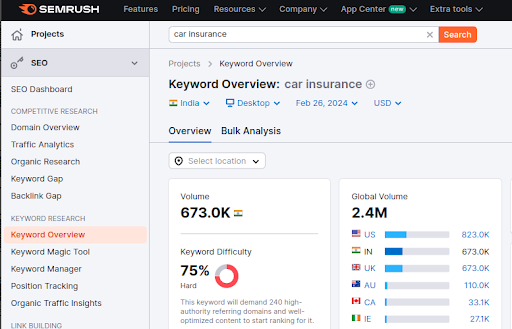
In SEMrush, when you search for ‘car insurance’, you can see a high search volume. A search volume is a measure of high competition for that keyword.
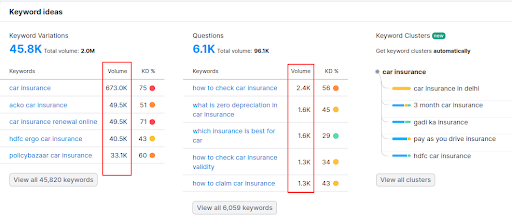
But it also suggests a list of related keywords for SEO. Terms like ‘How to check car insurance’ or ‘Which insurance is best for a car’ are commonly used by users when they inquire about car insurance on Google. These are the perfect examples of long-tail keywords, waiting to be answered.
Use Google’s Autocomplete Feature
When you type something on Google, you see a list of suggested terms. Analyzing keyword suggestions and autocomplete features can uncover commonly searched long-tail phrases and the search intent of your industry.
Users are looking for phones that cater to their needs. One of the filter criteria for them is by price range. Most searched queries on Google are for a specific price range for mobile phones, which can be used as keyword ideas.
Try Google Ads Planner
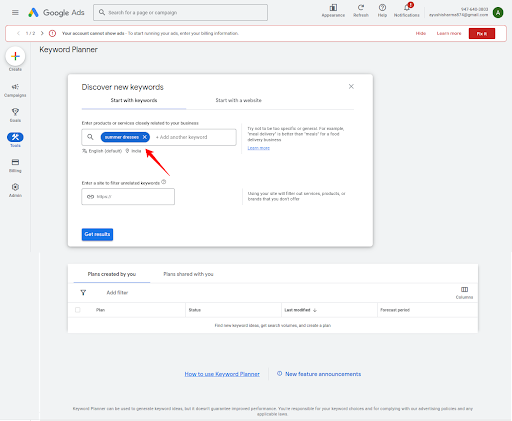
We know Google Ads Planner is a valuable tool for researching and planning advertising campaigns. One unique feature of the tool is finding long-tail keywords. By entering seed keywords related to your niche or topic of interest, the Ads Planner generates keyword suggestions along with their search volume, keyword difficulty, and competition level.
This information can help you identify and focus on long-tail keywords that are relevant to your content or products.
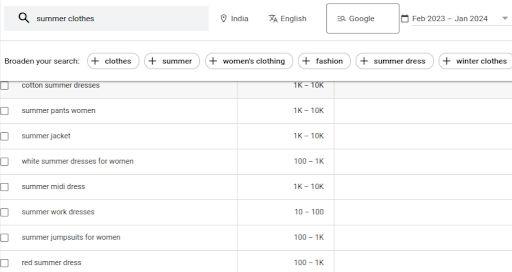
Suppose a user is planning a vacation and wants to explore keywords important to “summer dresses.” Using Google Ads Planner, input your head keyword “summer dresses.” The tool then provides suggestions such as “white summer dress for women,” “red jumpsuits for summer,” and “cotton dresses for summer.” These insights allow you to discover specific topics and phrases that users are searching for, empowering you to tailor your content accordingly and enhance your website’s search engine visibility.
People Also Ask Section
The “People Also Ask” (PAA) section is a feature within Google search results that displays related questions based on the user’s initial query. This section can be a goldmine for discovering long-tail keyword ideas that are directly relevant to the topics your audience is interested in.
By examining the questions listed in the PAA section, you can find relevant keywords and phrases that users are searching for. Incorporating these long-tail keywords in SEO into your content strategy allows you to address the specific needs and inquiries of your target audience, potentially increasing your website’s visibility and attracting more organic traffic.
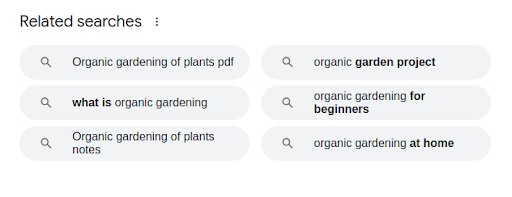
Continuing with the gardening website example, when you search for “organic gardening” on Google, you notice the “People Also Ask” section. Here, you find keywords like “What are the benefits of organic gardening?” and “How to start an organic garden from scratch?” These questions reflect keyword searches that users have about organic gardening. By incorporating these questions and related keywords into your content strategy—for instance, creating blog posts or FAQs—you can address the interests and concerns of your target audience more effectively, potentially driving more organic traffic to your website.
Study social media interactions
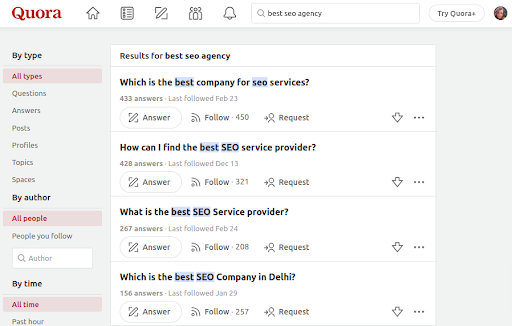
Mining data from customer interactions, forums, and social media platforms to identify specific questions, concerns, or interests that can be addressed through popular keywords. Questions on Quora are perfect examples of long-tail questions or keywords.
By leveraging these queries, businesses can unravel long-tail keywords that align with the needs and interests of their target audience and write their content accordingly.
Ask AI Chatbots for Ideas
AI-powered chatbots like ChatGPT, Gemini, and Perplexity can be excellent tools for discovering unique, intent-based long-tail keyword ideas that traditional SEO tools may overlook.
Simply ask prompts such as:
“Give me long-tail keywords related to eco-friendly home decor.”
“What are people searching for before buying noise-cancelling headphones?”
These tools analyze massive datasets and conversational search trends to generate natural, question-based keyword ideas that align closely with how users speak and search.
Pro Tip: Combine AI chatbot insights with SEO tools like Ahrefs or SEMrush to verify metrics like search volume and keyword difficulty. This hybrid approach ensures your keywords are both creatively diverse and data-backed, giving you a strong edge in competitive niches.
How to Optimize Content with Long Tail Keywords
Once you’ve identified relevant long-tail keywords, it’s essential to incorporate them strategically into your content. Maintaining an optimal keyword density is also crucial, as it ensures keywords appear naturally and effectively within the content without appearing forced or overused. Using on page SEO techniques such as optimizing meta tags, headings, and content with long-tail keywords can improve their visibility and relevance to search engines. Here are some tips for using long-tail keywords effectively:
Incorporate long-tail keywords naturally into your content, ensuring that they fit seamlessly within the context of your writing.
Create dedicated landing pages or blog posts around specific long-tail queries to provide in-depth information and solutions to users’ queries.
Optimize meta tags, headings, and content with long-tail keywords to improve their visibility and relevance to engines.
Monitor the performance of your long-tail keyword strategies using analytics tools and adjust your approach as needed based on data insights.
By implementing these best practices, businesses can maximize the impact of their long-tail keyword optimization efforts and drive tangible results in terms of search engine rankings, traffic, and conversions.
Long-tail keywords offer a multitude of advantages for businesses looking to enhance their SEO performance and attract targeted traffic to their websites. From increased relevance and lower competition to higher conversion rates and improved ranking opportunities, the benefits of long-tail keywords are undeniable.
By incorporating long-tail keywords into your SEO strategy and optimizing your content accordingly, you can position your business for success in today’s competitive online landscape. By understanding where to find long-tail keywords and how to use them effectively, you can unlock the full potential of this powerful SEO strategy and drive sustainable growth for your business.
Contact us if you need help implementing long-tail keyword strategies in your business. We’d be happy to help you.
Frequently Asked Questions
What are long-tail keywords in search engine optimization?
Long-tail keywords are long, very specific search terms that people use when they want to find certain information, products, or services. They have a lower search volume than short-tail keywords, but they have a higher chance of converting because they target people who are ready to buy. Long-tail keywords help your SEO strategy get more people to see your site, make it more relevant, and bring in qualified traffic.
What makes long-tail keywords important for SEO?
Long-tail keywords are very important because they help businesses match what users want exactly. They usually have less competition, which makes it easier for new or niche sites to get high rankings. Also, targeting long-tail keywords leads to higher conversion rates and better engagement because users find what they are looking for right away. Adding these keywords to your content, meta tags, and headings will make your SEO strategy stronger.
How do I find long-tail keywords that work?
You can find long-tail keywords by using
Tools for SEO include SEMrush, Ahrefs, and Google Keyword Planner.
Sections like “People Also Ask” and “Google Autocomplete”
Interacting with people on social media and sites like Quora
Chatbots like ChatGPT can help you come up with ideas.
These methods help you find high-intent search queries that are relevant to your niche. This makes sure that your content optimisation efforts bring in targeted organic traffic.
How do long-tail keywords help websites get more conversions?
People who search with long-tail keywords usually have a specific goal in mind, like buying something or finding out more about it. Businesses get more qualified visitors who are more likely to convert by optimising their content for these queries. Long-tail keyword optimisation is very effective for improving ecommerce SEO results because someone who searches for “best vegan chocolate cake recipe” is more likely to take action than someone who searches for “chocolate cake.”
What is the best way to use long-tail keywords in content?
To get the most out of long-tail keywords in SEO:
Use them naturally in headings, meta tags, and content.
Make separate pages or blog posts that answer specific questions.
Make sure the keyword density is even so that the text is easy to read.
Use analytics tools to keep an eye on performance and change the content as needed.
This method makes your SEO strategy stronger, makes your site easier to find on search engines, and brings in high-quality organic traffic.
Sarvesh Bagla is an enterprise SEO expert and industry leader who has driven transformational digital growth for India’s top brands across the BFSI, Healthcare, Automotive, and ECommerce industries. As the Founder and CEO of Techmagnate, he leads large-scale organic search strategies and performance marketing campaigns for businesses looking to succeed in today’s AI-driven search landscape.
A strong advocate for thought leadership, Sarvesh is deeply involved in SEO evangelism and regularly contributes to industry discussions through LinkedIn, webinars, and CMO roundtables. His focus today is on helping brands prepare for an AI-first SEO future (AEO, GEO) and strategies for Large Language Models (LLMs) at the core.
Get the most valuable search related insights about leading brands, trending keywords, search volumes, fastest growing categories, city-level insights and much more!
It has come to our notice that fraudulent job offers are being circulated on the internet through messaging apps like WhatsApp and Telegram, which falsely claim to be from Techmagnate. We take this matter seriously and would like to caution all candidates to be wary of such postings.
Please Note That –
We do not charge any fees/security deposit/payment from candidates, irrespective of the professional experience they hold, for job applications or interviews
Official communication channels include our website and verified social media accounts, primarily LinkedIn.
Kindly double-check the domain name – @techmagnate.com – in the email address
We follow a transparent and ethical approach for hiring/onboarding supported by proper documentation.
Ensure that you only apply through verified channels to avoid being scammed. We also recommend that you exercise caution when sharing personal information or financial details with any job posting or recruitment agencies claiming to represent us.
We want to ensure that potential candidates interested in joining Techmagnate have a safe and positive experience.
If you find that someone that fits the description above has reached out to you, please notify us immediately at jobs@techmagnate.com.
 Important Alert:
 Important Alert:

























 6th Feb | Invite-only


