Beware of fake job offers and payment requests. We only use official email IDs and never conduct interviews on messaging apps.Beware of fake job offers and payment requests. We only use official email IDs and never conduct interviews on messaging apps.
Summary: Google search is evolving and incorporating new features to help users find answers to their queries in a single click. Instead of showing website links, there are featured snippets that you can optimize to rank above every other website.
What has changed from the original post:
Improved keyword density
Added missing subheadings to improve information depth
Improved content structure for better readability
Linked to internal and external links to establish content trustworthiness and verifiability
Updated content information to reflect current changes in Google search
While everyone puts more effort into claiming the first spot on the SERPs, savvy marketers aim for “position zero.” As you may know, SEO is multi-faceted, and a one-size-fits-all approach won’t deliver the expected results.
But first, position zero? What’s that?
This is the first thing users see when they type a search query, even before they click on a website. Or what is commonly called Google Snippets.
Since the discovery of Google’s answer boxes, there has been stiff competition among those who want to win them, which makes sense why you would want to figure out how optimizing Google featured snippets works.
Winning a featured snippet almost automatically guarantees organic traffic, especially if your answer offers the solution the reader needs. So, learning how to optimize for featured snippets to boost your website ranking is definitely a plus.
Table of Contents
What are Google’s Featured Snippets?
Google featured snippets are blocks of text that appear above search results for a specific keyword in a spot known as “position zero.” These sections answer the search query before users click on a website and have since been popularized as “answer boxes.”
Featured snippets are often extracted from pages with the best answer to the reader’s question and will include a link to the website.
They commonly answer complex search queries as opposed to queries that trigger direct yes or no answers. What started as Google’s experiment for generating quick answers is now a powerful SEO tool for boosting click-through rates (CTR).
These snippets outperform regular search listings, with 42% of the total click share. For this reason, optimizing Google featured snippets could guarantee a spot in position zero since Google extracts them from web pages.
Discover What Your Customers Search ForDiscover What Your Customers Search For
Get insights on evolving customer behaviour, high volume keywords, search trends, and more.
Google’s featured snippets are categorized based on the information a user is searching for. Once you understand how to get featured snippets, you can organize your content in a way that increases the chances of Google locating and rewarding it with a snippet.
But first, you must understand the types of featured snippets available so you know which one to target and when.
Paragraph Snippets
List Snippets
Table Snippets
Video Snippets
Rich Snippets
1. Paragraph Snippets
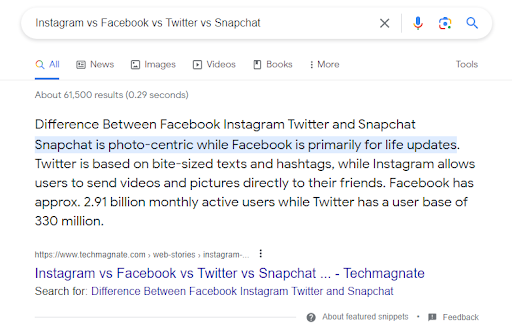
Most users are familiar with paragraph snippets since they account for 70% of results for searches with “who,” “what,” “why,” and “how to.” They feature a paragraph that concisely answers a question and displays a link to the source or web page. Paragraph snippets also highlight helpful content in blue, showing the key point within a text block. Here is a paragraph featured snippets example:
2. List Snippets
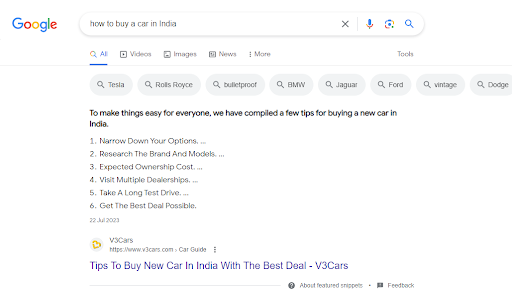
List snippets appear as numbered (ordered) or bulleted (unordered) lists to rank items or detail the steps in a process for how-to queries. This is the second most common type of Featured Snippet on Google SERPs. Check this list featured snippets example:
3. Table Snippets
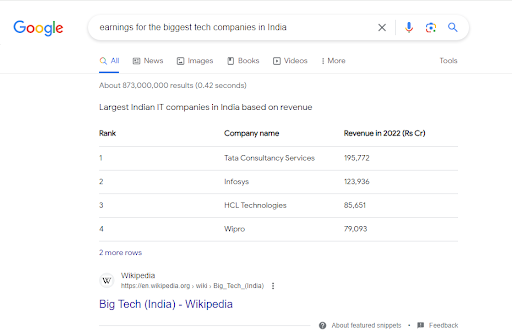
Table snippets are ideal for visualizing data in a tabular format for comparisons, rates, prices, and relevant numerical data searches. Even if the information on a website is not formatted into tables, Google can extract specific data and create its table snippet for better presentation.
4. Video Snippets
Google does not restrict featured snippets to websites alone. It may extract them from YouTube if relevant to the search query. Google will highlight the video section that answers the user’s question. By optimizing Google featured snippets, users can play this video directly without launching YouTube or watching the video from the beginning.
5. Rich Snippets
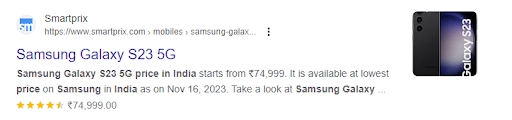
Rich snippets or rich results are Google search results displaying extra website details. From ratings to images and prices that aim to attract attention and boost organic traffic from Google. Unlike featured snippets pulled from web pages, Google pulls rich snippets from structured data markup within a webpage’s HTML.
When to Optimize for Rich Snippets and Why It Matters for SEO
Optimizing for rich snippets is especially useful when targeting competitive keywords, providing clear answers to user queries, or improving local SEO. They work particularly well for content such as product reviews, recipes, event details, and FAQs. Rich snippets not only help your content stand out visually in search results but also improve visibility, drive more traffic, and increase user engagement.
Additionally, rich snippets can be particularly effective for:
How-to Guides: If your content involves step-by-step instructions, using structured data can make it more likely to appear in rich snippets, offering better click-through rates.
Local Businesses: For businesses that rely on local SEO, rich snippets can display vital information like location, hours, and reviews, directly in search results.
Video Content: Video content can be enhanced with rich snippets that display thumbnails and additional information directly in the search results, increasing visibility and engagement. By structuring your content with schema markup, you give search engines more context about your pages, which in turn helps them return more relevant results for users.
Why are Featured Snippets Important for SEO?
Featured snippets are a highly visible section at the top of Google search results, often called “position zero.“ They provide a quick, concise answer to a user’s query without needing to click on a website. For businesses, particularly in competitive industries like finance, securing a featured snippet offers significant advantages.
Increased Visibility: Featured snippets appear above the regular search results, giving your website prime exposure, even if you don’t rank #1 organically.
Higher Click-Through Rates (CTR): Pages that feature in snippets tend to get more clicks because users trust these answers as concise and authoritative.
Enhanced Credibility: Being chosen as a featured snippet signals to both users and Google that your content is high-quality, relevant, and trustworthy.
Voice Search Optimization: Many voice search devices pull their answers directly from featured snippets, making them essential for capturing voice-driven traffic.
Improved User Experience: Featured snippets provide users with quick, direct answers, which improves their overall search experience and encourages more engagement with your site.
In summary, featured snippets boost visibility, drive more traffic, improve brand credibility, and enhance user experience, making them a crucial SEO asset.
How to Optimize for Featured Snippets
Optimizing for featured snippets requires a strategic approach to content and SEO. Here’s how you can increase your chances of securing a featured snippet:
1. Target Question-Based Queries
Focus on question-based search terms like “How to,” “What is,” or “Why is,” as these are commonly used for featured snippets. Use tools like Google’s Keyword Planner or Answer the Public to identify popular questions related to your topic.
2. Provide Clear, Concise Answers
Ensure that your content directly answers the user’s query in a concise and structured format. Keep answers within 40-50 words. Google prefers clear, easy-to-understand responses that provide immediate value.
3. Structure Content with Lists, Tables, and Bullets
Google often features content in lists, step-by-step guides, or tables. Organize your content with numbered lists or bullet points to make it easy for Google to extract and display.
4. Use Header Tags (H1, H2, H3) for Organization
Properly structure your content using header tags (H1, H2, H3) to break down information. Google looks at headings to understand the main topics and may pull content from these sections for featured snippets.
5. Focus on Long-Tail Keywords
Long-tail keywords are specific and often lead to featured snippets. Targeting long-tail, conversational queries that people frequently ask can help your content get noticed by Google.
6. Optimize for User Intent
Ensure that your content aligns with user intent. If users are looking for definitions, how-to guides, or comparisons, tailor your content to meet those specific needs.
7. Implement Structured Data
Although Google doesn’t require structured data to create featured snippets, adding schema markup (e.g., FAQ schema) can help Google understand your content better, increasing your chances of being featured.
8. Monitor and Refine
Keep track of which pages are ranking for featured snippets using tools like Google Search Console or Ahrefs. Update your content regularly to keep it relevant and refine your approach based on performance.
By following these steps, you can improve your chances of securing a featured snippet and gain increased visibility in search results
Featured Snippets vs. Rich Snippets
Featured Snippets are concise answers that appear at the very top of search results, often in the form of a list, paragraph, or table. They aim to directly answer a user’s query without requiring them to click on a website.
Rich Snippets enhance search results with additional information such as ratings, prices, or events, pulled from structured data embedded on a webpage. They don’t appear at the top of the results but provide extra details to make the listing more attractive and informative.
Both are important for SEO because they increase visibility and improve the user experience, but they serve different purposes in how content is presented in search results.
Here’s a comparison between Featured Snippets and Rich Snippets in a tabular format, with a brief explanation:
Feature
Featured Snippets
Rich Snippets
Definition
A block of text that appears at the top of Google search results (position zero), providing a concise answer to a user’s query.
Enhanced search result listings that display additional information, like ratings, prices, or events, directly in the search results.
Display Location
Appears above the traditional organic search results, often in position zero.
Appears within the regular search results, enhancing the listing with extra data (e.g., star ratings, product info).
Content Type
Typically a summary answer, list, or table that directly addresses a user’s query.
Can display reviews, product prices, event details, recipes, etc., based on structured data.
Example
“How to save for retirement?” → “To save for retirement, start by contributing to a 401(k) or IRA…”
Product listing showing a star rating, price, or recipe showing cooking time.
Purpose
To provide an immediate, authoritative answer to a query.
To enhance search results with additional information that makes the listing more attractive and informative.
User Experience
Directly answers a question, improving search efficiency.
Provides additional context about the content of the page, helping users decide if they want to click.
Improves the appeal of your search result, potentially increasing CTR.
Structured Data Needed
No structured data is needed; Google pulls content directly from the page.
Structured data (like schema.org markup) is required to enable rich snippets.
Voice Search Impact
Frequently used in voice search responses.
Less common for voice search but may appear in voice search results depending on the query.
How to Identify Featured Snippet Opportunities ?
There is no special Google trick to extract a paragraph from your web page and display it as a featured snippet. Winning snippets trickles down to on-page SEO, where you must deliver helpful content that conforms to Google’s helpful content requirements.
This implies that content should display experience, expertise, authoritativeness, and trustworthiness, popularly called E-E-A-T factors. Let us explore the various ways of optimizing Google featured snippets to be click-worthy.
1. Use Headings
Make sure you properly use H1, H2, and H3, especially when writing a listicle. This tells Google what to feature in your list article.
2. Write Concise Answers
Most Google snippets are 2-3 sentences of a direct answer to a specific question. Even if Google displays a longer paragraph, it will highlight up to four sentences and cut out the rest of the answer. This means you have 40-50 words featured. When optimizing Google featured snippets make sure your main answer is within this word limit.
3. Answer Related Questions
After answering the target questions, answer any related questions. You can do this later in your content or as sub-headings. Identify any autocomplete suggestions in Google search box or frequently asked questions and provide a better answer than the ones provided. Know when to optimize for snippets that require simple answers to complex queries.
4. Write with a Logical Structure
When optimizing for Google featured snippets, write naturally and logically without overthinking. Factor in readability and flow, so your content reads naturally. Injecting too many keywords will appear unnatural, weakening your ranking and hurting your CTR.
5. Use Lists and Tables
Research queries that need tabular representation or lists, then include them in your content to increase your chances of winning a list or table snippet. Create well-formatted and easy-to-read tables, with rows and columns defining hierarchy. Use schema markups for structured data to improve how your tables and lists appear on Google’s featured snippets.
Optimization for Google’s Featured Snippets
Google features are always evolving, and featured snippets are no exception. Always perform regular research and experiments to find new ways to leverage snippets and use them to boost your web traffic. Although it takes more effort to land in position zero, the results are worth the hassle.
Did you find this helpful but would love help with your SEO needs? Book a free call. We would love to hear about your project needs and help you come up with a plan to win snippets and get more eyeballs on your content.
Frequently Asked Questions (FAQs)
Are featured snippets good for SEO?
Optimizing for featured snippets will improve website visibility in corresponding Google search results. Ranking in position zero means that you appear on top of other websites on the SERPs.
What do you need to create featured snippets?
Google does not have any minimum length requirement for featured snippets. The required amount of text depends on the information in the snippet, language and platform, either mobile phone, app, or PC.
Can I rank for more than one featured snippet?
Yes, it is possible to rank for multiple featured snippets for different queries related to your content. However, competition is high, so optimizing for a variety of keyword phrases is key.
What types of content can appear as featured snippets?
Google’s featured snippets can include text, lists, tables, images, and videos. Your content should be formatted in a way that allows Google to easily pull relevant information from it, such as using header tags and organized structure.
Can featured snippets appear for any type of search query?
No, not all search queries result in featured snippets. They are most commonly triggered by queries with specific questions, comparisons, or instructions. Identifying these types of queries can help you optimize for them.
Sarvesh Bagla is an enterprise SEO expert and industry leader who has driven transformational digital growth for India’s top brands across the BFSI, Healthcare, Automotive, and ECommerce industries. As the Founder and CEO of Techmagnate, he leads large-scale organic search strategies and performance marketing campaigns for businesses looking to succeed in today’s AI-driven search landscape.
A strong advocate for thought leadership, Sarvesh is deeply involved in SEO evangelism and regularly contributes to industry discussions through LinkedIn, webinars, and CMO roundtables. His focus today is on helping brands prepare for an AI-first SEO future (AEO, GEO) and strategies for Large Language Models (LLMs) at the core.
Get the most valuable search related insights about leading brands, trending keywords, search volumes, fastest growing categories, city-level insights and much more!
It has come to our notice that fraudulent job offers are being circulated on the internet through messaging apps like WhatsApp and Telegram, which falsely claim to be from Techmagnate. We take this matter seriously and would like to caution all candidates to be wary of such postings.
Please Note That –
We do not charge any fees/security deposit/payment from candidates, irrespective of the professional experience they hold, for job applications or interviews
Official communication channels include our website and verified social media accounts, primarily LinkedIn.
Kindly double-check the domain name – @techmagnate.com – in the email address
We follow a transparent and ethical approach for hiring/onboarding supported by proper documentation.
Ensure that you only apply through verified channels to avoid being scammed. We also recommend that you exercise caution when sharing personal information or financial details with any job posting or recruitment agencies claiming to represent us.
We want to ensure that potential candidates interested in joining Techmagnate have a safe and positive experience.
If you find that someone that fits the description above has reached out to you, please notify us immediately at jobs@techmagnate.com.
 Important Alert:
 Important Alert: