Beware of fake job offers and payment requests. We only use official email IDs and never conduct interviews on messaging apps.Beware of fake job offers and payment requests. We only use official email IDs and never conduct interviews on messaging apps.
Summary: Ecommerce SEO can be tough, but automation makes it easier. Learn how automation can improve your online store performance and increase sales. The success of an ecommerce business relies on its visibility in SERP. The greater online visibility a product has, the higher its chances of generating sales. Search Engine Optimization (SEO) plays a pivotal role in ensuring that potential customers can find your online store – beating all the competitors. In 2025, ecommerce SEO continues to be a topic of discussion, presenting both challenges and opportunities for brands to drive sales. Here’s a guide for beginners and professionals to understand SEO for ecommerce and drive measurable results.
Key Takeaways:-
Ecommerce SEO is different from traditional SEO and requires targeted strategies.
Benefits of Ecommerce SEO include more traffic, better visibility, increased sales, and credibility.
Trends in Ecommerce SEO for 2025 include visual search, sales funnel optimization, personalization, and content diversification.
Automation makes Ecommerce SEO easier with tools for content creation, pricing optimization, and analytics.
Important practices for Ecommerce SEO include keyword research, technical optimization, content marketing, and staying updated.
Success in Ecommerce SEO can be measured through metrics like traffic, rankings, engagement, and revenue.
Table of Contents
What is Ecommerce SEO?
Ecommerce SEO is a marketing practice of optimizing your online store’s website and content to rank higher in search engine results. A website ranking on top results attracts more organic traffic and potential customers.
Unlike paid advertisements that require payment per click to drive traffic to a website, SEO enables you to attract genuine customers. Major search engines such as Google, Bing, and Yahoo rank an ecommerce site based on its performance.
You can enhance ecommerce SEO by implementing strategies like a product-led SEO approach, which involves creating detailed product pages, optimizing product descriptions, incorporating blogs, and conducting a technical SEO audit. Additionally, Ecommerce category page optimization is crucial to ensure categories are well-structured and easily discoverable, boosting search visibility.
Discover What Your Customers Search ForDiscover What Your Customers Search For
Get insights on evolving customer behaviour, high volume keywords, search trends, and more.
What is the difference between ecommerce SEO and normal SEO?
On the foundation level, there is not much difference between the services. But, ecommerce SEO is a bit more targeted and strategic than regular SEO.
Unlike traditional SEO services, ecommerce SEO focuses more on optimizing individual product and category pages.
This includes optimizing,
Product descriptions,
Meta tags and meta descriptions,
Alt texts for images,
Call-to-actions, and
Site structure.
Benefits of Ecommerce SEO
Increased organic traffic: Optimized ecommerce product pages attract more visitors to your website without the need to spend a fortune on Google ads or Facebook ads.
Enhanced visibility on search engine: Higher rankings in search engine results pages (SERPs) make your online store more visible to potential customers.
Boost in sales: With more traffic and visibility, there’s a higher likelihood of converting visitors into customers, resulting in increased sales.
Establish credibility as a brand: Ranking high in search engines signals credibility and trustworthiness to users.
Cost-effectiveness: Compared to paid advertising, ecommerce SEO services offers a cost-effective way to drive traffic and sales to an online store.
Improved user experience and navigation: SEO ensures your site is easy to navigate, which increases engagement.
Competitive advantage: Outperform competitors in search rankings.
Latest Trends in SEO for Ecommerce (2025 Edition)
The landscape of ecommerce SEO is constantly evolving, making it crucial for brands to stay updated with the dynamics of SEO in ecommerce, especially for online stores.
1. Rise in Visual Search
The global visual search market is expected to rise to $33 billion by 2028. The growing technology is favored by users to search for products using images rather than text.
Images are an important factor for online stores. It visually attracts a customer to make a purchase decision. Therefore, ecommerce platforms need to continue increasingly integrating visual search capabilities, enabling users to find products based on photos or screenshots. This trend is specifically important for Ecommerce as optimizing product images and implementing structured data markup improve the chances of your website images in the search results.
Leveraging AI-powered image recognition tools can further improve product discoverability through visual search.
2. Build a Sales Funnel
Instead of mindlessly creating webpages, the focus should be on creating seamless experiences for customers to navigate the website. The aim is to make websites easy to use, so customers can browse and buy without needing external help.
To lower bounce rates and reduce abandoned carts, it’s important to understand where website visitors come from, like
Social media targeted ads,
Organic Google searches,
Targeted emails, or
Returning customers.
Successful ecommerce businesses acknowledge how visitors arrive and design their websites to suit them. They create sales funnels that start in sales channels or marketing campaigns, leading users to the website later on.
Integrating analytics tools helps track customer behavior and optimize the funnel for maximum SEO impact.
3. Personalization in Ecommerce
A 2021 study by McKinsey says that companies doing exceptional personalization make 40% more revenue than those with average to no personalization efforts. Not personalizing your customer experience can push potential buyers away—71% of consumers back the statement.
Be it product recommendation or browsing experience, personalized shopping experiences cannot be one-size-fits-all in the ecommerce industry.
SEO in ecommerce is all about leveraging customer data to deliver personalized product recommendations, tailored content, and targeted promotions.
4. Content Diversification
Ecommerce SEO is no longer limited to product pages and category descriptions.
Content diversification is becoming a key strategy for attracting organic traffic and improving search visibility.
Depending on a business type, diversification allows brands to discover new markets and opportunities.
Leveraging Automation in Ecommerce Website
One important trend that cannot be ignored in 2025 and beyond is the use of Automation.
Advanced technologies are instrumental in optimizing ecommerce SEO strategies and boosting sales.
Here’s how they can be used to improve your SEO campaigns:
Automated Content Creation: Tools like ChatGPT and Gemini (previously Bard) can help generate content automatically based on the suggested keywords and wireframes. This streamlines the content creation and ensures a consistent flow of fresh, relevant content to attract the target audience. But make sure not to include any duplicate content.
Dynamic Pricing Optimization: Algorithms can analyze competitor pricing, market demand, and consumer behavior to adjust pricing strategies for ecommerce products dynamically. By optimizing pricing in real-time, businesses can improve competitiveness, maximise revenue, and unlock an additional SEO benefit – better rankings through improved click-through rates and user engagement.
Predictive Analytics: Predictive analytics tools like Google Analytics can forecast future trends, demand patterns, and consumer preferences in a specific industry. This enables businesses to anticipate changes, adapt their SEO strategies accordingly, and capitalize on emerging opportunities.
Best Practices for Implementing Advanced Ecommerce SEO Strategies
Explore the top SEO tips for ecommerce sites to implement advanced strategies effectively. These best practices will help you optimize your online store, boost search rankings, and drive more traffic and sales.
1. Keyword research for ecommerce website SEO
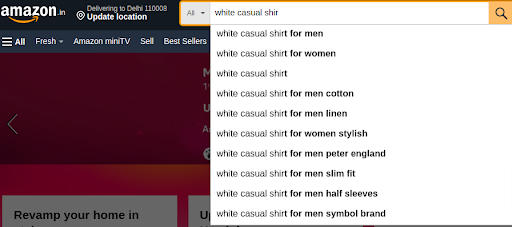
To find keywords that are relevant to your products or services, start by doing some keyword research for your online store. As part of your SEO strategy for online stores, use tools like SEMrush, Google Keyword Planner, Google Search Console, and Amazon’s search bar autocomplete.
If you want to check keywords for a white shirt, for instance, type the word into Amazon’s search bar to see what other people are using. Then, look at these keywords to see how many people are searching for them and how relevant they are.
It’s very important to know what a keyword means:
Informational Intent: When people want information in the form of tips or answers to questions.
Navigational Intent: When people want to know about a specific product.
Transactional Intent: When people are ready to buy something.
Commercial Investigation (or Commercial Intent): When people check different product options or check reviews before making a purchase.
2. On-Page optimization for ecommerce website
Once you know what keywords you want to target, it’s important to optimize each product and category page to get more people to see them in search results and get them interested in buying.
Important parts of on-page optimization:
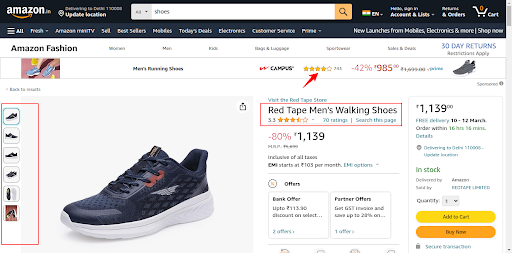
Product Titles and Descriptions: Use keywords that are relevant to the product while also highlighting its features, benefits, and unique selling points.
Meta Titles and Descriptions: Make your meta titles and descriptions interesting so that more people click on your search results.
Image Optimization: Use descriptive filenames and alt texts that include keywords to make your images easier to find and more useful.
URL Structure: Make sure that URLs are clean and have keywords for the product or category in them (for example, www.example.com/men-white-shirts).
Linking to other pages on your site: Link to related products and categories to make navigation easier and improve SEO.
Calls-to-Action (CTAs): CTAs are buttons or links that make it easy for users to do something, like “Buy Now” or “Add to Cart.”
3. Technical SEO
Technical SEO for ecommerce entails actions like optimizing website speed through techniques like ecommerce site architecture, image compression, and enabling browser caching.
Additionally, ensuring mobile-friendliness involves implementing responsive design. How a website adjusts seamlessly to different screen sizes should be checked in a site audit.
Implementing schema markup, like using Product schema for ecommerce site products, helps search engines understand and display website content accurately in search results.
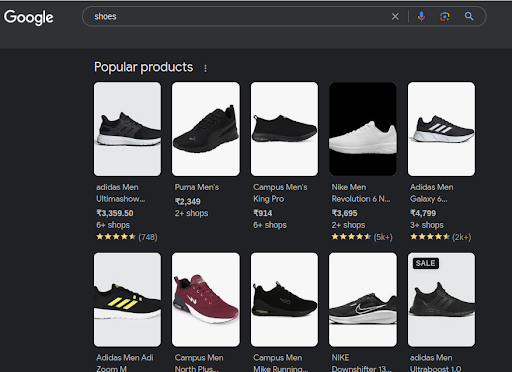
If SEO best practices are followed, e-commerce products appear in the popular products section on Google. These practices enhance user experience and drive more organic traffic, ultimately boosting the eCommerce conversion rate.
4. Content Model
Create a comprehensive content model by mapping out your content and establishing clear guidelines for its structure. Identify the entities you want to include, such as products, campaigns, and relevant stakeholders. Using tools like WordPress SEO plugins can also help ensure your content is optimized for search engines.
Once you’ve outlined these entities and their relationships, determine the specific information you need to capture for each item. For instance, for products, include details like name, description, price, and photos, along with keywords.
Incorporate considerations for your content model, including:
The length of each content piece and whether you need both short and long versions.
Key points to cover at different levels of detail.
Ensuring content is distinct and identifiable among your products and competitors.
Planning for tracking reviews, which are often displayed by search engines to potential buyers.
Making the model flexible enough to adapt to new channels and trends that may emerge in the future.
Speaking of channels, integrate content tailored for various social media platforms into your model. Platforms like Instagram, Facebook, Twitter, and others require different content types. Consider factors such as image dimensions, character limits, and preferred content types (such as videos, images, or text posts) for optimum social media marketing.
5. User-generated content marketing and Social Proof
Andy Crestodina famously said, “Marketing is what you say, but social proof is what your customers say.” Big Commerce found that 90% of consumers trust user-generated content more than branded ads. Two-thirds of users believe user-generated content makes shopping experiences more authentic.
User-generated content helps ecommerce sites build trust and connect with customers. Visual content, like product photos and videos, is crucial. Branded visuals are often dull, but user-generated content is exciting and realistic, showing products in real-life use.
Reviews and ratings, the most common user-generated content, provide valuable insights into product quality and reliability for ecommerce brands.
6. Continuous Monitoring with Ecommerce SEO tools
Use Amazon Seller Central’s analytics tools to monitor performance metrics such as conversion rate, click-through rate, and sales velocity.
Analyze this data regularly to identify trends and areas for improvement in your product listings and overall strategy.
Experiment with different optimization techniques, such as adjusting pricing, updating product titles, or testing different product images, to optimize your listings for better performance.
7. Stay Updated with Industry Trends
Stay informed about industry trends by regularly reading publications, attending webinars, and engaging in forums and discussions. Utilize search engines like Google and Bing to access the latest news and trends.
Use Google Alerts with relevant keywords specific to your industry to receive notifications directly to your email whenever there’s news related to those terms.
Adjust your strategy as needed to incorporate new techniques and best practices that align with Amazon’s search algorithm updates and evolving consumer behaviors. Keep adapting to stay ahead in the competitive landscape.
8. Measure Success and Adjust Strategies
Set clear objectives and KPIs to measure the success of your ecommerce SEO efforts on Amazon, such as improving search rankings, increasing sales, or enhancing customer satisfaction.
Regularly review performance metrics and adjust your strategies based on data-driven insights to optimize your product listings and drive better results.
By following these steps and leveraging Amazon’s platform to implement advanced strategies effectively, you can enhance your product visibility, credibility, and sales performance on one of the world’s largest online marketplaces.
Measuring the Success of Ecommerce SEO through KPIs
Determining the effectiveness of your ecommerce SEO endeavors becomes more straightforward once you identify the key performance indicators (KPIs) to focus on.
Here are the essential metrics to gauge the success of your SEO activities:
Organic Traffic: This metric quantifies the volume of visits originating from organic search engines, serving as a fundamental indicator of SEO performance. Google Analytics is a useful tool for tracking organic traffic trends over time.
Keyword Rankings: Assessing your ranking for targeted keywords is crucial when evaluating the impact of your content. Tools like Google Search Console or SEMRush can help monitor your content’s performance against specific keywords and identify additional relevant keywords for your e-commerce site.
Organic Click-Through Rate (CTR) and Bounce Rate: A successful SEO campaign not only drives traffic but also ensures that visitors stay on your site and engage with your content. Monitoring CTR from search engine results pages (SERPs) and bounce rates provides insights into the effectiveness of your meta titles and descriptions in attracting visitors.
Revenue: Ultimately, the conversion of organic traffic into revenue is a key measure of e-commerce SEO success. Analyzing how much value your SEO efforts contribute to your marketing for ecommerce startup can help refine your strategies. If the increase in qualified traffic does not translate into a corresponding revenue boost, it may be necessary to reevaluate the customer journey on your e-commerce platform.
User Engagement Metrics: Metrics like average session duration, pages per session, and repeat visitors indicate how well your ecommerce SEO guide strategies are engaging your audience and providing value.
Mastering e-commerce SEO requires a comprehensive understanding of its fundamentals, as well as staying updated with the latest trends and technologies.
By leveraging SEO automation and advanced strategies, businesses can enhance their online visibility, attract more customers, and ultimately drive success in the competitive world of ecommerce. Moreover, implementing Ecommerce CRO Services can significantly improve the conversion rates on your site, ensuring that the traffic you attract is also converted into paying customers. These services focus on optimizing user experience, reducing bounce rates, and maximizing the effectiveness of your site’s calls to action, making it an integral part of your overall strategy.
So, seize the opportunity, implement the strategies discussed in this guide, and watch your ecommerce website soar to new heights in search engine rankings and profitability.
If you need help with the implementation of these strategies, contact us and book a one-on-one consultation call.
Frequently Asked Questions
What are the essential SEO services needed for e-commerce website optimization?
Essential eCommerce SEO services include technical audits, keyword research, product and category page optimization, site speed improvement, content marketing, mobile optimization, and link-building. These help increase search rankings, drive qualified traffic, and boost sales.
What can an eCommerce SEO agency actually deliver to improve online sales?
An eCommerce SEO agency delivers higher visibility, optimized product listings, structured data, conversion-focused content, and technical fixes. Their work ensures better rankings, stronger organic traffic, and measurable sales growth for online stores.
What are the key deliverables offered by eCommerce SEO agencies?
Key deliverables from eCommerce SEO agencies include keyword mapping, SEO-friendly product descriptions, technical SEO fixes, structured data integration, link acquisition, and performance reporting. These collectively enhance visibility, improve rankings, and support sustainable eCommerce growth.
What is the difference between ecommerce SEO and traditional SEO?
Ecommerce SEO focuses on very specific, purchase-intent keywords for product and category pages, while traditional SEO focuses on broader website content and informational keywords. Ecommerce SEO also focuses on conversion optimization, which is the process of turning traffic into sales.
How can I track the success of ecommerce SEO efforts?
Monitor KPIs such as organic traffic, keyword rankings, CTR, bounce rate, user engagement metrics, and revenue from organic search. Tools like Google Analytics, Google Search Console, and SEMRush help track performance and refine strategies.
Why is content important for ecommerce SEO?
Product pages, blogs, and guides with high-quality, relevant content help answer customer questions, boost search rankings, and build brand authority. Content diversification also brings in more organic traffic from people who are looking for different things.
How does keyword intent influence ecommerce SEO?
Understanding keyword intent, informational, navigational, transactional, and commercial, ensures that product pages, category pages, and content meet what potential customers are actively searching for, increasing the likelihood of conversions.
What role do reviews and user-generated content play in ecommerce SEO?
User-generated content like reviews, ratings, and photos builds trust, adds fresh content to product pages, and enhances search relevance. Google often considers reviews in ranking and rich snippets.
How important is mobile optimization for ecommerce SEO?
With the rise of mobile shopping, mobile-friendly websites are essential. Optimizing for mobile ensures faster load times, better user experience, lower bounce rates, and higher conversions, which all contribute to improved SEO performance.
Can ecommerce SEO strategies benefit international or global stores?
Yes. Using global ecommerce SEO techniques like localised content, hreflang tags, and keyword optimisation for specific regions makes sure that your site is visible in many countries and languages, which increases your reach and sales potential.
Sarvesh Bagla is an enterprise SEO expert and industry leader who has driven transformational digital growth for India’s top brands across the BFSI, Healthcare, Automotive, and ECommerce industries. As the Founder and CEO of Techmagnate, he leads large-scale organic search strategies and performance marketing campaigns for businesses looking to succeed in today’s AI-driven search landscape.
A strong advocate for thought leadership, Sarvesh is deeply involved in SEO evangelism and regularly contributes to industry discussions through LinkedIn, webinars, and CMO roundtables. His focus today is on helping brands prepare for an AI-first SEO future (AEO, GEO) and strategies for Large Language Models (LLMs) at the core.
Get the most valuable search related insights about leading brands, trending keywords, search volumes, fastest growing categories, city-level insights and much more!
It has come to our notice that fraudulent job offers are being circulated on the internet through messaging apps like WhatsApp and Telegram, which falsely claim to be from Techmagnate. We take this matter seriously and would like to caution all candidates to be wary of such postings.
Please Note That –
We do not charge any fees/security deposit/payment from candidates, irrespective of the professional experience they hold, for job applications or interviews
Official communication channels include our website and verified social media accounts, primarily LinkedIn.
Kindly double-check the domain name – @techmagnate.com – in the email address
We follow a transparent and ethical approach for hiring/onboarding supported by proper documentation.
Ensure that you only apply through verified channels to avoid being scammed. We also recommend that you exercise caution when sharing personal information or financial details with any job posting or recruitment agencies claiming to represent us.
We want to ensure that potential candidates interested in joining Techmagnate have a safe and positive experience.
If you find that someone that fits the description above has reached out to you, please notify us immediately at jobs@techmagnate.com.
 Important Alert:
 Important Alert:



















 6th Feb | Invite-only


