Beware of fake job offers and payment requests. We only use official email IDs and never conduct interviews on messaging apps.Beware of fake job offers and payment requests. We only use official email IDs and never conduct interviews on messaging apps.
Summary: Ecommerce content marketing is essential for attracting, engaging, and converting customers. It builds trust, improves SEO, and boosts conversions. Effective strategies include blogs, videos, influencer marketing, and social media. By optimizing content for search engines and leveraging analytics, businesses can enhance brand authority, drive organic traffic, and achieve long-term growth.
Key takeaways:-
Quality content builds trust, attracts traffic, and drives conversions.
Optimize for search engines and use social platforms for wider reach.
Use analytics to measure success and refine strategies.
Today, with growing competition in the virtual world, ecommerce content marketing is not an option but a necessity. With several online shops vying for the attention of the same customer, businesses have to look beyond conventional advertising and resort to content marketing strategies to build trust, engage, and ultimately increase conversions.
According to Ahrefs, 82% of marketers are using content marketing because it generates more leads at lower costs than outbound marketing at lower costs than outbound marketing.
In this guide, we will discuss ecommerce content marketing, its advantages, proven methods for success, SEO for ecommerce, and how to overcome common challenges.
Table of Contents
What is Ecommerce Content Marketing?
Ecommerce content marketing is a strategic approach that helps online businesses attract, engage, and convert customers through valuable and relevant content. It goes beyond direct product promotion by providing educational, entertaining, and problem-solving content that resonates with the target audience. Common formats include blog posts, videos, infographics, product guides, and social media content.
An effective content marketing strategy enhances SEO, increasing organic traffic and improving brand visibility. By addressing customer pain points, showcasing expertise, and leveraging storytelling, businesses can build trust and establish brand authority. Product demonstrations, customer testimonials, and user-generated content further strengthen credibility and influence purchasing decisions.
Discover What Your Customers Search ForDiscover What Your Customers Search For
Get insights on evolving customer behaviour, high volume keywords, search trends, and more.
Blog posts that are a guide, a comparison of various products, or an insight into the industry.
SEO-friendly product descriptions that will engage the buyer.
Video marketing, product demos, and customer reviews.
Social media content that is a continuation of building brand visibility and engagement.
UGC builds trust and credibility.
Examples: How Nike Sephora uses blogs, videos, and influencer collaborations to boost customer experience and loyalty to their brand.
Why Is Ecommerce Content Marketing Important?
Content marketing plays a vital role in the success of an ecommerce business. It helps build trust, drive traffic, improve search visibility, and ultimately increase conversions. Here are the key reasons why it’s essential:
Drives Organic Traffic – Well-optimized content improves your search rankings and attracts potential customers without paid ads.
Builds Brand Authority – Helpful, informative content positions your brand as an expert in your niche, making customers more likely to trust you.
Improves Customer Engagement – Blogs, videos, and guides give customers more reasons to interact with your brand beyond just buying.
Supports the Buyer Journey – Content helps answer questions and overcome objections at different stages—awareness, consideration, and decision.
Boosts SEO Performance – Regularly publishing keyword-rich content supports better indexing and increases visibility on search engines.
Increases Conversion Rates – Educated and informed users are more likely to convert. Content that highlights product benefits and use-cases helps drive sales.
Encourages Repeat Visits – Quality content brings users back for more, helping with customer retention and loyalty.
Benefits of Content Marketing for Ecommerce Websites
Well-executed content marketing in ecommerce brings so many advantages to a business venture, such as:
Increased Organic Traffic: As long as the content created is SEO-friendly, search engines will rank better.
Building Brand Authority: Informative content establishes credibility and makes your brand a market leader.
Increased Customer Engagement: Interactive content will get potential customers interested to view more and come back for more.
Increased Conversion Rates: Customers engaging with related content buy more.
Strengthening Customer Retention: A consistent process of content generation tends to build long-term customer relationships.
Increased conversion rates by six times above previous marketing are created by content marketing.
10 Ecommerce Content Marketing Strategies That Work in 2025
An effective ecommerce content marketing strategy is required to increase brand visibility, engage customers, and generate conversions. Below are ten effective strategies ecommerce businesses can implement to build trust, improve SEO, and increase revenue.
1. Create a Blog to Educate Your Audience
A blog for ecommerce services educates customers, builds trust, and improves search rankings. Blogs tend to address the most common customer questions, provide industry knowledge, and establish the brand as an industry leader.
Example: Shopify can educate readers on how to scale an ecommerce business, how to do SEO for the store owner, and current industry trends, enriching the store owner while promoting its service in the background.
How to Implement: Develop weekly blog posts with comprehensive guides, comparisons, and industry news. Caption each post appropriately with ecommerce content marketing and content marketing for ecommerce sites.
2. Leverage Product Videos
Video content is highly engaging and memorable, with up to 95% retention rate. Ecommerce businesses can leverage these while producing video content.
Example: ASOS promotes its clothes collection through product try-on videos, styling tips, and influencer collaborations.
How to Implement: Production of demo videos, behind-the-scenes videos, and customer testimonials to prompt engagement. The best way to optimize videos is through the right SEO tags.
3. Optimize Product Descriptions for SEO
Product descriptions should not only describe the product but also incorporate storytelling elements, emotional triggers, and ecommerce SEO best practices to engage customers effectively.
Example: A page from Apple employs persuasive copywriting by emphasizing the benefits of products and using keywords smoothly.
How to Implement: Use keyword-rich, descriptive product descriptions emphasizing unique selling points and benefits. Incorporate storytelling elements to make them engaging.
4. Develop User-Generated Content Campaigns
Making customers share their stories builds trust and fosters a sense of community.
Example: GoPro’s user-generated content campaigns showcase real customers, showing how they use their products and garnering millions of organic views.
How to Implement: Launch branded hashtags and ask customers to shoot a photo or video of your product. Use UGC everywhere: product pages, emails, and all social networks.
5. Influencer Marketing
Partnering with influencers guarantees that the breadth of the reach of the brand will increase, and the voice of the brand will ring louder among target audiences.
Example: Fashion Nova collaborates with influencers who post photos wearing Fashion Nova apparel. Such campaigns typically have a higher engagement level and generate more sales.
How to Implement: Partner with micro and macro influencers in your niche. Give them free products or commissions through Amazon Associates or other affiliate marketing for conversions.
6. Provide Interactive Content
Interactive content has the potential to engage users and make them spend more time on your site.
Example: Sephora’s beauty product recommendations use quizzes based on customer preference.
How to Implement: To maximize engagement, the site should include quizzes, polls, interactive infographics, and AR-based gizmos.
7. Share Case Studies and Success Stories
Case studies establish credibility by demonstrating how real customers benefit from your products.
Example: HubSpot releases detailed case studies on how companies have used their platform to great success.
How to Implement: Gather data from satisfied customers, create success stories, and sell them through content marketing platforms.
8. Social Media Content
Social media is a great platform for brand awareness and engagement.
Example: Glossier utilizes Instagram Stories and TikTok to engage with their audience and display real customer testimonials.
How to Implement: Mix a combination of social media content in the form of videos, behind-the-scenes, and user-generated content to engage with customers.
9. Repurpose Content Across Platforms
Repurposing content allows it to be consumed by different segments of your audience without creating new content from scratch.
Example: Neil Patel repurposes blog posts as YouTube videos, Instagram carousels, and LinkedIn posts.
How to Implement: To extend the shelf life of long content, break it into short-form videos, social media posts, and email newsletters. If you want to dominate professional circles without the time commitment, our LinkedIn marketing services can transform your existing assets into high-authority posts that drive leads.
10. Use Email Marketing Campaigns
Email marketing is a high-ROI marketing channel for building customer relationships and driving sales.
Example: Amazon uses personalized email recommendations for repeat buying.
How to Implement: Segment email lists, automate follow-ups, and individualize emails to drive more engagement and conversions.
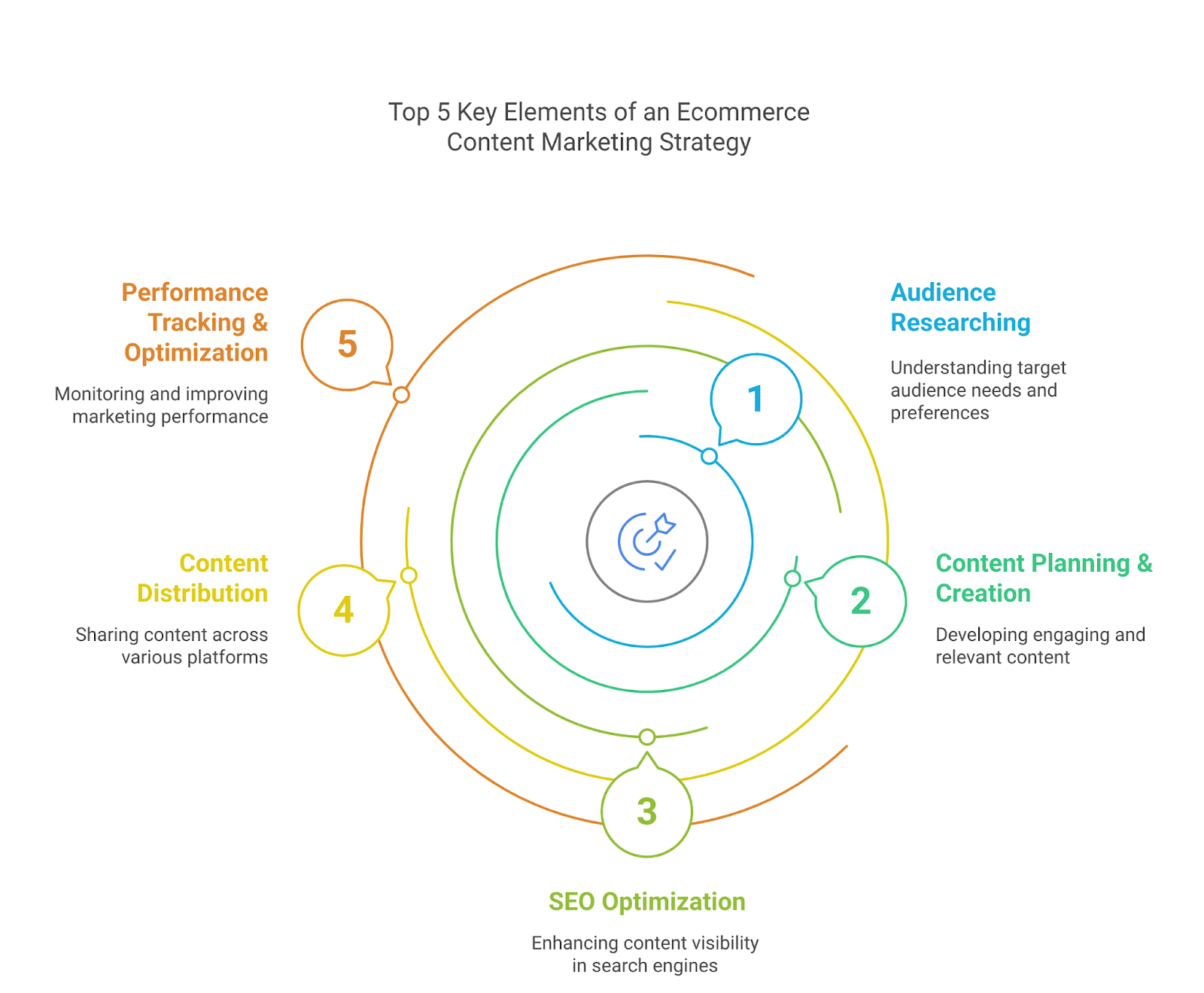
Top 5 Key Elements of an Ecommerce Content Marketing Strategy
A strong ecommerce content marketing strategy helps attract the right audience, improve search rankings, and drive more conversions. It’s not just about writing blog posts—it’s about delivering valuable content at every stage of the buyer journey. Below are the key elements that form the foundation of a successful strategy:
1. Audience Researching
Understanding your ideal customers is the first step. Know their needs, interests, search behavior, and buying habits. This helps you create content that connects with them and addresses their specific pain points.
2. Content Planning & Creation
Plan content around your audience’s journey—from awareness to purchase. Create blogs, product guides, videos, and FAQs that are engaging, informative, and aligned with your brand’s voice and goals.
3. SEO Optimization
Use ecommerce keyword research to find relevant terms your audience is searching for. Then, optimize meta tags, structure your content well, and focus on user intent. Strong SEO ensures your content ranks on search engines and reaches your target audience effectively.
4. Content Distribution
It’s not enough to just publish—share your content across the right channels like social media, email newsletters, and even paid ads. This boosts visibility and helps bring traffic to your site.
5. Performance Tracking & Optimization
Monitor how your content performs using tools like Google Analytics or social insights. Track metrics like traffic, bounce rate, and conversions, then adjust your strategy to improve results over time.
Measuring Ecommerce Content Marketing Success
Creating great content is only half the job—measuring its performance is what tells you what’s working and what needs improvement. By tracking the right metrics, you can evaluate ROI and make data-driven decisions to improve your strategy.
Key Metrics to Track:
Organic Traffic – Monitor how much traffic your content brings in from search engines. Growth here indicates improved visibility and effective SEO.
Engagement Metrics – Track time on page, bounce rate, and pages per session to understand how users interact with your content.
Conversion Rate – Measure how often content leads to actions like purchases, sign-ups, or downloads—depending on your goals.
Keyword Rankings – See how well your content ranks for targeted keywords, including ecommerce keyword research terms.
Social Shares & Comments – High engagement on social media shows your content is resonating and being shared organically.
Backlinks – Quality backlinks to your content help boost domain authority and improve SEO.
Customer Retention & Lifetime Value – Content that educates and builds loyalty can help increase repeat purchases and long-term customer value.
Amazon’s strategy is based on recommended content for a specific individualized browsing history, and it features AI-generated insights.
Nike reaches its audiences through influencer marketing, storytelling, and the UGC campaign.
Sephora creates engagement through quizzes and how-to videos.
Glossier utilized customer-led content strategies to create a community on Instagram.
Challenges in Ecommerce Content Marketing and How to Overcome Them
Although ecommerce content marketing has many advantages, it still has many challenges:
Issue 1. Scaling Content Production
Solution: Automate repeat tasks and utilize AI-based content tools.
Issue 2: Maintaining Consistency
Solution: Create a content calendar and have a specialist content team.
Issue 3. Ensuring ROI
Solution: Measure performance through Google Analytics and adjust accordingly.
Issue 4. Keeping Up with SEO Changes
Solution: Stay up to date with Google algorithm changes and concentrate on high-quality, evergreen content.
Conclusion
A strong ecommerce content marketing strategy, backed by professional content writing services, is the secret to brand awareness, customer engagement, and increased conversions. By utilizing SEO-optimized content, social media, and email marketing, ecommerce businesses can drive long-term growth in 2025 and beyond.
Start applying these proven strategies today and elevate your ecommerce content to the next level with expert ecommerce SEO services!
Frequently Asked Questions (FAQs)
What is ecommerce content marketing, and why do I need it?
Ecommerce content marketing is the process of creating helpful and relevant content—like blog posts, videos, buying guides, or product tutorials—to attract and engage potential customers. Instead of pushing ads, it builds trust and answers customer questions naturally. You need it because it helps bring in organic traffic, supports SEO, improves conversions, and turns one-time buyers into loyal customers. It’s a long-term strategy that grows your brand while boosting sales without always relying on paid ads.
How do I create a solid content marketing strategy for ecommerce?
Start by understanding your audience—what they search for, need, or struggle with. Then, plan content that guides them through the buyer’s journey: awareness, consideration, and purchase. Use ecommerce keyword research to find relevant terms and topics. Optimize all content for SEO and keep it consistent in tone and publishing frequency. Finally, promote your content across channels like email and social media, and track its performance to refine what works over time.
What are some effective ecommerce content marketing examples?
Examples include blog posts that answer product-related questions, how-to videos showing product use, buyer’s guides that help with decisions, and user-generated content like reviews or testimonials. Some stores create lookbooks or style guides, while others use comparison charts to show product value. FAQs, email newsletters, and even helpful social media posts also count. The key is to provide value and build trust, not just push for a sale.
How do I measure the ROI of my ecommerce content marketing efforts?
Start by tracking metrics like traffic, engagement (bounce rate, time on site), conversions, and sales generated from content pages. Use tools like Google Analytics to set goals and see how content contributes to them. Check how well your keywords are ranking, how many backlinks your content gets, and how social media engagement looks. ROI can also be long-term—look at increased brand awareness, returning customers, and lower customer acquisition costs over time.
What is the goal of content marketing in ecommerce?
The main goal is to attract, engage, and convert potential customers by offering valuable information instead of hard-selling. Content marketing builds trust, educates buyers, answers questions, and supports the sales funnel at every stage. It also helps improve SEO, drive organic traffic, and create a better shopping experience. Ultimately, the goal is to grow your ecommerce business by turning traffic into loyal customers and increasing long-term revenue.
Sarvesh Bagla is an enterprise SEO expert and industry leader who has driven transformational digital growth for India’s top brands across the BFSI, Healthcare, Automotive, and ECommerce industries. As the Founder and CEO of Techmagnate, he leads large-scale organic search strategies and performance marketing campaigns for businesses looking to succeed in today’s AI-driven search landscape.
A strong advocate for thought leadership, Sarvesh is deeply involved in SEO evangelism and regularly contributes to industry discussions through LinkedIn, webinars, and CMO roundtables. His focus today is on helping brands prepare for an AI-first SEO future (AEO, GEO) and strategies for Large Language Models (LLMs) at the core.
Get the most valuable search related insights about leading brands, trending keywords, search volumes, fastest growing categories, city-level insights and much more!
It has come to our notice that fraudulent job offers are being circulated on the internet through messaging apps like WhatsApp and Telegram, which falsely claim to be from Techmagnate. We take this matter seriously and would like to caution all candidates to be wary of such postings.
Please Note That –
We do not charge any fees/security deposit/payment from candidates, irrespective of the professional experience they hold, for job applications or interviews
Official communication channels include our website and verified social media accounts, primarily LinkedIn.
Kindly double-check the domain name – @techmagnate.com – in the email address
We follow a transparent and ethical approach for hiring/onboarding supported by proper documentation.
Ensure that you only apply through verified channels to avoid being scammed. We also recommend that you exercise caution when sharing personal information or financial details with any job posting or recruitment agencies claiming to represent us.
We want to ensure that potential candidates interested in joining Techmagnate have a safe and positive experience.
If you find that someone that fits the description above has reached out to you, please notify us immediately at jobs@techmagnate.com.
 Important Alert:
 Important Alert:

















 6th Feb | Invite-only


