Beware of fake job offers and payment requests. We only use official email IDs and never conduct interviews on messaging apps.Beware of fake job offers and payment requests. We only use official email IDs and never conduct interviews on messaging apps.
Summary: Migrating to a new CMS or switching to a web hosting service will require website migration. While most website hosting platforms enable free site migration services, many business owners have queries related to migration links such as data loss or KPI tracking.
Keep reading to create your SEO migration checklist before you start the website migration process for your business.
Key takeaways:-
Website migration shifts major components of your website’s structure from one host to another in an attempt to optimize the website usage experience.
If the migration process doesn’t go smoothly, it could cause issues such as 404 errors or misplaced website content among other pages and other
Having a SEO migration checklist handy can help to get your website up and running before and after you have migrated your website.
URL mapping and site audits, among other things, are essential to consider before the website migration process.
Once the site migration is complete, make sure you regularly crawl the website to optimize your SEO and regularly review benchmark data.
Regular crawling, AI-driven audits, and benchmark monitoring via GA4 are vital post-migration.
Website migration is a critical yet complex process that can significantly impact your website’s performance, user experience, and search engine rankings. Whether you are moving to a new CMS, changing your domain name, or restructuring your site, a well-planned migration strategy is essential to minimise risks and maintain SEO equity.
Poorly executed migrations can lead to broken links, 404 errors, loss of organic traffic, and even revenue dips. Therefore, it is crucial to approach website migration with a clear roadmap, defined objectives, and a detailed checklist.
In this comprehensive guide, we will walk you through everything you need to know about successful website migration, from pre-migration planning to post-migration checks. Follow this step-by-step SEO website migration checklist to ensure a seamless transition and keep your site’s visibility and performance intact.
Table of Contents
What is Website Migration?
In 2025, AI SEO migration plays a critical role with tools like Screaming Frog’s AI integration, ChatGPT-powered audits, and predictive analytics in Google Search Console helping teams avoid costly migration errors.
Migration can be a challenging process, which is why you must have a very good reason to start in the first place. There are many categories of website migration, defined by the reason behind considering migration. Some of the leading reasons for website migration are:
Moving to a new website platform or framework to enhance the functionality, security and performance of your website
Changing the architecture of your website to improve SEO results and enhance user experience
Creating a more secure site by moving from HTTP to HTTPS to encrypt visitor data
Switching to a new website hosting platform to increase your website speed, especially for a growing website. A fast website is a huge benefit for both search engines and visitors
Changing your website name as a part of a rebrand is another reason, for which you will have to move your existing content to the new website.
It is possible that, considering how you are risking all your current website SEO efforts in trying to switch to a different platform, website migration could seem like a challenging process. If performed incorrectly, the website migration process can also cause problems like
404 error messages
Misplacement or accidental removal of previous website content
Lowered SEO ranking
Types of Website Migrations
Website migration can look different for different businesses. Whether you’re transferring to a new CMS or a different platform, here are the different headings under which you can categorize website migrations.
Protocol change: This is where you migrate from an HTTP to HTTPS protocol.
Subfolder or subdomain change: If you choose to shift from one country code top-level domain to a related subfolder or subdomain (for example, from www.sample.uk to www.uk.sample.com.
Domain name change: When businesses are rebranding and switch from one domain to another
Top-level domain change: This is when you are either launching a business in a different country or limiting yourself to just one country (using .in as a domain).
Site structure changes: This includes changes to the website layout, which generally affects the internal reference and the page’s URL structure.
SEO Migration Checklist: How to Do a Migration?
Before initiating the migration process, ensure your data is backed up. You must also use specialized tools to check your page inventory. Several website crawler tools allow you to list all the pages that are currently live. Once migration is complete, make sure you cross-check all the migrated pages against the live list.
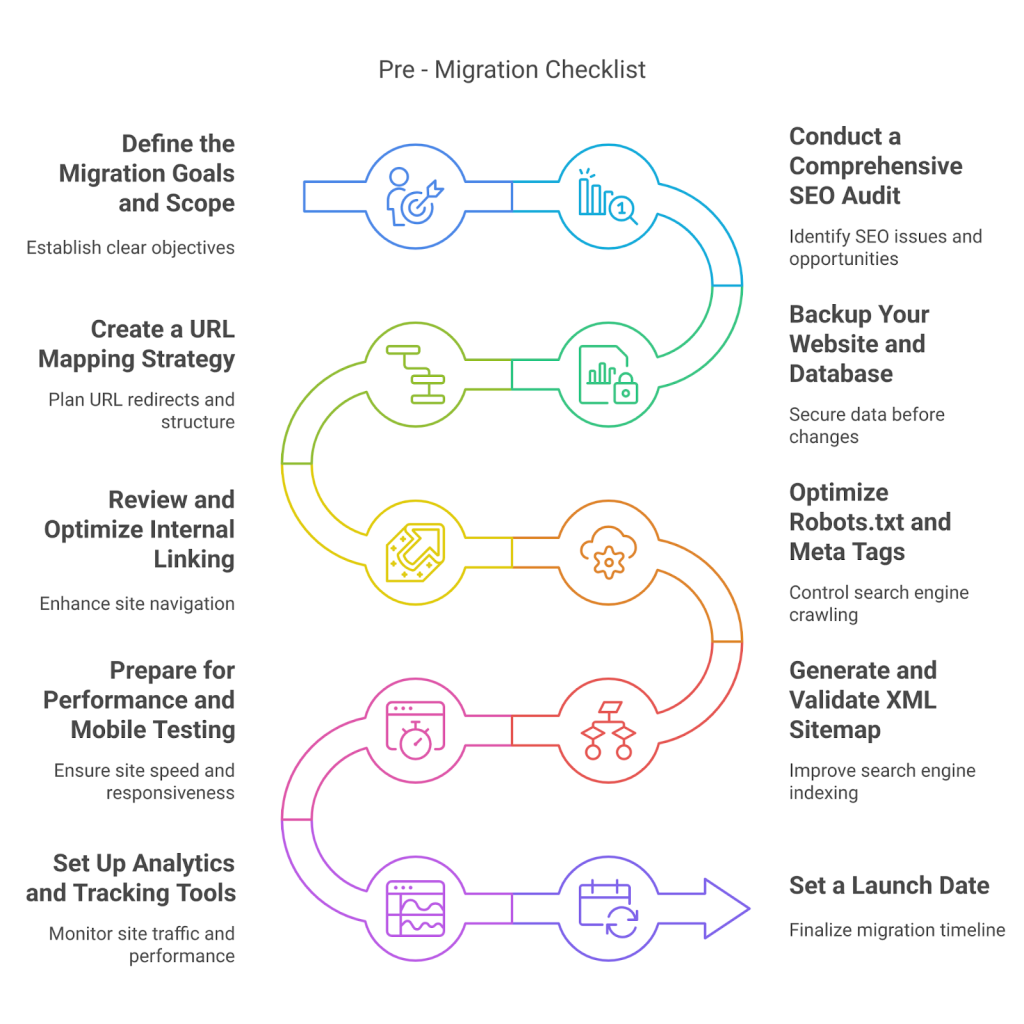
Pre-Migration Checklist
1. Define the Scope and Objectives of your Migration
The migration process is long, and it’s easy to get distracted from your main objective. Once you get started, make sure you follow any of the approved migration processes, based on whether you are looking for a new domain name, website structure, new design or DNS. Once this
is clear: either migrate your website using a website hosting service provider or migrate it manually.
2. Conduct a Website Audit
The next step is a complete website audit. Some of the data you collected before can help in multiple situations. Your website SEO audit data includes:
Internal links
Redirects
Noindex/index information
Server response times
3. Keep a Backup Team Ready
IT professionals and developers should always have tools and resources ready to overcome any mishaps. Once your SEO website migration is complete, there could be several tasks that need immediate action to ensure data loss does not take place. This helps mitigate risks and ensures smooth website operations. Make sure your team includes key professionals like content writers, professional SEO experts, marketing automation tools, UX specialists and others.
4. Create a Strategy for URL Mapping
Optimizing URL structures is one of the first operational steps of the website migration process. Some questions you need to ask regarding your current URL structure are
Is it linked to the taxonomy of your website?
Can you configure it yourself or do you need a developer?
Can you override it?
An optimized and accurate redirect map will ensure your page’s authority gets accurately transferred from the old page to the new one. This could increase the chances of your new page ranking among search results. At this point, you should have collected the top-performing URLs from your previous website and established the new site’s URL structure.
5. Review and optimize internal linking
One of the steps you should definitely not skip is reviewing your internal links. Make sure all the links within your existing website are mapped correctly against their counterparts on your newly migrated website. This ensures there are no broken links that can sully the user experience. Check each link carefully and update them according to the requirements of your newly migrated site.
6. Optimize Meta Tags and Robot.txt
Optimizing meta tags (like title and description) helps search engines understand and display your pages better, improving click-through rates.
A properly configured robots.txt file controls which parts of your site search engines can crawl, protecting sensitive pages and directing attention to important content, boosting SEO performance and visibility.
7. Generate and validate an XML Sitemap
Make sure you account for all the necessary pages in an SEO site migration by performing thorough site crawls for all XML sitemaps and internal links.
Tools such as Sitebulb, Ahrefs and Screaming Frog can round up all accessible site pages. Since migrations require redirects, this site crawl data is critical to double-check these redirects. Expert website development services can help you with your XML sitemap.
8. Prepare for performance testing and mobile device testing
Usability is one of the most critical aspects of website migration, but it often gets overlooked. Your website might maintain the SEO rankings, but if usability diminishes, you might lose revenue.
The next step is to manually test key areas of your website, which you must perform across both desktop and mobile devices. Some areas you must double-check are downloadable content, mailing lists, live chatbots and navigation.
9. Set up Analytics and Tracking tools.
Never ignore your website’s analytics data. Once the migration is complete, this data will help you check for any loss of website traffic. A face-to-face comparison is the best way to get exact data about where you’re losing traffic.
If you use Google Analytics, check your traffic count for individual landing pages. You can choose ‘Traffic Acquisition’ from the Reports section to access this data. It is critical to implement this measure because these landing pages add value to your website’s page authority.
10. Set a Launch Date
During website migration, you will most likely have a launch call with all team members actively monitoring the process. This is where your new website will typically go live. Make sure this activity is organized in the best way possible, considering every team and element you need to monitor.
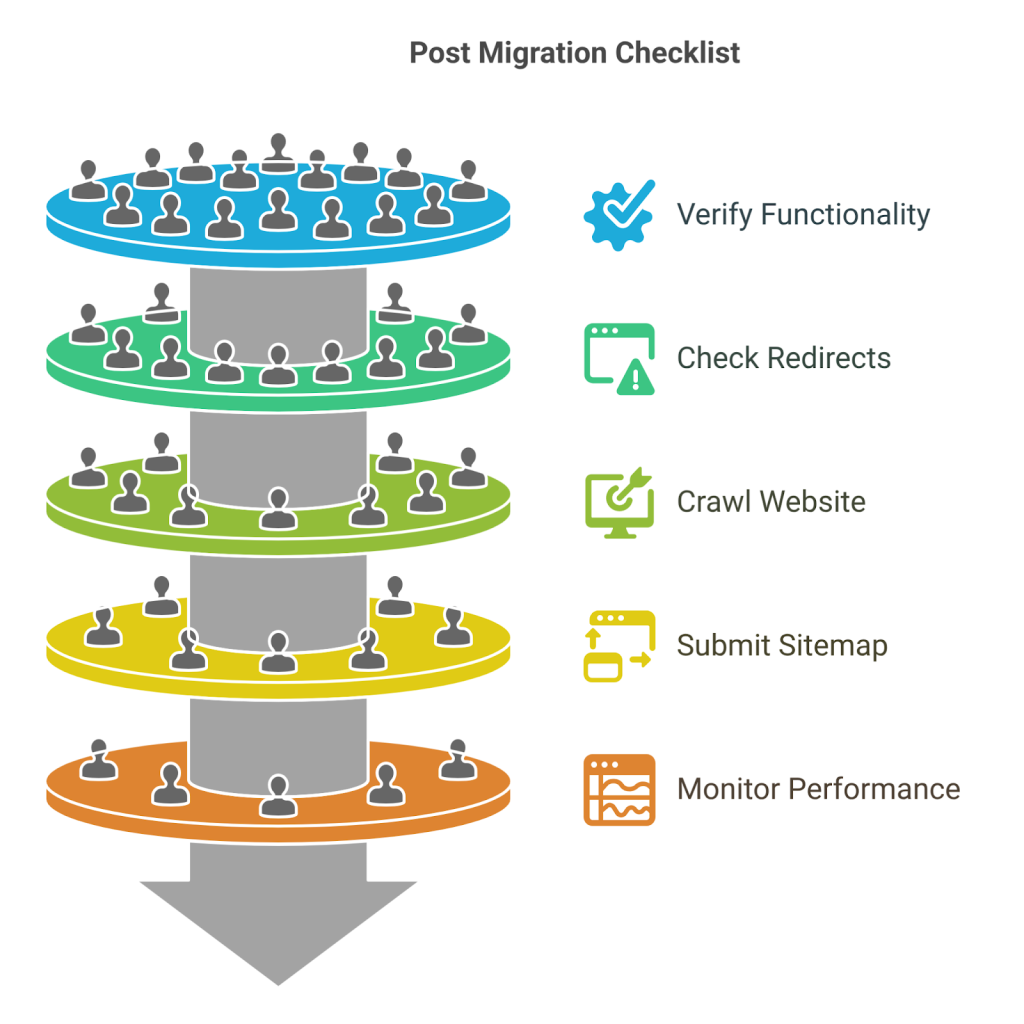
Post-Migration Checklist
Once your website migration is complete, you still have a lot to do. You need to analyse the new implementations, evaluate what works and what doesn’t, and make changes according to what is necessary. Take a look at the post-migration checklist you should keep in mind.
1. Verify Website Functionality and Performance
It is critical to monitor all website elements such as navigation, forms, buttons, and CTAs after migration. Test site speed, mobile responsiveness, and cross-browser compatibility to prevent user experience issues.
If you look closely enough, your data will tell you a story. If some aspects of your new website don’t perform as expected:
Develop a corrective action plan based on data trends.
2. Check 301 Redirects and URL Structure
Validate that all 301 redirects are correctly implemented using tools like Screaming Frog or Google Search Console. Confirm that old URLs properly redirect to their new counterparts without broken links or redirect loops.
Updating and maintaining redirects will continue to be necessary, especially if URL or taxonomy changes occur later.
3. Crawl the New Website to Identify Issues
Regularly crawl your website using SEO tools like Screaming Frog or Sitebulb. During crawling, check for:
Missing meta tags
404 errors
Duplicate content
Indexing issues
Website owners and developers often push live updates even after migration. Crawling helps you identify and fix any new issues that may arise.
4. Submit Updated XML Sitemap to Search Engines
Ensure your updated XML sitemap is submitted to Google Search Console and Bing Webmaster Tools. This helps search engines crawl and index your new website efficiently and keeps indexing data fresh.
5. Monitor Indexing and Search Rankings
Google Search Console must be actively collecting data regarding the new website’s status.
Review all indexing reports to understand:
How many URLs are valid
Which URLs have issues
Which ones are excluded
Monitor redirects, server errors, missing webpages, and any URLs left out of search results. Also, keep an eye on your keyword rankings to detect sudden visibility drops.
6. Analyze Organic Traffic and User Behavior
Use Google Analytics to track changes in:
Traffic volume
Bounce rates
User engagement metrics
Compare pre- and post-migration performance carefully. Sudden changes can signal deeper issues that need immediate attention.
There are no outdated or broken links within the navigation
Regular audits keep the user journey seamless and support SEO.
8. Check Robots.txt and Meta Directives
Review your robots.txt file to make sure search engines are allowed to crawl the important pages. Also, verify that meta robots tags are not blocking indexing of critical pages inadvertently.
9. Test Structured Data Markup
Use Google’s Rich Results Test to validate structured data (schema markup) across your site. Ensure that there are no errors or missing elements that could limit your search visibility enhancements.
10. Fix Any Canonicalization Issues
Confirm that canonical tags correctly point to the preferred URL versions to avoid duplicate content problems. Check especially for changes introduced during or after migration that may have affected canonical settings.
11. Monitor Backlinks and Update Referrals
Identify backlinks pointing to old URLs using tools like Ahrefs or SEMrush. For important links, contact referring sites to update them to the correct, live URLs. Tracking lost backlinks post-migration helps maintain your domain’s authority.
12. Keep a Close Eye on Error Reports
Regularly monitor Google Search Console for:
Crawl errors
Mobile usability warnings
Security issues
Address flagged problems immediately to protect your search presence and user trust.
13. Plan Ongoing SEO Monitoring and Optimization
Continue SEO monitoring through weekly performance reviews for the first few months post-migration. Set up automated dashboards (e.g., using Looker Studio) for keyword ranking and traffic tracking. Adjust strategies quickly based on ranking trends and indexing reports.
Importance of SEO in Website Migration
SEO is a critical factor during website migration, especially if you are trying to preserve or improve a website’s search engine ranking, traffic and visibility. Poor SEO practices during your website migration could mean significant ranking and traffic losses for your business. There are many reasons that explain the importance of optimised SEO practices during migration.
Visibility: Migrating your website can cause a glitch in search engine indexing and ranking, which can potentially make your loss out on organic traffic.
Preserved backlink authority: It ensures your existing backlinks are preserved and redirected to your newly migrated business website.
Avoids duplication: Proper content management and redirection ensures content duplication is avoided and that you stay clear of any search engine penalties that could harm your SEO efforts.
Enhanced user experience: A seamless website migration that understands SEO improves user experience and increases conversions and user engagement.
New for 2025: AI & Automation in Website Migration
AI-Driven SEO Migration Tools
In 2025, AI automation is transforming how migrations are managed. Tools like:
Surfer AI (content re-optimization post-migration)
ChatGPT API audits (for error detection and meta rewriting)
JetOctopus AI Monitor (crawl and index tracking automation)
These help reduce migration errors, improve crawlability, and maintain SEO consistency.
Predictive SEO & LLM Audits
Leverage LLMs (Large Language Models) to predict keyword volatility post-migration and rewrite content dynamically for E-E-A-T alignment.
GA4 + AI Analytics Integration
Integrate GA4 with AI analytics dashboards to automatically flag dips in sessions, CTR, or conversions within 24 hours of migration.
Use SEO Best Practices for Optimized Website Migration
As you go ahead with your website migration, take the time to define the project goals, set a deadline, and follow all the tips from these checklists to keep the project on track. For professional SEO migration services and other SEO services, get in touch with Techmagnate’s experts today.
Frequently Asked Questions (FAQs)
What is an SEO website migration and why is it important?
An SEO website migration involves transferring your website to a new domain, platform, or structure while preserving search rankings, organic traffic, and user experience. It’s crucial because improper migration can lead to traffic loss, broken links, and ranking drops.
How do I prepare for a website migration without losing SEO value?
Start by auditing your existing site, mapping old URLs to new ones, creating 301 redirects, backing up content, and setting up tracking tools. Careful planning ensures that you maintain link equity and organic visibility post-migration.
What are the common SEO issues during website migration?
Some common issues include missing redirects, broken internal links, incorrect canonical tags, and missing XML sitemaps. Monitoring crawl errors and analytics after migration helps fix these problems quickly.
How long does it take for SEO to recover after a website migration?
It typically takes 4–12 weeks for search engines to reindex new URLs and stabilize rankings. The recovery period depends on factors like site size, redirect accuracy, and crawl frequency.
How can AI tools help in a website migration process?
AI-powered SEO tools can automate tasks like URL mapping, redirect validation, and content auditing. They also use predictive analytics to forecast potential ranking fluctuations and help maintain visibility during the transition.
Sarvesh Bagla is an enterprise SEO expert and industry leader who has driven transformational digital growth for India’s top brands across the BFSI, Healthcare, Automotive, and ECommerce industries. As the Founder and CEO of Techmagnate, he leads large-scale organic search strategies and performance marketing campaigns for businesses looking to succeed in today’s AI-driven search landscape.
A strong advocate for thought leadership, Sarvesh is deeply involved in SEO evangelism and regularly contributes to industry discussions through LinkedIn, webinars, and CMO roundtables. His focus today is on helping brands prepare for an AI-first SEO future (AEO, GEO) and strategies for Large Language Models (LLMs) at the core.
Get the most valuable search related insights about leading brands, trending keywords, search volumes, fastest growing categories, city-level insights and much more!
It has come to our notice that fraudulent job offers are being circulated on the internet through messaging apps like WhatsApp and Telegram, which falsely claim to be from Techmagnate. We take this matter seriously and would like to caution all candidates to be wary of such postings.
Please Note That –
We do not charge any fees/security deposit/payment from candidates, irrespective of the professional experience they hold, for job applications or interviews
Official communication channels include our website and verified social media accounts, primarily LinkedIn.
Kindly double-check the domain name – @techmagnate.com – in the email address
We follow a transparent and ethical approach for hiring/onboarding supported by proper documentation.
Ensure that you only apply through verified channels to avoid being scammed. We also recommend that you exercise caution when sharing personal information or financial details with any job posting or recruitment agencies claiming to represent us.
We want to ensure that potential candidates interested in joining Techmagnate have a safe and positive experience.
If you find that someone that fits the description above has reached out to you, please notify us immediately at jobs@techmagnate.com.
 Important Alert: